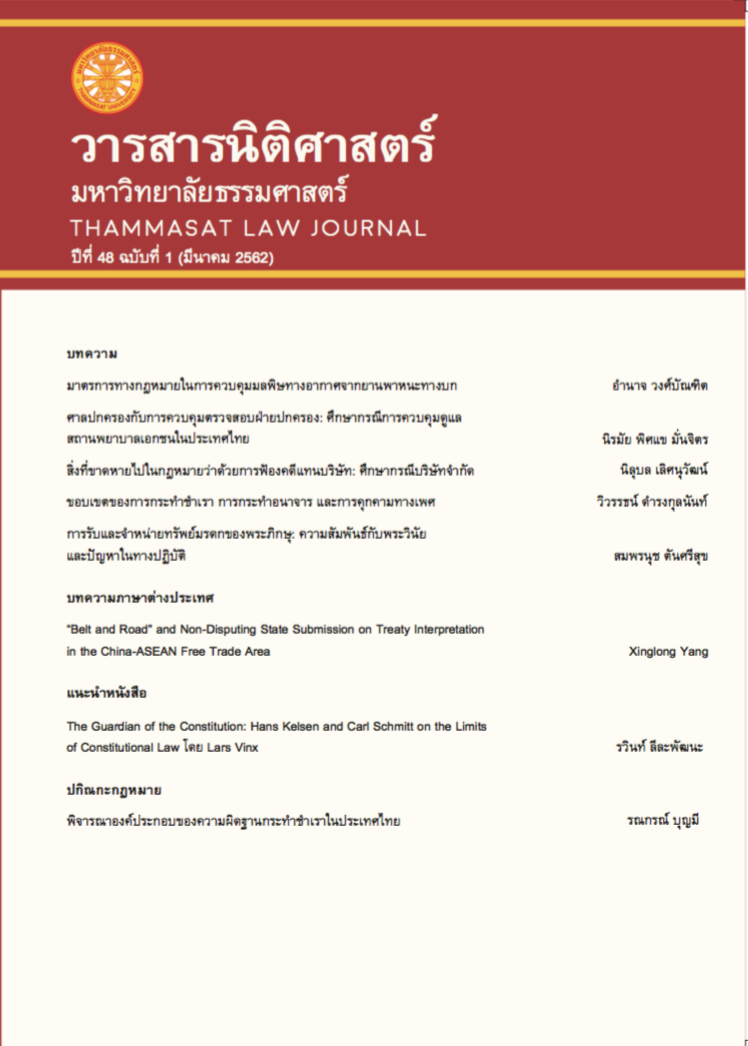
“Belt and Road” and Non-Disputing State Submission on Treaty Interpretation in the China-ASEAN Free Trade Area
Keywords:
Belt and Road Initiative, CAFTA, Non-Disputing State Submission, Treaty Interpretation, Joint Interpretation MechanismAbstract
Since the ambitious Belt and Road Initiative that focuses on connectivity and cooperation was officially proposed by China in 2013, the last five years have witnessed a dramatic increase of investment in the China and ASEAN Free Trade Area (“CAFTA”). The year of 2019 will mark the 10th anniversary of the conclusion of the Agreement on Investment between China and ASEAN (“Agreement on Investment”). Indeed, the Agreement on Investment, as a product of compromise between the eleven contracting states, inevitably contains vague provisions. Recent practice has shown that in case of ambiguity or lacunae in investment treaties, tribunals have always come to different conclusions, so how to interpret those provisions coherently, logically and consistently by adjudicatory bodies, especially arbitral tribunals, becomes a crucial task for China and ASEAN. In order to alleviate the above concern, the Article firstly aims to explore the significant role in terms of the mechanism of non-disputing state submission on treaty interpretation in arbitral proceedings. Subsequently, since China and ASEAN failed to explicitly incorporate the mechanism into the Agreement on Investment, the Article proposes China and ASEAN to increase their awareness of using the mechanism to avoid tribunals’ unpredictable interpretations. In addition, the Article, based on the current practices and laws of non-disputing state submission worldwide, points out several factors to be considered by China and ASEAN while developing the consensus on the adoption of the non-disputing state submission mechanism in the CAFTA.
Downloads
Published
Issue
Section
License
The manuscripts published in the Law Journal is the copyright of the Law Journal, Thammasat University
Any article or opinion appeared in the Law Journal will solely be under the responsibility of the author The Faculty of Law, Thammasat University and the editors do not need to reach in agreement or hold any responsibility.

