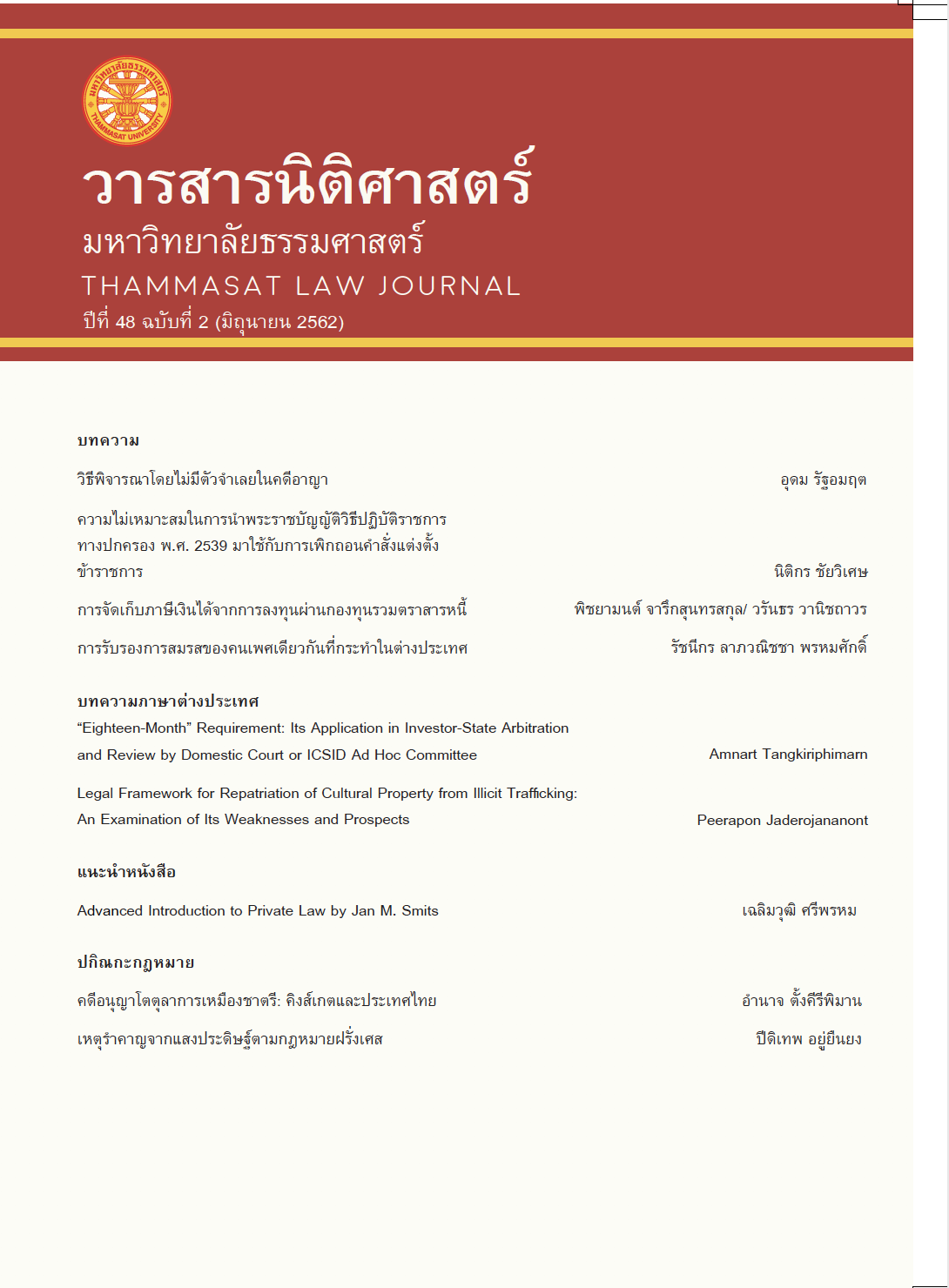
Legal Framework for Repatriation of Cultural Property from Illicit Trafficking
An Examination of Its Weaknesses and Prospects
Keywords:
Repatriation, Cultural Property, Alternative Approach for States of OriginAbstract
The repatriation of cultural property from illicit trafficking necessarily depends on the cooperation between states of origin as a requesting party and market states as a requested party of repatriation. However, the legal framework for repatriation under the Convention on the Means of Prohibiting and Preventing the Illicit Import, Export and Transfer of Ownership of Cultural Property (the 1970 UNESCO Convention) and Convention on Stolen or Illegally Exported Cultural Objects (the 1995 UNIDROIT Convention) is only designed with cultural property nationalism. This preference for only cultural property nationalism fails to attract many market states into the cooperation. Moreover, its legal defects also decrease opportunities of states of origin to succeed in their repatriation. This article mainly aims to examine the international legal framework and Thailand’s practice in order to prove how states of origin including Thailand have been difficult to request for the repatriation. According to the examination, this article finds that the cooperation for repatriation would be impossible without the balance between cultural property nationalism and cultural property internationalism. The balance of both concepts should be promoted as an alternative approach for states of origin so that they would probably convince the requested party to cooperate with them for the repatriation. This would be more interesting to make the win-win solution between the requesting party and the requested party than complying with the international legal framework.
Downloads
Published
Issue
Section
License
The manuscripts published in the Law Journal is the copyright of the Law Journal, Thammasat University
Any article or opinion appeared in the Law Journal will solely be under the responsibility of the author The Faculty of Law, Thammasat University and the editors do not need to reach in agreement or hold any responsibility.

