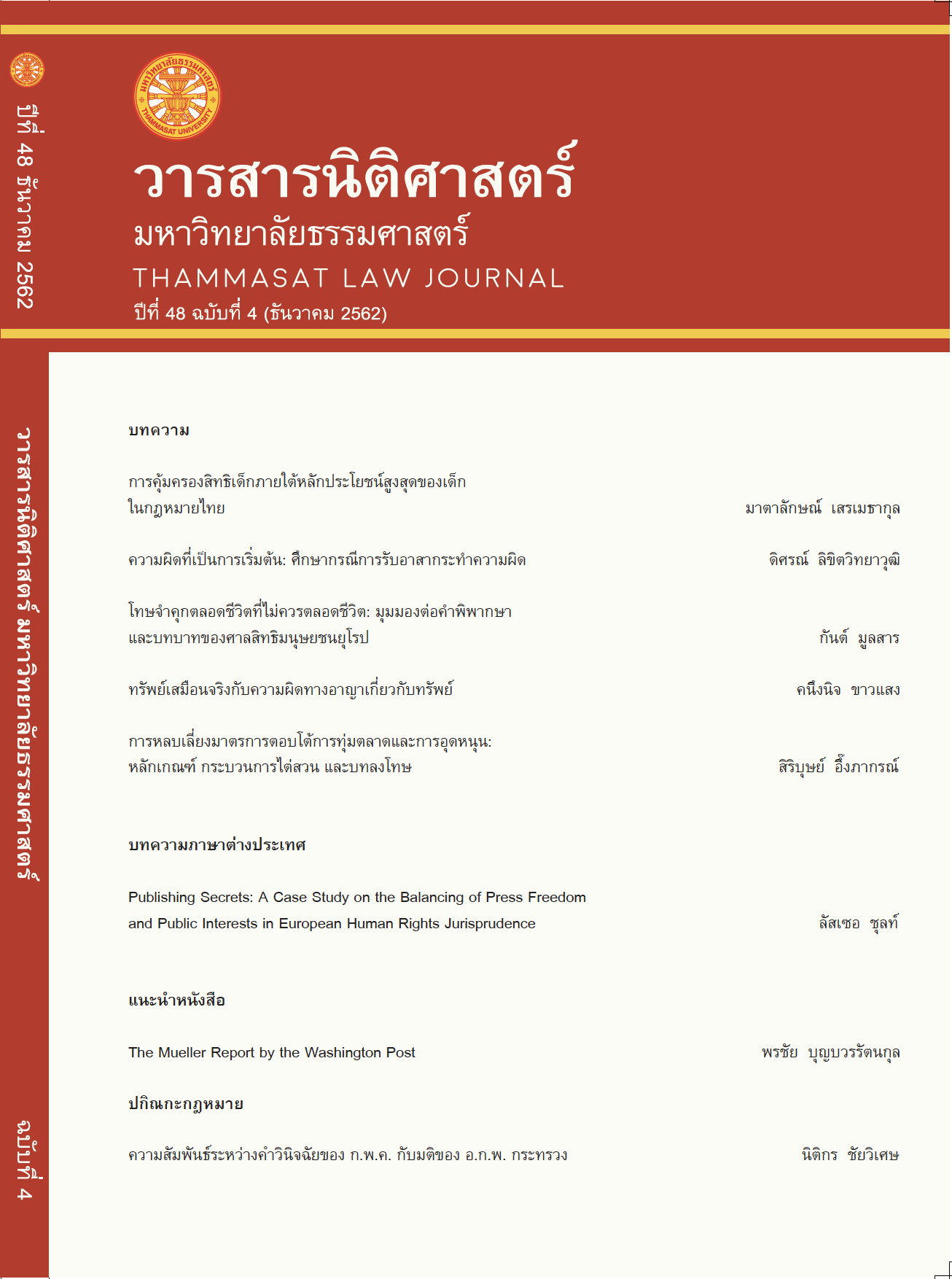
Publishing Secrets: A Case Study on the Balancing of Press Freedom and Public Interests in European Human Rights Jurisprudence
Keywords:
secrecy, press freedom, human rights, balancing, proportionalityAbstract
The European Court of Human Rights has frequently been criticised for methodical weakness and especially for how it balances rights against public interests. This article demonstrates that the Court’s jurisprudence is acceptably consistent but lacks conceptual clarity. Janneke Gerards’ recommendation of the classic proportionality test to improve the Court’s balancing approach is therefore well founded. Whether the proportionality test is also practically compatible with the Court’s jurisprudence becomes the next pertinent question. This analysis is based on a review of Article 10 cases in which states restricted freedom of the press by enforcing secrecy laws to protect public interests. A case review suggests that the Court tacitly uses some elements of proportionality in an unstructured manner. It is argued that the Court’s reasoning may be systematised and ordered through the three-step test of proportionality. However, the test’s third step (proportionality in the narrow sense) can hardly be reconciled with the Court’s prevalent interpretation of its margin of appreciation doctrine.
Downloads
Published
Issue
Section
License
The manuscripts published in the Law Journal is the copyright of the Law Journal, Thammasat University
Any article or opinion appeared in the Law Journal will solely be under the responsibility of the author The Faculty of Law, Thammasat University and the editors do not need to reach in agreement or hold any responsibility.

