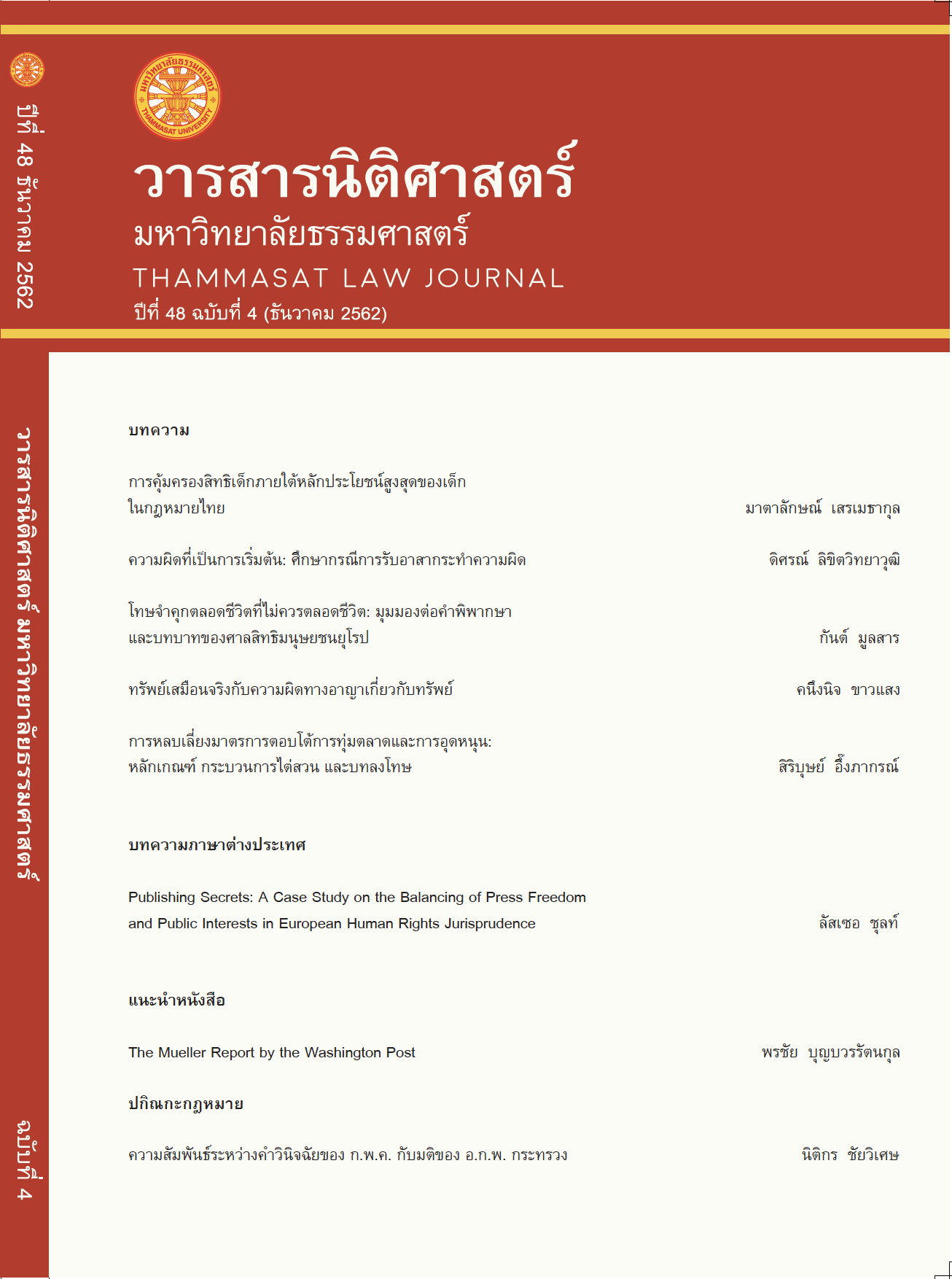
การคุ้มครองสิทธิเด็กภายใต้หลักประโยชน์สูงสุดของเด็กในกฎหมายไทย
Keywords:
Child protection, The Best Interest of the ChildAbstract
Currently, many countries around the world attach importance to legislation so as to protect children in several aspects under the framework of the ‘best interests of the child’ principle. Nevertheless, the application of the principle of is often complex, and requires careful interpretation. As a result, the study on the evolution of the relevant thoughts and theories are important to understand and apply the principle in a correct and appropriate manner. Thailand has enacted laws to protect children, employing the principle of the best interests of the child as one of the most important frameworks. These include: the protection of general fundamental rights of children as the subject of inviolable rights; the protection of minors who have committed criminal offences so that they receive appropriate treatment; and the protection of general children’s safety as the future populations of the nation. The protection of the children’s rights under each law has different aims and purposes. The protection of those rights in accordance with the law’s spirit so as to achieve highest effectiveness and truly in the best interests of children is extremely difficult, given the conditions that law-applying officers lack accurate understanding about the rationales and essence of the principle, inevitably affecting the effectiveness of children protection in various circumstances. Moreover, in a society where children are regarded as a member of the family, community, and nation, law enforcement with an aim to protect children requires care and consideration of the ‘scope’ and ‘balance’ between the protection of rights of the child and the public order and morals so as not to infringe on the rights of other persons or a collective life in the society. The study finds that, historically, the protection of rights of the child as a subject of rights has developed from human rights principles, resulting in an internationally binding written instrument entitled ‘The Convention on the Rights of the Child, 1989’. At present, it is observed that the parties, including Thailand, face an unavoidable difficulty in interpreting the principle. The cause of such inconsistent application of the principle is due to the refusal of the Committee on the Rights of the Child to clearly define the scope and meaning of ‘best interests of the child’. The Committee is of the view that the absence of definition serves its application better and that the clear definition will limit the interpretation and application, which will make it difficult to apply the principle to certain cases and circumstances. The real problem of the interpretation and application of the principle of the best interests of the child lies in the determination when one should consider the best interests of the child as the ‘most important element’ and when one should consider it as ‘the first priority’. The principal, primary considerations are a clash of interests, a dangerous condition of the child, a person injured by it, and a duration which danger and injury may occur. Nevertheless, the interpretation and application in Thailand still conflate these different factors, which, consequently, requires the concrete determination of approaches to the interpretation and application of the principle in each scope and with regard to each issue.
Downloads
Published
Issue
Section
License
The manuscripts published in the Law Journal is the copyright of the Law Journal, Thammasat University
Any article or opinion appeared in the Law Journal will solely be under the responsibility of the author The Faculty of Law, Thammasat University and the editors do not need to reach in agreement or hold any responsibility.

