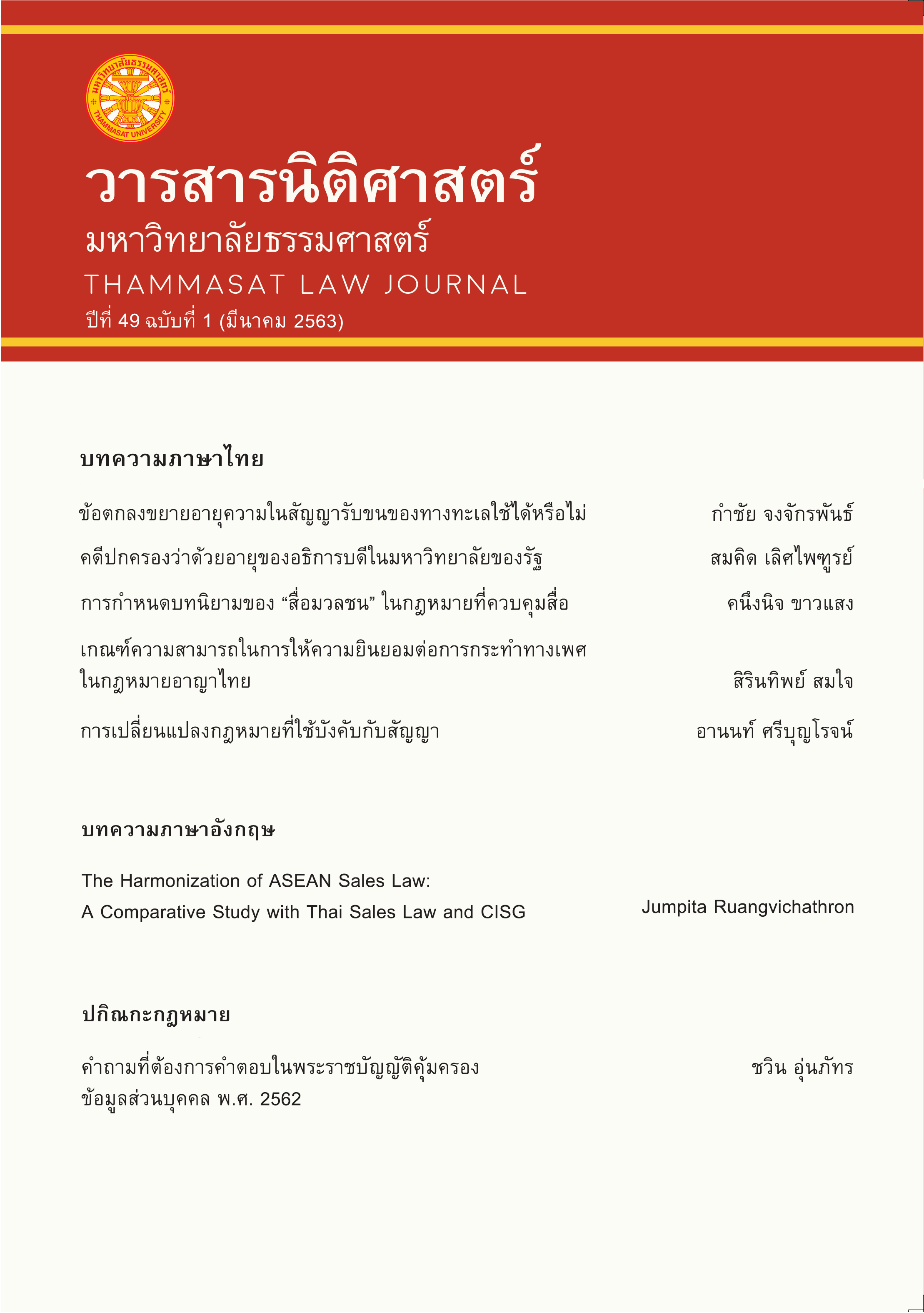
The Harmonization of ASEAN Sales Law: A Comparative Study with Thai Sales Law and CISG
Keywords:
ASEAN, sales law, CISG, HarmonizationAbstract
The Association of South East Asian Nations (“ASEAN”) consists of 10 Nations, i.e. Indonesia, Malaysia, Philippines, Singapore, Thailand, Brunei Darussalam, Vietnam, Lao PDR, Myanmar and Cambodia with total population of more than 620 Million people. As one of ASEAN’s objective is to jointly develop and unify the community in various aspects in order to reduce obstacles within it, one of which is to join hand in harmonizing its laws regarding crossed-border or international sales transactions.
The United Nations Convention on Contracts for the International Sale of Goods, or Vienna Sales Convention, or “CISG” is an international sales convention currently consisted of 92 member states worldwide which are member states of the United Nations. CISG was the product of the United Nations Commission on International Trade Law, or “UNCITRAL” adopted in a diplomatic conference at Vienna, Austria in 1980. Among its current member states are 2 nations in ASEAN, i.e. Singapore and Vietnam. Another ASEAN nation is Lao PDR in which CISG will become effective therein on the forthcoming 1st October 2020.
CISG is an international convention that has been renounced as worldwide accepted and successful, both by the number of its member states and the volume of sale transactions governed by it during more than 35 years since its existence. Accordingly, the writer is in the opinion that, for ASEAN, instead of harmonizing its sales law at a regional level which will certainly takes time and enormous efforts, all ASEAN nations which have not yet been CISG member states should consider acceding to it. This can be regarded as a “short cut” towards ASEAN’s sales law harmonization and the law to be obtained like CISG is the law which has already been widely accepted at a global level.
In supporting the writer’s proposal as such, a series of researched information presented herein throughout this Article are from international and reliable sources. The writer also put efforts in presenting such series of information in orderly manner and easily reading, and, with the hope that they will be beneficial for our ASEAN in the future.
Downloads
Published
Issue
Section
License
The manuscripts published in the Law Journal is the copyright of the Law Journal, Thammasat University
Any article or opinion appeared in the Law Journal will solely be under the responsibility of the author The Faculty of Law, Thammasat University and the editors do not need to reach in agreement or hold any responsibility.

