
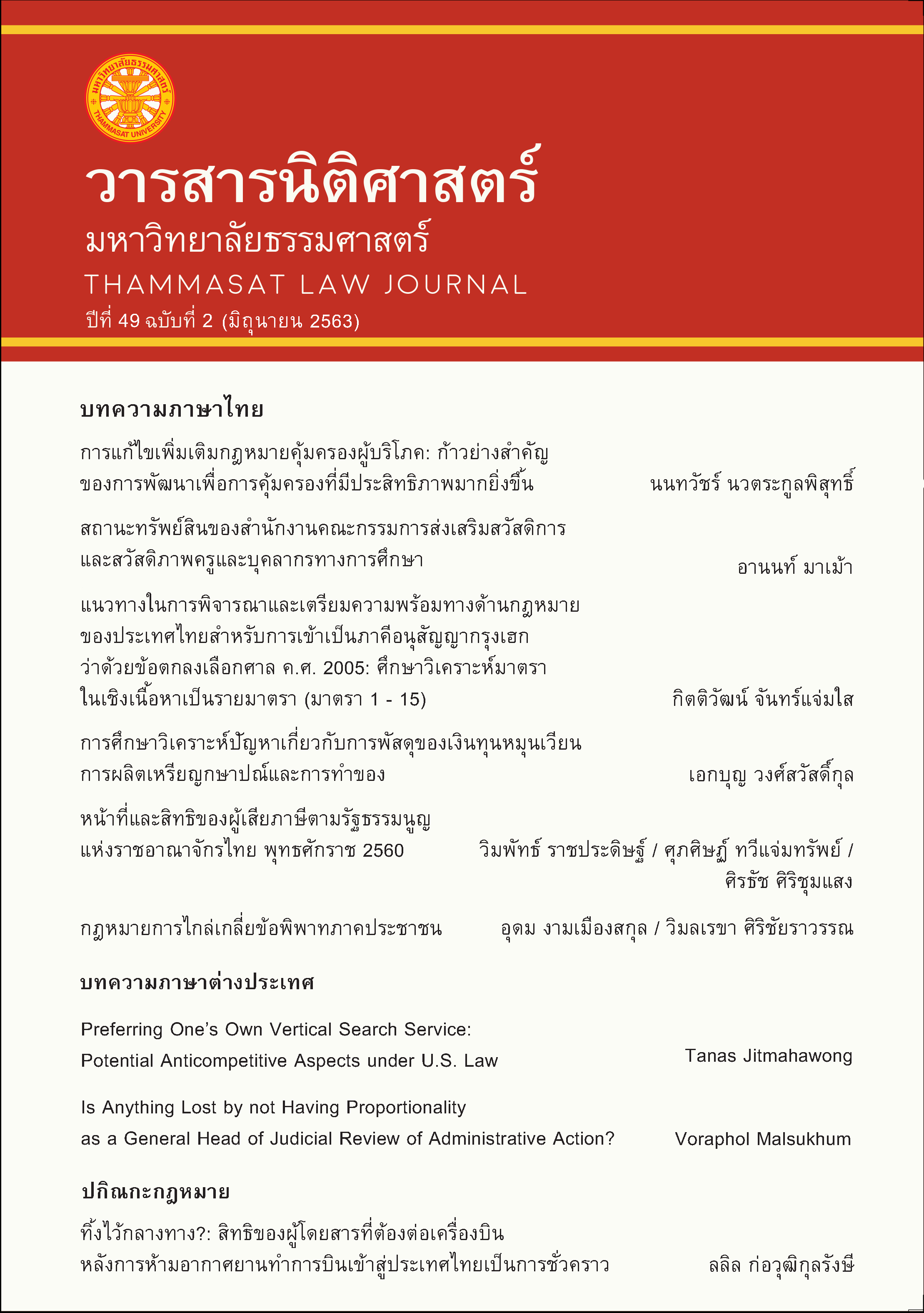
Preferring One’s Own Vertical Search Service: Potential Anticompetitive Aspects under U.S. Law
Keywords:
Antitrust, Competition, Vertical Search, Organic Search, Anticompetitive EffectAbstract
One major trend of current market strategies is leaping toward online advertisement which may bring a great fortune to the advertising sellers and may create efficiency on the informed buyers’ part at the same time. However, when an Organic Search Service (OSS) provider decides to expand its service to include Vertical Search Service (VSS), an OSS provider may prefer and firstly display its own VSS on top of its page to searching consumers instead of displaying any other more relevant products or services set up by other advertising sellers or any other more relevant vertical search services in relevant order. This may be viewed as on viable business strategy or vicious scheme to shield out other competitors from the VSS market. This hypothetical concerning conduct will be the main subject of the analysis. In this article, first, the three ways for consumers to obtain information pertaining relevant products or services will be presented. The discussion will, then, lead to one of the most efficient ways of obtaining information – online search and advertising. After that, the hypothetical concerning conduct – an organic search provider expanding its service to include the vertical search service market and putting its own integrated vertical search service before the other vertical search services when consumers enter the search keywords on certain conditions will be explored. Then, the real cost of using such services will be explained with an aim to understand the real cost of zero or near-zero monetary charge of most organic search services currently available. Further, potential cognizable U.S. antitrust claims will be discussed. The main discussion will be toward the selected potential cognizable U.S. antitrust claims namely potential predatory pricing claim, potential monopolization claim, potential tying claim, and potential refusal to deal claim. After that, the possible anticompetitive effects from these possible cognizable U.S. antitrust claims discussed will be elaborated. These include deprivation of information, coercion of demand, unreasonable price increases, lower quality service, barriers to entry, exclusion of competitors, upward pricing pressure, and increase in bargaining power. However, as explicitly illustrated in the title of this article, no procompetitive justification, business justification, or the weighting between procompetitive and anticompetitive effects will be elaborated in this article. This article offers only possible anticompetitive effects and analysis of possible cognizable U.S. antitrust claims of the hypothetical concerning conduct upon certain conditions.
References
Books
1. Daniel L. Rubinfeld and Robert S. Pyndyck, Microeconomics (9 ed. 2018).
2. Stephen A. Ross et al, Corporate Finance (11 ed. 2016).
Articles
1. Adam Candeub, Behavioral Economics, Internet Search, and Antitrust, 9 I/S: J.L. & Pol'y for Info. Soc'y 407 (2014).
2. Catherine Tucker & Alexander Marthews, Social Networks, Advertising, and Antitrust, 19 Geo. Mason L. Rev. 1211 (2012).
3. Christopher Paul Saari, The Efficient Capital Market Hypothesis, Economic Theory and the Regulation of the Securities Industry, 29 Stan. L. Rev. 1031 (1977).
4. Daniel L. Rubinfeld & Michal S. Gal, Access Barriers to Big Data, 59 Ariz. L. Rev. 339 (2017).
5. Florian Wagner-von Papp, Should Google's Secret Sauce Be Organic?, 16 Melb. J. Int'l L. 609 (2015).
6. Frederick C. Dunbar & Dana Heller, Fraud on the Market Meets Behavioral Finance, 31 Del. J. Corp. L. 455 (2006).
7. Heather Schneider, An Antitrust Tying Analysis of Microsoft's Security Software Products, 7 Colum. Sci. & Tech. L. Rev. 3 (2006).
8. Ignacio Cofone, Google v. Spain: A Right to Be Forgotten?, 15 Chi.-Kent J. Int'l & Comp. L. 1 (2015).
9. James Ratliff & Daniel L. Rubinfeld, Is There a Market for Organic Search Engine Results and Can Their Manipulation Give Rise to Antitrust Liability, 10 J. Competition L. & Econ. 517 (2014).
10. John M. Newman, Antitrust in Zero-Price Markets: Foundations, 164 U. Pa. L. Rev. 149 (2015).
11. John M. Newman, The Myth of Free, 86 Geo. Wash. L. Rev. 513 (2018).
12. Marina Lao, Networks, Access, and "Essential Facilities": From Terminal Railroad to Microsoft, 62 SMU L. Rev. 557 (2009).
13. Marina Lao, Search, Essential Facilities, and the Antitrust Duty to Deal, 11 Nw. J. Tech. & Intell. Prop. 275 (2013).
14. Mark A. Jamison, Should Google Be Regulated As A Public Utility?, 9 J.L. Econ. & Pol'y 223 (2013).
15. Michal S. Gal, Daniel L. Rubinfeld, The Hidden Costs of Free Goods: Implications for Antitrust Enforcement, 80 Antitrust L.J. 521 (2016).
16. Nathan Newman, Search, Antitrust, and the Economics of the Control of User Data, 31 Yale J. on Reg. 401 (2014).
17. Phillip Areeda, Essential Facilities: An Epithet in Need of Limiting Principles, 58 Antitrust L.J. 841 (1989)
18. Richard A. Posner, Antitrust in the New Economy, 68 Antitrust L.J. 925 (2001).
19. Robin Cooper Feldman, Defensive Leveraging in Antitrust, 87 Geo. L.J. 2079 (1999).
20. Thomas Chen, Authorized Generics: A Prescription for Hatch-Waxman Reform, 93 Va. L. Rev. 459 (2007).
Downloads
Published
Issue
Section
License
The manuscripts published in the Law Journal is the copyright of the Law Journal, Thammasat University
Any article or opinion appeared in the Law Journal will solely be under the responsibility of the author The Faculty of Law, Thammasat University and the editors do not need to reach in agreement or hold any responsibility.

