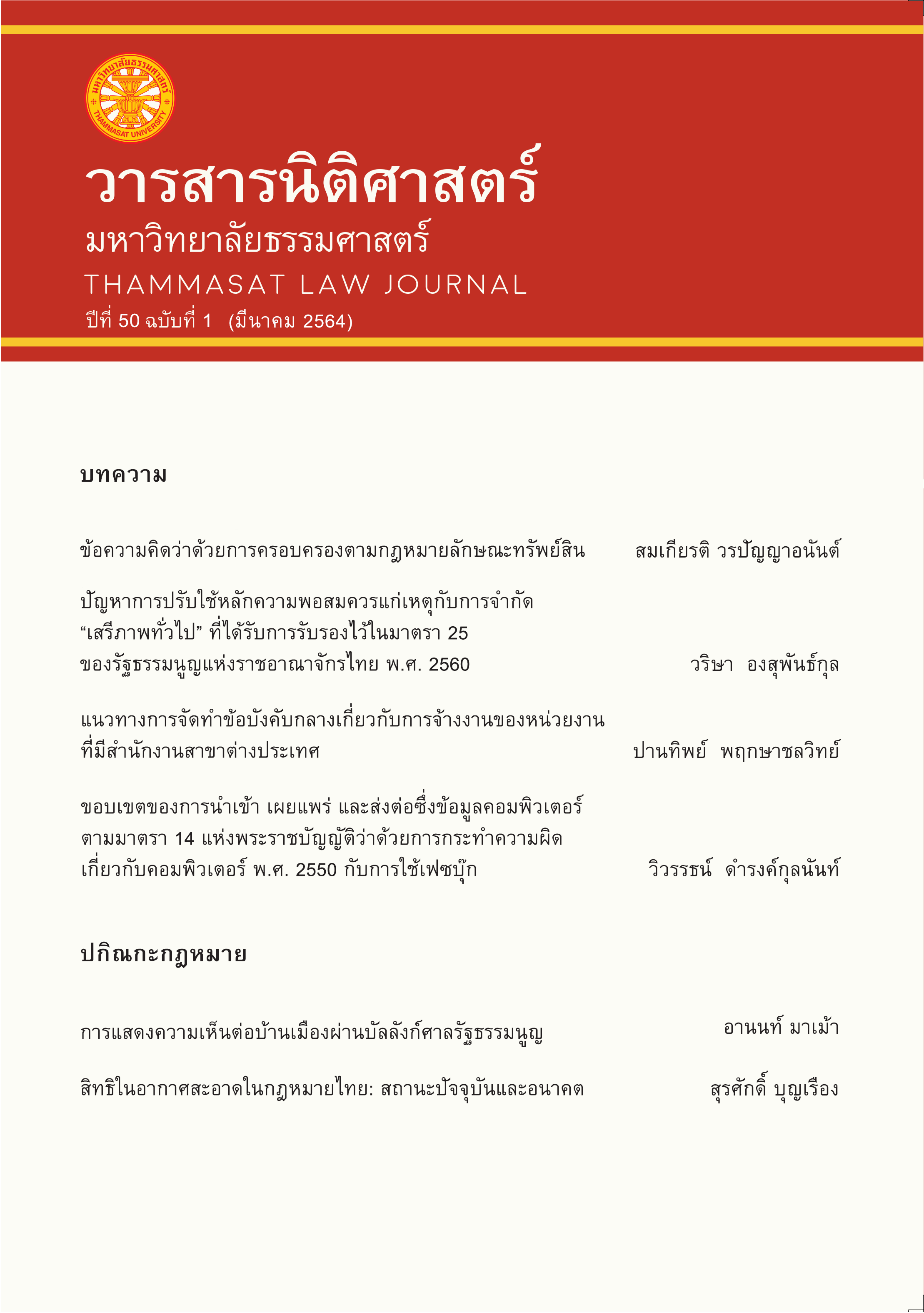
Problems on the Application of the Principle of Proportionality to the Limitation of the “Right to General Liberty” Enshrined in Article 25 of the Thai Constitution B.E. 2560
Keywords:
general right to liberty, constitutional rights, principle of proportionality, law of balancing, human dignityAbstract
The general right to liberty or the liberty to do or not to do as one pleases is guaranteed for the first time in Article 25 of the Thai Constitution B.E. 2560. The general right to liberty thus becomes a constitutional right, directly granting a subjective right to the right-holder against the state that it should not interfere with the individual’s freedom of action, state of affairs and legal positions. Such a wide scope as that of the general right to liberty, however, entails a wide conception of limiting clause because there are other principles and values protected in the constitution. In case where the conflict arises between the general right to liberty and other principles or values, relevant state organs have to apply the principle of proportionality when limiting the general right to liberty so that diverse principles and values recognised by the constitution can be factually and legally realised as much as possible, in accordance with the doctrine of harmonious construction used in constitutional interpretation. Nevertheless, the general right to liberty, embracing all indeterminate actions of all constitutional right-holders, has been criticised as having no content. The question thus remains as to how the principle of proportionality applies when limiting the right to general liberty. Therefore, this paper analyses problems arising in each of the three stages of the control of constitutionality when limiting the general right to liberty as well as the approaches used in France and Germany which gives importance to the use of the law of balancing. Moreover, the possibilities and challenges in implementing the German approach in the context of Thai constitutional law are also explained, such as the ‘Formal-Material Conception of the General Right to Liberty’ which incorporates the concept of human dignity to the material dimension of the general right to liberty to address the vagueness of the scope of such right.
References
เกรียงไกร เจริญธนาวัฒน์. หลักกฎหมายว่าด้วยสิทธิเสรีภาพ. กรุงเทพฯ: วิญญูชน, 2547.
เกษียร เตชะพีระ. “ระบอบประชาธิปไตยอันมีพระมหากษัตริย์ทรงเป็นประมุข: ที่มาและที่ไป.” วารสารฟ้าเดียวกัน, ปีที่ 9,ฉบับที่ 1,หน้า 88-114(2554).
ฐาปนันท์ นิพิฏฐกุล. คำประกาศว่าด้วยสิทธิมนุษยชนและพลเมืองค.ศ. 1789. มูลนิธิอาสาสมัครเพื่อสังคม สืบค้นเมื่อวันที่ 25 มิถุนายน 2563 จาก https://www.thaivolunteer.org/คำประกาศว่าด้วยสิทธิ.
ณัฐพล ใจจริง. ขอฝันใฝ่ในฝันอันเหลือเชื่อ: ความเคลื่อนไหวของขบวนการปฏิปักษ์ปฏิวัติสยาม (พ.ศ. 2475-2500). นนทบุรี: ฟ้าเดียวกัน, 2556.
ดิเรก สุขสว่าง. “การตรวจสอบความชอบด้วยรัฐธรรมนูญของกฎหมายภายใต้หลักความพอสมควรแก่เหตุ.” วิทยานิพนธ์มหาบัณฑิต มหาวิทยาลัยธรรมศาสตร์, 2554.
ต่อพงศ์ กิตติยานุพงศ์. “การปะทะกันแห่งคุณค่าในกฎหมายรัฐธรรมนูญไทย.” วารสารนิติศาสตร์, ปีที่ 48 ฉบับที่ 3, หน้า 439-466 (2562).
________________. ทฤษฎีสิทธิขั้นพื้นฐาน. พิมพ์ครั้งที่ 2 กรุงเทพฯ: วิญญูชน, 2562.
ทักษ์ เฉลิมเตียรณ.การเมืองระบบพ่อขุนอุปถัมภ์แบบเผด็จการ. แปลโดย พรรณี ฉัตรพลรักษ์, ม.ร.ว. ประกายทอง สิริสุขและธำรงศักดิ์ เพชรเลิศอนันต์. พิมพ์ครั้งที่ 6 กรุงเทพฯ: มูลนิธิโครงการตำราสังคมศาสตร์และมนุษย์ศาสตร์, 2561.
ธงชัย วินิจจะกูล. ประชาธิปไตยที่มีพระมหากษัตริย์อยู่เหนือการเมือง: ว่าด้วยประวัติศาสตร์การเมืองไทยสมัยใหม่. นนทบุรี: ฟ้าเดียวกัน, 2562.
____________. “นิติรัฐอภิสิทธิ์ ราชนิติธรรม: ประวัติศาสตร์ภูมิปัญญาของ Rule by Law แบบไทย.”เอกสารประกอบการแสดงปาฐกถาพิเศษ ป๋วย อึ๊งภากรณ์ ครั้งที่ 17. วันที่ 9 มีนาคม 2563 ณ คณะเศรษฐศาสตร์ มหาวิทยาลัยธรรมศาสตร์.
___________. 6 ตุลา ลืมไม่ได้ จำไม่ลง: รวมบทความว่าด้วย 6 ตุลา 2519. พิมพ์ครั้งที่ 2 นนทบุรี: ฟ้าเดียวกัน, 2563.
บรรเจิด สิงคะเนติ. หลักพื้นฐานสิทธิเสรีภาพและศักดิ์ศรีความเป็นมนุษย์. พิมพ์ครั้งที่ 6 กรุงเทพฯ: วิญญูชน, 2562.
วรเจตน์ ภาคีรัตน์. “เงื่อนไขการตรากฎหมายจำกัดสิทธิและเสรีภาพของประชาชน: “มาตร” ในการควบคุมตรวจสอบความชอบด้วยรัฐธรรมนูญของกฎหมาย.” วารสารนิติศาสตร์, ปีที่ 30, ฉบับที่ 2, หน้า 184-194 (2543).
_____________. “การใช้การตีความกฎหมายมหาชน.” ใน การใช้การตีความกฎหมาย. งานวิชาการรำลึก
ชาตกาลศาสตราจารย์ จิตติ ติงศภัทิย์. พิมพ์ครั้งที่ 2กรุงเทพฯ: กองทุนศาสตราจารย์จิตติ ติงศภัทิย์ คณะนิติศาสตร์ มหาวิทยาลัยธรรมศาสตร์, 2552, หน้า 315-347.
_____________. คำสอนว่าด้วยรัฐและหลักทั่วไปของกฎหมายมหาชน. พิมพ์ครั้งที่ 2 กรุงเทพฯ: โครงการตำราและเอกสารประกอบการสอน คณะนิติศาสตร์ มหาวิทยาลัยธรรมศาสตร์, 2557.
____________. ด้วยกฎหมายและอุดมการณ์: รวมบทอภิปรายและบทสัมภาษณ์. กรุงเทพฯ: ไชน์พับลิชชิ่ง
เฮ้าส์, 2558.
____________. งานแนะนำหนังสือและบรรยาย “ประวัติศาสตร์ความคิดนิติปรัชญา.” ณ ห้องจี๊ด เศรษฐบุตร
คณะนิติศาสตร์ มหาวิทยาลัยธรรมศาสตร์ ท่าพระจันทร์, 18 มีนาคม 2561.
____________. ประวัติศาสตร์ข้อความคิดนิติปรัชญา. กรุงเทพฯ: สำนักพิมพ์อ่านกฎหมาย, 2561.
สำนักงานเลขาธิการสภาผู้แทนราษฎร. ความมุ่งหมายและคำอธิบายประกอบรายมาตราของรัฐธรรมนูญแห่งราชอาณาจักรไทย พ.ศ. ๒๕๖๐. (2562) สืบค้นเมื่อวันที่ 12 มิถุนายน 2562 จากhttps://www.parliament.go.th/ewtcommittee/ewt/draftconstitution2/download/article/article_20191021103453.pdf.
สำนักงานศาลรัฐธรรมนูญ. กฎหมายพื้นฐานสหพันธ์สาธารณรัฐเยอรมนี. แปลโดย คริสเตียน โทมุสชัท และ เดวิด เคอรีย์. กรุงเทพฯ: สำนักงานศาลรัฐธรรมนูญ, 2555.
“สรุปสาระสำคัญจากงานเสวนาวิชาการเรื่อง ‘ปัญหาของพระราชบัญญัติหลักเกณฑ์การจัดทำร่างกฎหมายและการประเมินผลสัมฤทธิ์ของกฎหมาย พ.ศ.2562 กับหลักนิติรัฐ.’” วันที่ 24 สิงหาคม 2562 ณ คณะนิติศาสตร์ มหาวิทยาลัยธรรมศาสตร์ ท่าพระจันทร์.
สุรศักดิ์ บุญญานุกูลกิจ. “สิทธิของบุคคลในการยื่นคำร้องต่อศาลรัฐธรรมนูญตามมาตรา 213 รัฐธรรมนูญแห่งราชอาณาจักรไทย พุทธศักราช 2560.” รายงานผลการวิจัยเสนอต่อคณะนิติศาสตร์มหาวิทยาลัยธรรมศาสตร์, 2562.
ปูนเทพ ศิรินุพงศ์. ตลก รัฐธรรมนูญ.กรุงเทพฯ: ไชน์ พับลิชชั่ง เฮาส์, 2559.
ปิยบุตร แสงกนกกุล. ศาลรัฐประหาร: ตุลาการ ระบอบเผด็จการ และนิติรัฐประหาร. นนทบุรี: ฟ้าเดียวกัน (2550).
_______________. “กฎหมาย กับ อุดมการณ์.” วารสารฟ้าเดียวกัน, ปีที่ 9,ฉบับที่ 1 (2554), หน้า 40-44.
_______________. ราชมัล ลงทัณฑ์ บัลลังก์ ปฏิรูป: บทอภิปรายว่าด้วยรัฐธรรมนูญ สถาบันกษัตริย์ ตุลาการ และกองทัพ. กรุงเทพฯ: ไชน์ พับลิชชิ่ง เฮ้าส์, 2557.
_______________. กฎหมายรัฐธรรมนูญ: การก่อตั้งรัฐธรรมนูญและการแก้ไขรัฐธรรมนูญ. กรุงเทพฯ: โครงการตำราและเอกสารประกอบการสอน คณะนิติศาสตร์ มหาวิทยาลัยธรรมศาสตร์, 2560).
_______________. รัฐธรรมนูญ: ประวัติศาสตร์ข้อความคิด อำนาจสถาปนา และการเปลี่ยนผ่าน. นนทบุรี: ฟ้าเดียวกัน, 2562.
ประจักษ์ ก้องกีรติ. ประชาธิปไตยในยุคเปลี่ยนผ่าน: รวมบทความว่าด้วยประชาธิปไตย ความรุนแรงและความยุติธรรม. นนทบุรี: ฟ้าเดียวกัน, 2558.
สมชาย ปรีชาศิลปะกุล. นี่คือปณิธานที่หาญมุ่ง: ข้อถกเถียงว่าด้วยสถาบันพระมหากษัตริย์ในองค์กรจัดทำรัฐธรรมนูญของไทย ตั้งแต่ พ.ศ. 2475-2550. นนทบุรี: ฟ้าเดียวกัน, 2561.
_________________. เมื่อตุลาการเป็นใหญ่ในแผ่นดิน: รวมบทความว่าด้วยตุลาการภิวัฒน์ ตุลาการพันลึก และตุลาการธิปไตยกรุงเทพฯ: บุ๊คสเคป, 2562.
พุทธทาสภิกขุ. ธัมมิกสังคมนิยมแบบเผด็จการ.พิมพ์แจกเป็นที่ระลึกในงานณาปนกิจศพ นางมณฑา หมื่นนิกร.กรุงเทพฯ, 2518.
พระพรหมคุณาภรณ์ (ป. อ. ปยุตฺโต). นิติศาสตร์แนวพุทธ. พิมพ์ครั้งที่ 16 นครปฐม: วัดญาณเวศกวัน, 2557.
__________________________. สิทธิมนุษยชน: สร้างสันติสุขหรือสลายสังคม.กรุงเทพฯ: กระทรวงการต่างประเทศ. จัดพิมพ์เนื่องในโอกาสครบ 50 ปี ปฏิญญาสากลว่าด้วยสิทธิมนุษยชนแห่งสหประชาชาติ, 2541.
ภิญญพันธ์ พจนะลาวัณย์. ไทยปิฎก: ประวัติศาสตร์การเมืองสังคมร่วมสมัยของพุทธศาสนาไทย. กรุงเทพฯ: อิลลูมิเนชันส์ เอดิชันส์, 2562.
เอกสารภาษาต่างประเทศ
Alec Stone Sweet and Jud Mathews.“Proportionality Balancing and Global Constitutionalism.” Columbia Journal of Transnational Law. Vol. 47, No. 1,pp. 68-149(2008).
______________________________. Proportionality Balancing and Constitutional Governance: A Comparative and Global Approach. Oxford: Oxford University Press, 2019.
Dieter Grimm, Constitutionalism: Past Present, and Future. Oxford: Oxford University Press, 2016.
Eugénie Mérieu, “Buddhist Constitutionalism in Thailand: When Rajadhamma Supersedes the Constitution.” Asian Journal of Comparative Law. Vol.13, No. 2,pp.1-23(2018).
Isaiah Berlin. Liberty. Oxford: Oxford University Press, 2002.
Jacon Weinrib. Dimensions of Dignity: The Theory and Practice of Modern Constitutional Law. Cambridge: Cambridge University Press, 2016.
Jill Marshall. Human Rights Law and Personal Identity. London and New York: Routledge, 2014.
Louis Althusser. “Idéologie et Appareils Idéologiques d’État.”La Pensée. No.151, pp. 67-125 (1970).
Louis Favoreu et al. Droit Constitutionnel. 22e édition. Paris: Dalloz, 2020.
Michel Lascombe, Xavier Vandendrisessche, and Christelle de Gaudemont. Code Constitutionnel et des Droits Fondamentaux 2016, commenté. 5e édition. Paris: Dalloz, 2017.
Robert Alexy. A Theory of Constitutional Rights. translated by Julian Rivers. New York: Oxford University Press, 2002.
Xavier Bioy. “Le Libre Développement de la Personnalité en Droit Constitutionnel:Essai de Comparaison (Allemagne, Espagne,France, Italie,Suisse).” Revue Internationale de Droit Comparé. Vol. 55, No.1, pp.123-147 (2003).
Downloads
Published
Issue
Section
License
The manuscripts published in the Law Journal is the copyright of the Law Journal, Thammasat University
Any article or opinion appeared in the Law Journal will solely be under the responsibility of the author The Faculty of Law, Thammasat University and the editors do not need to reach in agreement or hold any responsibility.

