
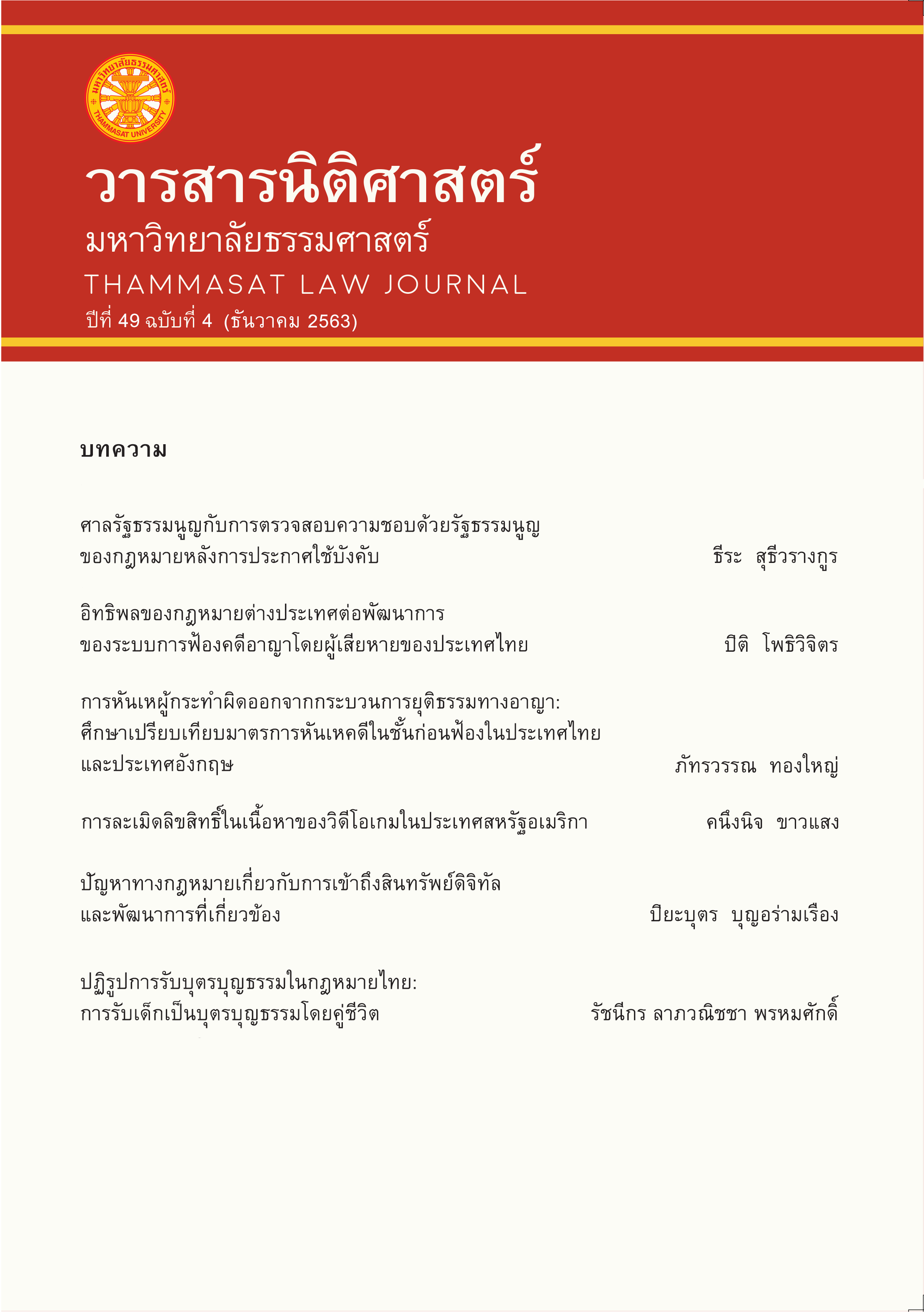
The Constitutional Court and the repressive (a posteriori) review of the constitutionality of laws
Keywords:
Constitutional Court, principle of the legal superiority of the Constitution, the repressive (a posteriori) review of the constitutionality of laws, principle of the effective and efficient review of the exercise of the state’s powerAbstract
In a state adopting the “legal state” principle, the constitutional review of laws is considered a significant mechanism for ensuring that the Constitution is the supreme law of the land. Thailand has had a system of the repressive (a posteriori) review of the constitutionality of laws since the 1932 Siamese revolution, but the review exercised by the Constitutional Court in many cases remains the subject of controversy, such as, “the object of the proceedings to be under the Court’s jurisdiction”, “the mechanism for presenting the case to be reviewed by the Court”, “the rules and procedures for the Court’s review”, and “the outcome of the Court’s review”. The repressive review of the constitutionality of laws is very important in the legal system of Thailand since it relates to the principle of the legal superiority of the Constitution, the principle of the effective and efficient review of the exercise of the state’s power, and the principle of the prevention of arbitrariness of the state’s institutions. It is, therefore, expedient to revisit the concepts used in drafting the Constitution, the provisions of the Constitution, and the application and interpretation, conducted by the Constitutional Court and other relevant institutions, of the Constitution in order for the review in question to be more appropriate.
Downloads
Published
Issue
Section
License
The manuscripts published in the Law Journal is the copyright of the Law Journal, Thammasat University
Any article or opinion appeared in the Law Journal will solely be under the responsibility of the author The Faculty of Law, Thammasat University and the editors do not need to reach in agreement or hold any responsibility.

