
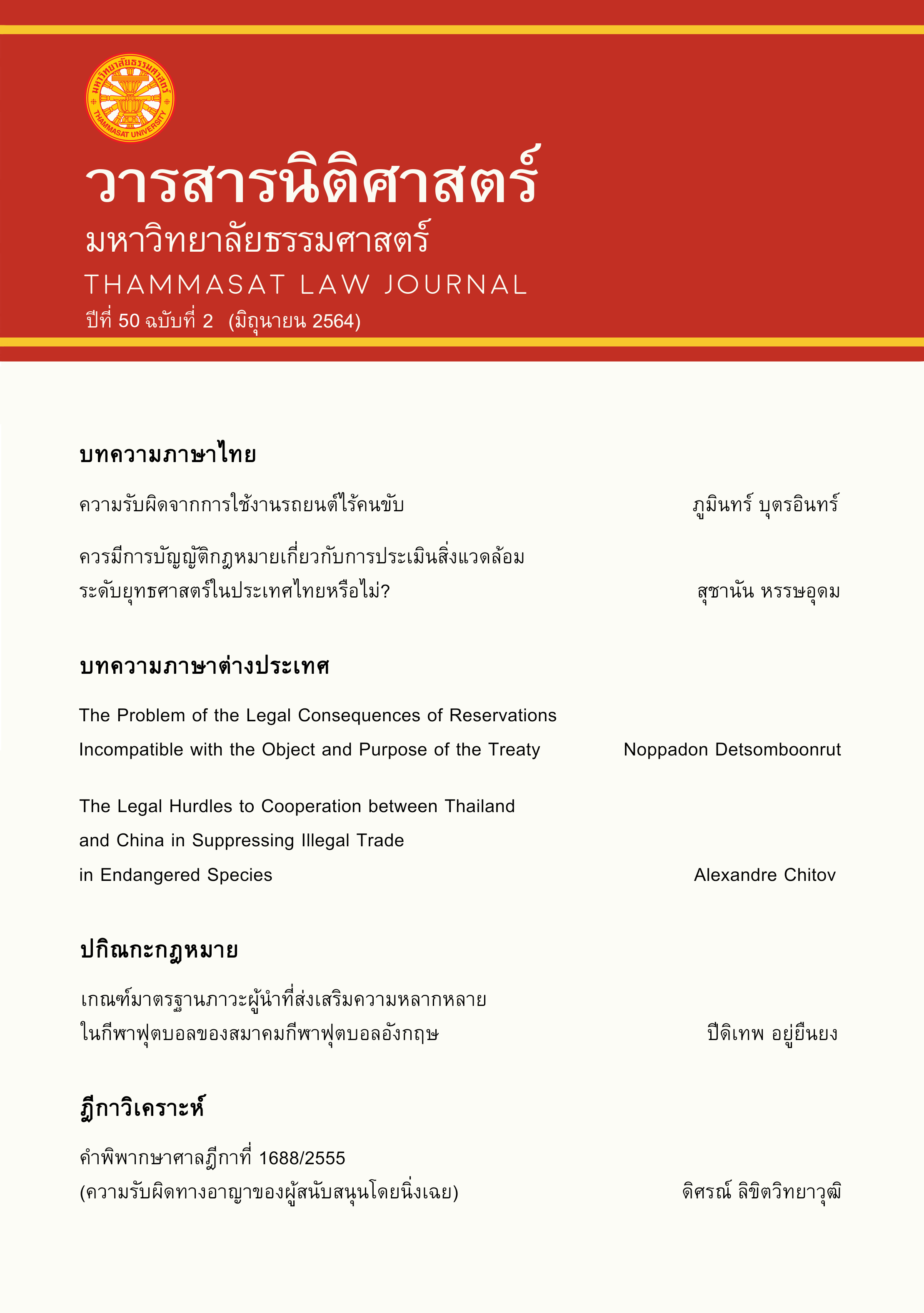
The Problem of the Legal Consequences of Reservations Incompatible with the Object and Purpose of the Treaty
Keywords:
Treaties, Reservations, Reservations Incompatible with the Object and Purpose of the TreatyAbstract
This article aims to address the problem of the legal consequences of reservations incompatible with the object and purpose of the treaty according to Article 19(c) of the Vienna Convention on the Law of Treaties 1969 (VCLT). As there are no provisions in the VCLT that indicate the legal consequences of reservations incompatible with the object and purpose of the treaty, this raises the issues of the vagueness and uncertainty of the legal consequences of the incompatibility between a reservation and the object and purpose of the treaty.
The legal consequences of reservations incompatible with the object and purpose of a treaty must be addressed in two dimensions. The first dimension is the determination of the legal consequence of a reservation which is incompatible with the object and purpose of a treaty. The second dimension is the consequences of the state consent to be bound by a treaty given by a reserving state with which a problematic reservation is attached. Whilst the legal consequence of a reservation itself is less problematic, as it has been well-settled that the reservation prohibited by Article 19(c) is invalid and produces no legal effects, the legal consequence of the consent to be bound by a treaty of a reserving state is still an unsolved riddle. Academically, three proposals — the surgical approach, the backlash approach, and the severability approach — are put forward to serve as a proper threshold for determining the legal consequences of the consent of a reserving state which has made a reservation that is incompatible with the object and purpose of a treaty.
By examining the three approaches, this article argues that none of the three by itself can serve as a proper criterion to determine the legal consequence of incompatibility between a reservation and the object and purpose of the treaty on the consent of a reserving state. However, it is proposed by this article that the hybrid model based on the essentiality of a reservation to the consent of a reserving state which compromises between the backlash approach and the severability approach can serve as the solution to this issue. In order to deal with legal uncertainty caused by the essentiality criterion of the hybrid model, it is proposed by this article that the clause on the rebuttable presumption of severability should be incorporated into a treaty which will be helpful in cases where states fail to express to make a clear intention to be bound or not by a treaty in case of a reservation is considered invalid. Nevertheless, the suggestion of the ILC in its Guide to Practice on Reservations to Treaties that a reserving state is allowed to express its intention not to be bound by the treaty in case of invalidity of its reservation after the formulation of the reservation is rejected by this article due to a problem of legal uncertainty it may potentially cause.
References
Baratta R, ‘Should Invalid Reservations to Human Rights Treaties Be Disregarded?’ (2010) 11 European Journal of International Law 413
Bowett DW, ‘Reservations to Non-Restricted Multilateral Treaties’ (1976) 48 British Year Book of International Law 67
Buffard I and Zemanek K, ‘The “Object and Purpose” of a Treaty: An Enigma?’ (1998) 3 Austrian Review of International and European Law
Cameron lain and Horn F, ‘Reservations to the European Convention on Human Rights: The Belilos Case’ (1990) 33 German Yearbook of International Law German Yearbook of International Law
Coccia M, ‘Reservations to Multilateral Treaties on Human Rights’ (1985) 15 California Western International Law Journal 1
Goldsmith J and Levinson D, ‘Law for States: International Law, Constitutional Law, Public Law’ (2009) 122 Harvard Law Review 1791
Goodman R, ‘Human Rights Treaties, Invalid Reservations, and State Consent’ (2002) 96 The American Journal of International Law 531
Koh JK, ‘Reservations to Multilateral Treaties: How International Legal Doctrine Reflects World Vision’ (1982) 23 Harvard International Law Journal 71
Lijnzaad L, Reservations to UN Human Rights Treaties: Ratify and Ruin? (Martinus Nijhoff Publishers 2012)
MacDonald RStJ, ‘Reservations under the European Convention on Human Rights’ (1988) 21 Revue Belge de Droit International 428
McCall-Smith KL, ‘Severing Reservations’ (2014) 63 International & Comparative Law Quarterly 599
Moloney R, ‘Incompatible Reservations to Human Rights Treaties: Severability and the Problem of State Consent’ (2004) 5 Melbourne Journal of International Law 155
Paul Reuter, Introduction to The Law of Treaties (Jose Mica and Peter Haggenmacher trs, Routledge 2011)
Redgwell C, ‘Universality or Integrity? Some Reflections on Reservations to General Multilateral Treaties’ (1994) 64 British Yearbook of International Law 245
Ruda JM, ‘Reservations to Treaties’, Collected Courses of The Hague Academy of International Law, 1975-III, vol 146 (1977)
Simma B, ‘Reservations to Human Rights Treaties—Some Recent Developments’ in Gerhard Hafner (ed), Liber Amicorum:Professor Ignaz Seidl-Hohenveldern in Honour of His 80th Birthday (Springer)
Walter C, ‘Article 19. Formulation of Reservations’ in Oliver Dörr and Kirsten Schmalenbach (eds), Vienna Convention on the Law of Treaties: A Commentary (2nd edn, Springer 2018)
UN Documents
ILC, the Guide to Practice on Reservations to Treaties, Report of the International Law Commission on the work of its sixty-third session (26 April–3 June and 4 July–12 August 2011) (A/66/10)
ILC, Commentaries on the Guide to Practice on Reservations to Treaties and Commentaries', Document A/66/10/ADD.1
Cases
Reservations to the Convention on Genocide, Advisory Opinion : I.C.J. Reports 1951, p. 15
Case of Certain Norwegian Loans, Judgment of July 6th, 1957 : I.C J. Reports 1957, p.9
Interhandel Case, Judgment of March 21st, 1959 : I.C.J. Reports I959, p.6
European Court of Human Rights, Belilos v. Switzerland, Judgment of 29 April 1988, Series A: Judgments and Decisions, vol. 132
European Court of Human Rights, Weber v. Switzerland (Application No. 11034/84), Judgment Strasbourg 22 May 1990
European Court of Human Rights, Loizidou v. Turkey (Preliminary Objections, Application no. 15318/89), Judgment of 23 March 1995, Series A no. 310
Inter-American Court of Human Rights, Case of Hilaire v. Trinidad and Tobago, Judgment of September 1, 2001 (Preliminary Objections)
Inter-American Court of Human Rights, Benjamin et al. v. Trinidad and Tobago, Judgment of September 1, 2001 (Preliminary Objections)
Inter-American Court of Human Rights, Constantine et al. v. Trinidad and Tobago, Inter-American Court of Human Rights, Judgment of September 1, 2001 (Preliminary Objections)
Downloads
Published
Issue
Section
License
The manuscripts published in the Law Journal is the copyright of the Law Journal, Thammasat University
Any article or opinion appeared in the Law Journal will solely be under the responsibility of the author The Faculty of Law, Thammasat University and the editors do not need to reach in agreement or hold any responsibility.

