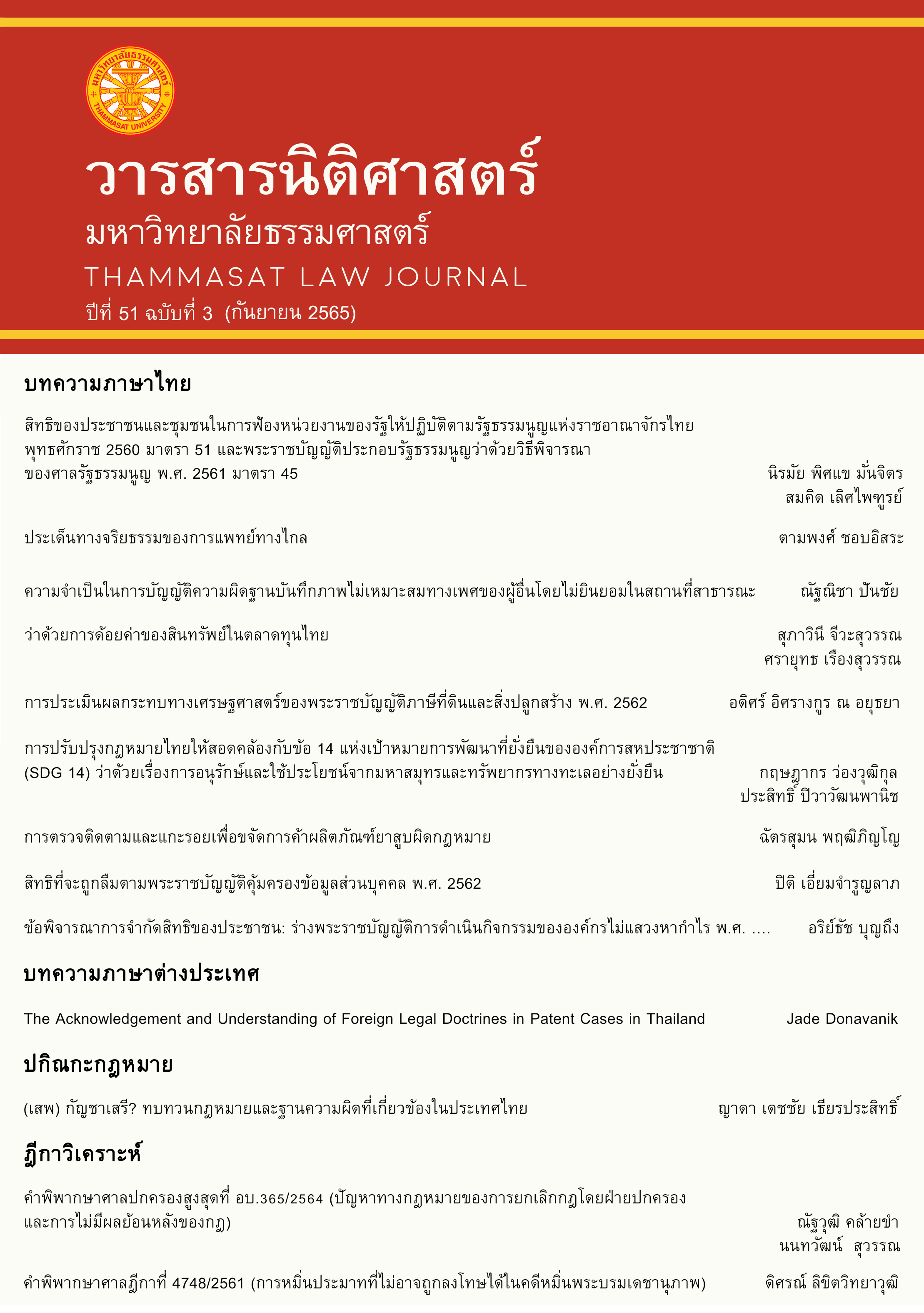
The Improvement of Thai Laws according to Sustainable Development Goal 14 of the United Nations Relating to Conserve and Sustainably Use of the Oceans, Seas and Marine Resources for Sustainable Development
Keywords:
Sustainable Development Goal 14, Conserve and Sustainably Use the Oceans, seas and marine resources, 1982 United Nations Convention on the Law of the SeaAbstract
This article aims to present the improvement of Thai laws according to Sustainable Development Goal 14 of the United Nations Relating to Conserve and Sustainably Use of the Oceans, Seas and Marine Resources for Sustainable Development. The hypothesis of the research is that the existing Thai laws that will be applied as one of the key tools in achieving SDG 14 are partially ready for implementation to achieve sustainable development. However, there are some legislations that need to be reviewed and updated to be in line with international agreements, in particular, the 1982 United Nations Convention on the Law of the Sea. For example, legislations relating to ocean acidification must reflect the connection between the problem of air and ocean pollution, greater public participation in management through area-based conservation measures must also be strengthened, drafting legislation on marine science research is required and market access for small-scale fishermen has to be ensured.
References
• Alex G. Oude Elferink, ‘Governance Principles for Areas beyond National Jurisdiction’ (2012) 27 International Journal of Marine and Coastal Law 205
• Anastasia Telesetsky, ‘UN Food and Agriculture Organization: Exercising Legal Personality to Implement the UN Convention on the Law of the Sea’ in Ribeiro M., Loureiro Bastos F., Henriksen T. (eds) Global Challenges and the Law of the Sea (Springer 2020)
• B.S. Halpern et al., ‘A Global Map of Human Impact on Marine Ecosystems’ (2008) 319 Science 948
• Chen-Ju Chen, Fisheries Subsidies under International Law (Springer 2010)
• Christel Cederberg, ‘Improving Nutrient Management in Agriculture to Reduce Eutrophication, Acidification and Climate Change’ in Ulf Sonesson, Joanna Berlin and Friederike Ziegler (eds), Environmental Assessment and Management in the Food Industry: Life Cycle Assessment and Related Approaches (Woodhead Publishing 2010) 3–15
• Christopher C. Joyner and Scot Frew ‘Plastic Pollution in the Marine Environment’ (1991) 22 Ocean Development & International Law 33–69.
• Daniel Owen, ‘The Application of the Wild Birds Directive Beyond the Territorial Sea of European Community Member States’ (2001) 13 Journal of Environmental Law 39, 61
• David Archer, The Global Carbon Cycle (Princeton UP 2010)
• Elisa Morgera and Mara Ntona, ‘Linking Small-Scale Fisheries to International Obligations on Marine Technology Transfer’ (2018) 93 Marine Policy 295
• Ellen Hey ‘The Fisheries Provisions of the LOS Convention’ in Ellen Hey (ed.) Developments in International Fisheries Law (Kluwer Law International 1999)
• FAO Doc. No. COFI/2003/8, “Conclusions and Recommendations of the FAO Expert Consultation on Identifying, Assessing and Reporting on Subsidies in the Fishing Industry” (FAO 2003) para. 4.
• GESAMP (IMO/FAO/UNESCO-IOC/UNIDO/WMO/IAEA/UN/UN Environment/UNDP Joint Group of Experts on the Scientific Aspects of Marine Environmental Protection), The Magnitude and Impacts of Anthropogenic Atmospheric Nitrogen Inputs to the Ocean. (Rep. Stud. GESAMP No. 97/ GAW Report No. 238, 2018)
• Hanling Wang, ‘Ecosystem Management and Its Application to Large Marine Ecosystems: Science, Law, and Politics’ (2004) 35 Ocean Development & International Law 41.
• Iris E Hendriks, Carlos M Duarte and Marta Álvarez, ‘Vulnerability of Marine Biodiversity to Ocean Acidification: A Meta-Analysis’ (2010) 86 Estuarine, Coastal and Shelf Science 157
• IUCN, Ocean Deoxygenation: Everyone’s Problem – Causes, Impacts, Consequences and Solutions (IUCN 2019)
• Jean-Pierre Gattuso and Lina Hansson, ‘Ocean Acidification: Background and History’, Ocean Acidification (OUP 2011) ch 1; Intergovernmental Panel on Climate Change (IPCC), ‘Summary for Policymakers’ in TF Stocker, D Quin, GK Platter et al. (eds), Climate Change 2013: The Physical Science Basis–Contribution of Working Group I to the Fifth Assessment Report of the Intergovernmental Panel on Climate Change (CUP 2013)
• Jenna R. Jambeck and others, ‘Plastic Waste Inputs from Land into the Ocean’ (2015) 347 Science 768–771
• Joji Morishita, ‘What is the Ecosystem Approach for Fisheries Management?’ (2008) 32 Marine Policy 19
• M Rhein, SR Rintoul, S Aoki et al., ‘Observations: Ocean’ in TF Stocker, D Quin, GK Platter et al. (eds), Climate Change 2013: The Physical Science Basis – Contribution of Working Group I to the Fifth Assessment Report of the Intergovernmental Panel on Climate Change (CUP 2013)
• Naporn Popattanachai, The Legal, Policy and Institutional Frameworks Governing Marine Plastics in Thailand (IUCN 2020)
• Tavis Potts, ‘Climate Change, Ocean Acidification and the Marine Environment: Challenges for the international legal regime’ in Daud Hassan and Md Saiful Karim (eds) International Marine Environmental Law and Policy (Routledge 2018)
• UNEP, Global Programme of Action for the Protection of the Marine Environment from Land-based Activities (UNEP 1995)
• UNGA, Transforming OurWorld: The 2030 Agenda for Sustainable Development (UN Doc A/RES/70/1, 25 September 2015).
• United Nations Convention on the Law of the Sea (adopted and opened for signature 10 December 1982, entered into force 16 November 1994) 1833 UNTS 3
• United Nations Sustainable Development Summit 2015, 25–27 September 2015, New York, available at < https://sustainabledevelopment.un.org/post2015/summit.> accessed 24 February 2022.
• United Nations, The First Global Integrated Marine Assessment (World Ocean Assessment I) by the Group of Experts of the Regular Process under the Auspices of the United Nations General
Downloads
Published
Issue
Section
License
Copyright (c) 2022 Thammasat Law Journal

This work is licensed under a Creative Commons Attribution-NonCommercial-NoDerivatives 4.0 International License.
The manuscripts published in the Law Journal is the copyright of the Law Journal, Thammasat University
Any article or opinion appeared in the Law Journal will solely be under the responsibility of the author The Faculty of Law, Thammasat University and the editors do not need to reach in agreement or hold any responsibility.

