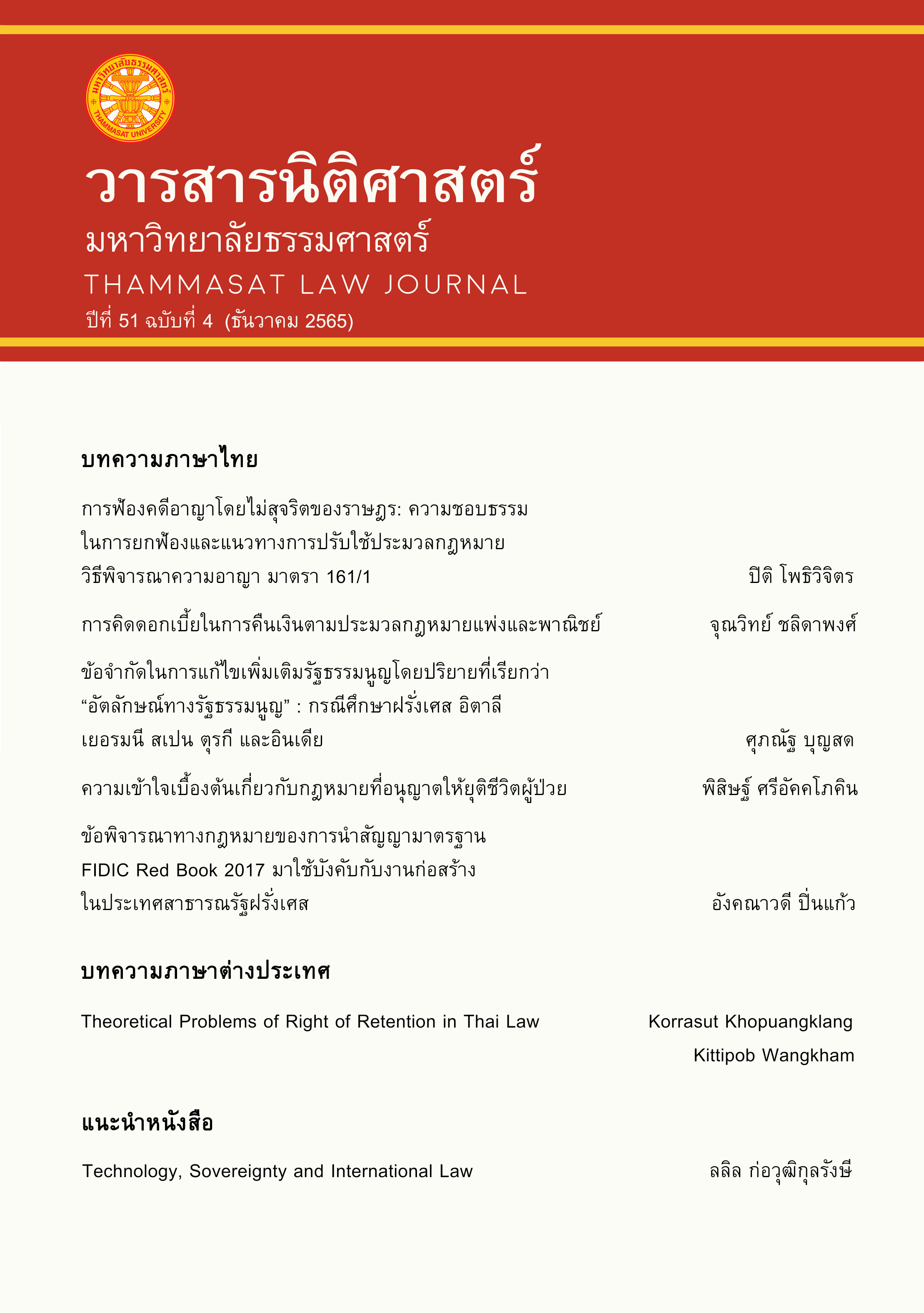
Malicious Prosecution Instituted by an Injured Person: Legitimacy of Dismissal and Application Guideline of Section 161/1 of the Criminal Procedure Code
Keywords:
Malicious Prosecution, Legitimacy, InterpretationAbstract
There is widespread debate over the legitimacy of Section 161/1, paragraph one of the Criminal Procedure Code (CPC), allowing courts to dismiss a bad faith complaint instituted by an injured person even if the case has merit. In paragraph two, the court’s obligation to deny a complaint instituted by the injured person willfully violating a final court order or court judgment in a previous case would be discriminatory, whereas the state has a constitutional duty to organize a justice procedural management system in all aspects to ensure efficiency, fairness, and non-discrimination. In addition, the provision’s terminology is too ambiguous for clear interpretation.
The results were that the objective of Section 161/1, paragraph one of the CPC is to prevent the criminal justice system from being used for any purpose other than bringing offenders to justice, its sole lawful purpose. Vexing another individual, bargaining in another case, and collecting civil debts are not lawful purposes. Prosecution for these purposes is termed malicious. As with any other existing case-dismissed measures of the CPC, such as the principle of de jure injured person or prosecutor failing to appear on the date of hearing, the court is empowered to dismiss such cases technically, even if well founded. Eliminating malicious prosecution also protects individuals from being forced to engage in unreasonable criminal processes. This legitimizes paragraph one. However, paragraph two aims to retaliate against the former accused violating past court orders or judgments, despite sanctions which should solely be imposed in the original case. Declining all new complaints filed regardless of the minimality of previous cases is likely contrary to the principle of proportionality. Therefore, paragraph two may be seen as unconstitutional and illegitimate and should be repealed.
As a provisional interpretation, malicious prosecution, according to paragraph one, means to file a criminal complaint with an improper purpose instead of proving guilty and sanctioning offenders. A secondary purpose accrues from sanctioning offenders, such as gloating over the wrongdoer punished, which coincides with the retribution theory as a lawful, a non-malicious objective of sanctions. Retribution theory also includes prosecution for remedy. Filing criminal lawsuits for any purpose consistent with other lawful objectives of punishment, such as deterrence, rehabilitation, and incapacitation of offenders, also constitutes proper purposes. Finally, in cases of concurrently malicious and unfounded lawsuits, the court shall decide on the merits, then acquit the accused in order that the right to institute the criminal prosecution shall be extinguished by a final judgment in reference to the offense for which the prosecution has been instituted in accordance with Section 39 (4) of the CPC.
References
คณะกรรมการวิสามัญพิจารณาร่างพระราชบัญญัติแก้ไขเพิ่มเติมประมวลกฎหมายวิธีพิจารณาความอาญา (ฉบับที่ ..) พ.ศ. …. สภานิติบัญญัติแห่งชาติ, บันทึกการประชุม ครั้งที่ 2-4, วันที่ 9, 13 และ 15 พฤศจิกายน 2561 ตามลำดับ.
จตุรงค์ เพิ่มรุ่งเรือง, ‘ปัญหาของจำเลยในชั้นไต่สวนมูลฟ้องคดีอาญา’ (การประชุมวิชาการเสนอผลงานวิจัยระดับชาติและนานาชาติ ครั้งที่ 8, มปป).
ณรงค์ ใจหาญ, หลักกฎหมายวิธีพิจารณาความอาญา (เล่ม 1, พิมพ์ครั้งที่ 14, บริษัท สำนักพิมพ์วิญญูชน จำกัด 2565).
ดวงธมล คำวิโส, ‘การไกล่เกลี่ยคดีอาญาความผิดต่อแผ่นดินในชั้นศาล: ศึกษาเฉพาะกรณีที่มีผู้เสียหาย’ (วิทยานิพนธ์ นิติศาสตรมหาบัณฑิต มหาวิทยาลัยธุรกิจบัณฑิตย์ 2556).
ธานิศ เกศวพิทักษ์, คำอธิบายประมวลกฎหมายวิธีพิจารณาความอาญา ภาค 3-4 (เล่ม 2, พิมพ์ครั้งที่ 15, บริษัทกรุงสยาม พับลิชชิ่ง จำกัด 2564).
ธานี สิงหนาท, คำอธิบายกฎหมายวิธีพิจารณาความอาญา ภาค 3 วิธีพิจารณาในศาลชั้นต้น ภาค 4 อุทธรณ์และฎีกา : แก้ไขเพิ่มเติมตาม ป.วิ.อ. (ฉบับที่ 33 และ 34) พ.ศ. 2562 (บริษัท กรุงสยาม พับลิชชิ่ง จำกัด 2563).
ปิติ โพธิวิจิตร, ‘อิทธิพลของกฎหมายต่างประเทศต่อพัฒนาการของระบบการฟ้องคดีอาญาโดยผู้เสียหายของประเทศไทย’ (2563) 4 วารสารนิติศาสตร์ มหาวิทยาลัยธรรมศาสตร์ 703.
วิจิตรา เลิศหิรัญกิจ, ‘ความผิดฐานเฝ้าติดตามและข่มขู่’ (วิทยานิพนธ์ นิติศาสตรมหาบัณฑิต มหาวิทยาลัยธรรมศาสตร์ 2550).
สหรัฐ กิติ ศุภการ, หลักและคำพิพากษา : กฎหมายวิธีพิจารณาความอาญา (พิมพ์ครั้งที่ 13, บริษัท อมรินทร์พริ้นติ้งแอนด์พับลิชชิ่ง จำกัด (มหาชน 2565).
สุรัชดา รีคี, เอควิตี้ : หลักแห่งความยุติธรรมในกฎหมายอังกฤษ (พิมพ์ครั้งที่ 2, บริษัท สำนักพิมพ์วิญญูชน จำกัด 2565).
‘Equity Jurisdiction to Enjoin Criminal Proceedings’ (1915) 24 The Yale Law Journal 327.
“A Digest of the Reported Cases Published during the Year 1863.” (9 Jurist, 1864) 147.
§ 16:241. Elements of malicious prosecution—Malice or improper purpose, 14D Mass. Prac., Summary of Basic Law § 16:241 (5th ed.).
C.J.S. Malicious Prosecution § 55.
Andrew LT Choo, Abuse of Process and Judicial Stays of Criminal Proceedings (Oxford University Press 2008).
Brian A Grossman, ‘Prosecuting Practices And The Administration of Criminal Justice in Canada’ (LL.M. Thesis, McGill University 1967).
Chuks Okpaluba, ‘Reasonable and Probable Cause in the Law of Malicious Prosecution: A Review of South Africa and Commonwealth Decisions’ (2013) 16 Potchefstroom Elec LJ 240.
David S Garland, et al. Editors. ‘Malicious Prosecution’ American and English Encyclopaedia of Law (Edward Thompson Co., no publication date).
Felix Golser, ‘The Concept of a Special Criminal Law as a Weapon Against “Enemies” of the Society’ (2016) 67 Studia Iuridica 65.
Francis M Burdick, The Law of Torts: A Concise Treatise on the Civil Liability at Common Law and Under Modern Statutes for Actionable Wrongs to Person and Property (Beard Books 1905).
George L Blum 1 Am Jur 2d Abuse of Process.
Günther Jakobs, ‘Kriminalisierung im Vorfeld einer Rechtsgutsverletzung’ (1985) 97 Zeitschrift für die gesamte Strafrechtswissenschaft 751.
Günther Jakobs, 'Bürgerstrafrecht und Feindstrafrecht' (2004) 3 Höchstrichterliche Rechtsprechung zum Strafrecht.
Herbert Stephen, The Law Relating to Actions for Malicious Prosecution (Blackstone Publishing Company 1889).
JF Clerk and others, Clerk & Lindsell on torts (Sweet & Maxwell 2000).
John G Fleming, The Law of Torts (8th edn, Law Book 1992) 620.
John Murphy, ‘Malice as an Ingredient of Tort Liability’ (2019) 78 The Cambridge Law Journal 355.
John Salmond, Salmond on jurisprudence (Sweet & Maxwell 1966).
Marc Franklin, Gilbert Law Summaries Torts (Harcourt Brace Legal & Professional 2017).
Neil Gold, ‘Abuse of Process : A Procedure Perspective’ (LL.M. Thesis York University 1975).
Restatement (Second) of Torts (1977).
Rosemary Pattenden, ‘Abuse of Process in Criminal Litigation’ (1989) 53 J CRIM L 341.
Stephen Lawrence, ‘Abuse of Judicial Process in Criminal Proceedings’ (Law Society of Fiji Conference 2015).
Downloads
Published
Issue
Section
License
Copyright (c) 2022 Thammasat Law Journal

This work is licensed under a Creative Commons Attribution-NonCommercial-NoDerivatives 4.0 International License.
The manuscripts published in the Law Journal is the copyright of the Law Journal, Thammasat University
Any article or opinion appeared in the Law Journal will solely be under the responsibility of the author The Faculty of Law, Thammasat University and the editors do not need to reach in agreement or hold any responsibility.

