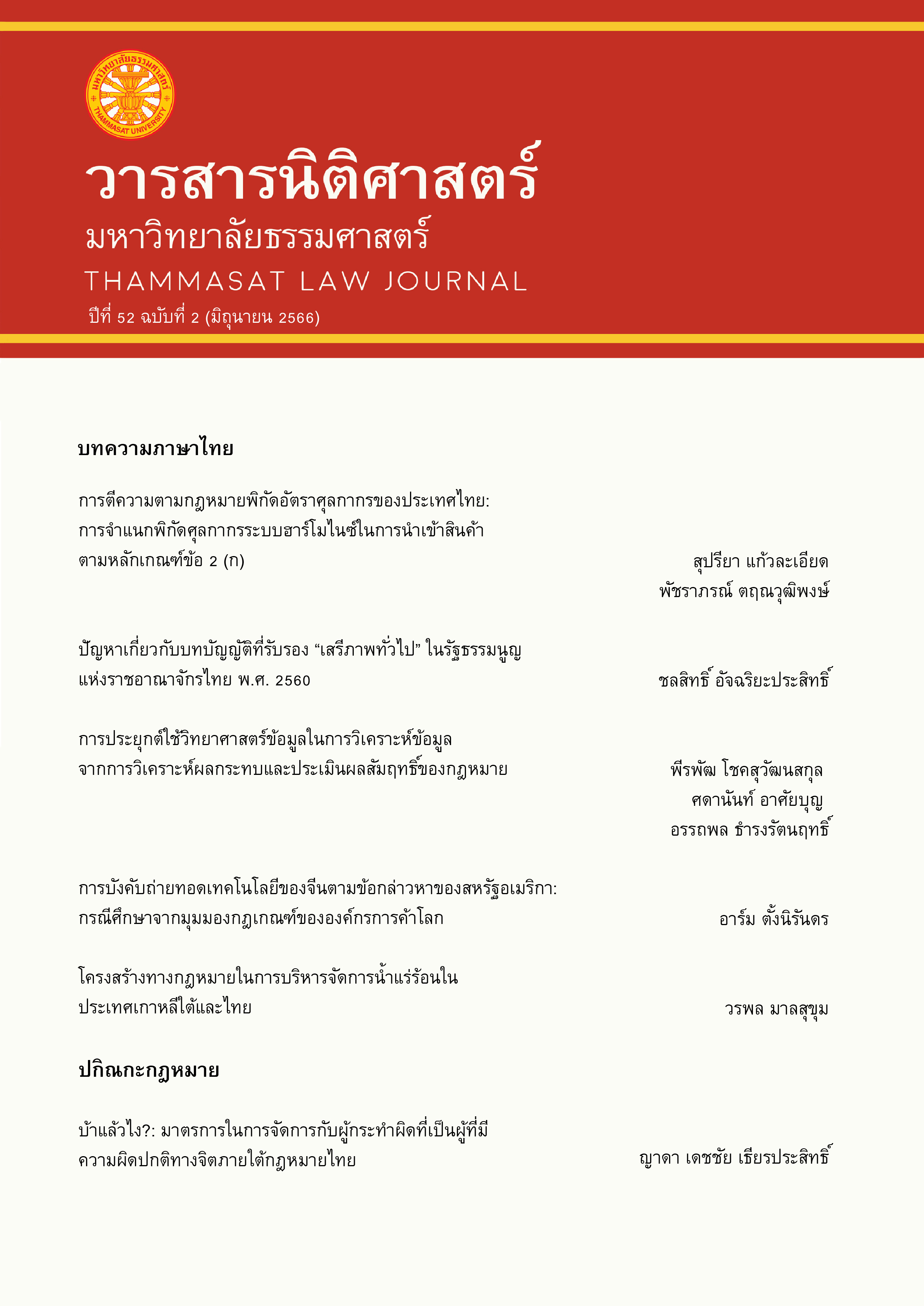
Legal Interpretation of Thai Customs Tariff: The Implications of Rule 2(a) of the General Rules for the Interpretation of the Harmonized System under the Thai Customs Law
Keywords:
: Tariff ClassificationAbstract
Tariff classification is the vital process in collecting customs duties, as it is the basis for categorizing commodities into a specific nomenclature with a relevant customs rate. The Customs Tariff Decree B.E. 2530 is an essential Thai customs regulation that specifically establishes tariff rates and general principles of interpretation for tariff categorization based on the Harmonized System: HS. As a contracting party, Thailand has implemented the system in accordance with the International Convention on the Harmonized Commodity Description and Coding System (HS Convention). According to the study, there are three major issues with how Rule 2(a) of the General Rules for the Interpretation of the Harmonized System under Thai Customs Law should be interpreted: (1) The difficulty in determining how to apply the general rules of interpretation because Thailand lacks a specific regulation outlining the sequential order of the rules; (2) The absence of a definition and clear explanation of "the essential character of the complete or finished article" results under Rule 2 (a) in disagreements between regulators and taxpayers; and (3) Thai courts have not established specific guidelines or practical norms for deferring the decisions of the HS Committee and the recommendations of the WCO related to tariff classification. This article aims to examine and analyze the abovementioned issues to develop suggestions on interpreting the law to achieve fair, clear, precise, transparent, standardize and predictable tariff procedures that adhere to the principles of good taxation and international standards.
References
ชัยสิทธิ์ ตราชูธรรม, คำสอนวิชากฎหมายภาษีอากร (พิมพ์ครั้งที่ 12, สำนักอบรมศึกษากฎหมายแห่งเนติบัณฑิตยสภา 2561).
ธานินทร์ กรัยวิเชียร และวิชา มหาคุณ, การตีความกฎหมาย (พิมพ์ครั้งที่ 3 สำนักพิมพ์ ชวนพิมพ์ 2523).
The International Convention on the Harmonized Commodity Description and Coding System.
U.S. Customs and Border Protection, ‘What Every Member of the Trade Community Should Know About: Tariff Classification’ (May 2004).
The International Convention on the Harmonized Commodity Description and Coding System (HS Convention).
‘WCO recommendations related to the Harmonized System Convention’ (World Customs Organization) <http://www.wcoomd.org/-/media/wco/public/global/pdf/about-us/legal-instruments/recommendations/hs/recommendationshsgeneral_en.pdf?la=e.> accessed 22 December 2022.
สรญา ตั้งจิตวิริยานนท์, ‘เอกสารประกอบการบรรยายของสำนักงานส่งเสริมการลงทุน เรื่อง พิกัดอัตราศุลกากร’ <https://www.boi.go.th/upload/content/02.%20พิกัดอัตราศุลกากร%20TH-CN_59358.pdf> สืบค้นเมื่อ 23 ธันวาคม 2565.
U.S. Customs and Border Protection, What Every Member of the Trade Community Should Know About: Vehicles, Parts and Accessories Under the HTSUS (2009). In general, articles are “parts” if they cannot be used on their own but must be combined with other articles to form goods capable of fulfilling an intended function; “accessories” are articles that are not needed to enable the goods with which they are used to fulfill their intended function.
Artur Nowak-Far, “Linking Signifie´ with Signifiant: The Court of Justice of European Union as a Product-Defining Authority” International Journal Semiot Law p. 685 (July 2017).
Skidmore and Swift & Co., 323 U.S. 134 (1944).
United States v. Mead, 533 U.S. 218 (2001).
Downloads
Published
Issue
Section
License
Copyright (c) 2023 Thammasat Law Journal

This work is licensed under a Creative Commons Attribution-NonCommercial-NoDerivatives 4.0 International License.
The manuscripts published in the Law Journal is the copyright of the Law Journal, Thammasat University
Any article or opinion appeared in the Law Journal will solely be under the responsibility of the author The Faculty of Law, Thammasat University and the editors do not need to reach in agreement or hold any responsibility.

