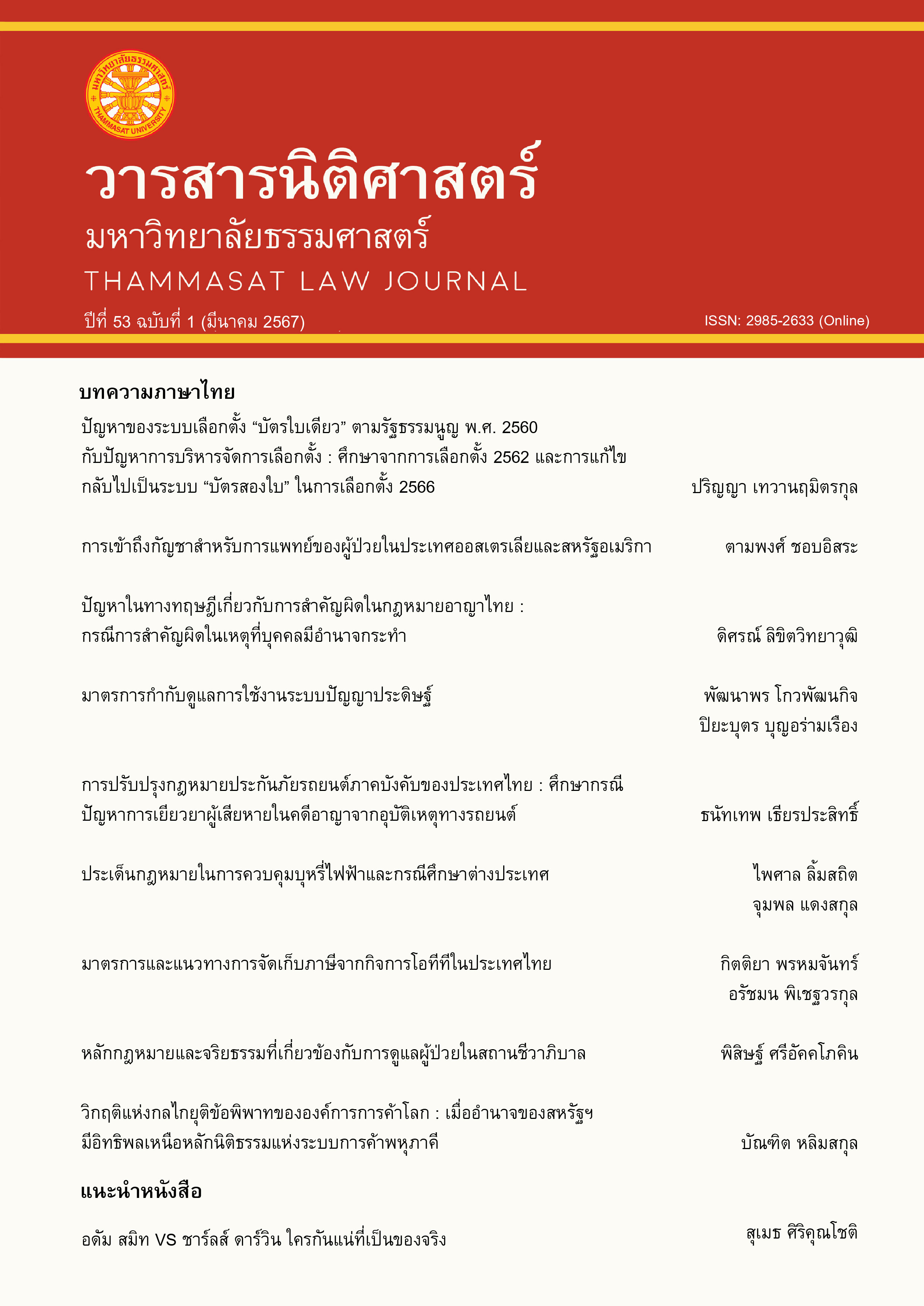
Problems with the 'One-Ballot' Electoral System of the 2017 Constitution and Electoral Management: A Study from the General Election in 2019 and the Reversion Back to the 'Two Ballots System' for the General Election in 2023
Keywords:
one-ballot system, two-ballot system, parallel system, proportional representation, electoral systemAbstract
The general election on March 24, 2019, based on the 2017 Constitution, introduced a new electoral system and several significant changes on election management. The purposes of this research were to evaluate and study the new system and to recommend how to improve the electoral system and election management of Thailand. Regarding the electoral system, according to the 2017 Constitution, there are Members of Parliament (MPs) elected through a majority principle in constituencies, as well as MPs from the party list through proportional representation. However, the election for party list MPs no longer existed. The number of MPs a party receives from the party list is now calculated based on the total votes the party’s candidates receive from all constituencies. This system, referred to as the “one-ballot system,” allows voters to cast their vote using only one ballot. However, this system has caused numerous problems, particularly the complexity of calculations. There were multiple methods for calculating the results, each leading to different outcomes, which gave certain parties advantages or disadvantages during negotiations to form a coalition. Another issue was the significant increase (4.5 times) in the number of candidates, which resulted in errors for election management.
The “one ballot system” for electing two types of MPs should be changed. The author recommends that Thailand should revert to a “two-ballots system” with two alternatives: (1) the Parallel System, as outlined in the 1997 and 2007 Constitutions, or (2) the Proportional Representation System, where the votes for party list MPs are calculated to determine the number of MPs each party should receive. However, in 2021, an amendment to the 2017 Constitution was passed, which reverted Thailand’s electoral system back to the Parallel System. This system was used in the general election on May 14, 2023. Therefore, it is important to compare and study whether the parallel system is truly suitable for Thailand.
In term of election management, provincial election commissions were abolished and replaced by “provincial election inspectors.” However, according to this study, the provincial election inspectors have proven to be ineffective. And one of the most significant issues with election management was the lack of the candidate names and party affiliations on the ballot papers. This created difficulties for voters, as they had only the candidate numbers to rely on when making their choices. Another problematic aspect was Gerrymandering, which involved the manipulation of constituencies, leading to unfair election. Additionally, the pre-election voting process for voters unable to visit the polling station on election day was overly complicated and caused numerous problems. All of these issues were identified during the 2019 election and continue to persist. Therefore, it is crucial to conduct a study of the election held on May 14, 2023, to improve Thailand’s future election management.
References
ปริญญา เทวานฤมิตรกุล, ‘คำนวณ ส.ส.บัญชีรายชื่อต้องใช้สูตรไหน พระราชบัญญัติประกอบรัฐธรรมนูญว่าด้วยการเลือกตั้ง ส.ส. มาตรา 128 ขัดรัฐธรรมนูญอย่างไร?’ (The Standard, 2562).
ปริญญา เทวานฤมิตรกุล, โครงการวิจัยประเมินผลการจัดให้มีการเลือกตั้งสมาชิกสภาผู้แทนราษฎรเป็นการทั่วไป พ.ศ. 2562 (สำนักงานคณะกรรมการการเลือกตั้ง 2562).
ปริญญา เทวานฤมิตรกุล, ‘ประเด็นสำคัญที่พึงมีและควรแก้ไขตามรัฐธรรมนูญแห่งราชอาณาจักรไทย พ.ศ.2560 : การได้มาซึ่งสมาชิกสภาผู้แทนราษฎร’ (สถาบันพระปกเกล้า, 2565).
ปริญญา เทวานฤมิตรกุล, ‘ปัญหาของระบบเลือกตั้งตามรัฐธรรมนูญ พ.ศ. ๒๕๕๐’ (ที่ประชุมวิชาการประจำปี คณะนิติศาสตร์ มหาวิทยาลัยธรรมศาสตร์) 17 ธันวาคม 2550).
Andrew Reynolds, Electoral System Design : the New International IDEA Handbook (International IDEA, 2004).
Downloads
Published
Issue
Section
License
Copyright (c) 2024 Thammasat Law Journal

This work is licensed under a Creative Commons Attribution-NonCommercial-NoDerivatives 4.0 International License.
The manuscripts published in the Law Journal is the copyright of the Law Journal, Thammasat University
Any article or opinion appeared in the Law Journal will solely be under the responsibility of the author The Faculty of Law, Thammasat University and the editors do not need to reach in agreement or hold any responsibility.

