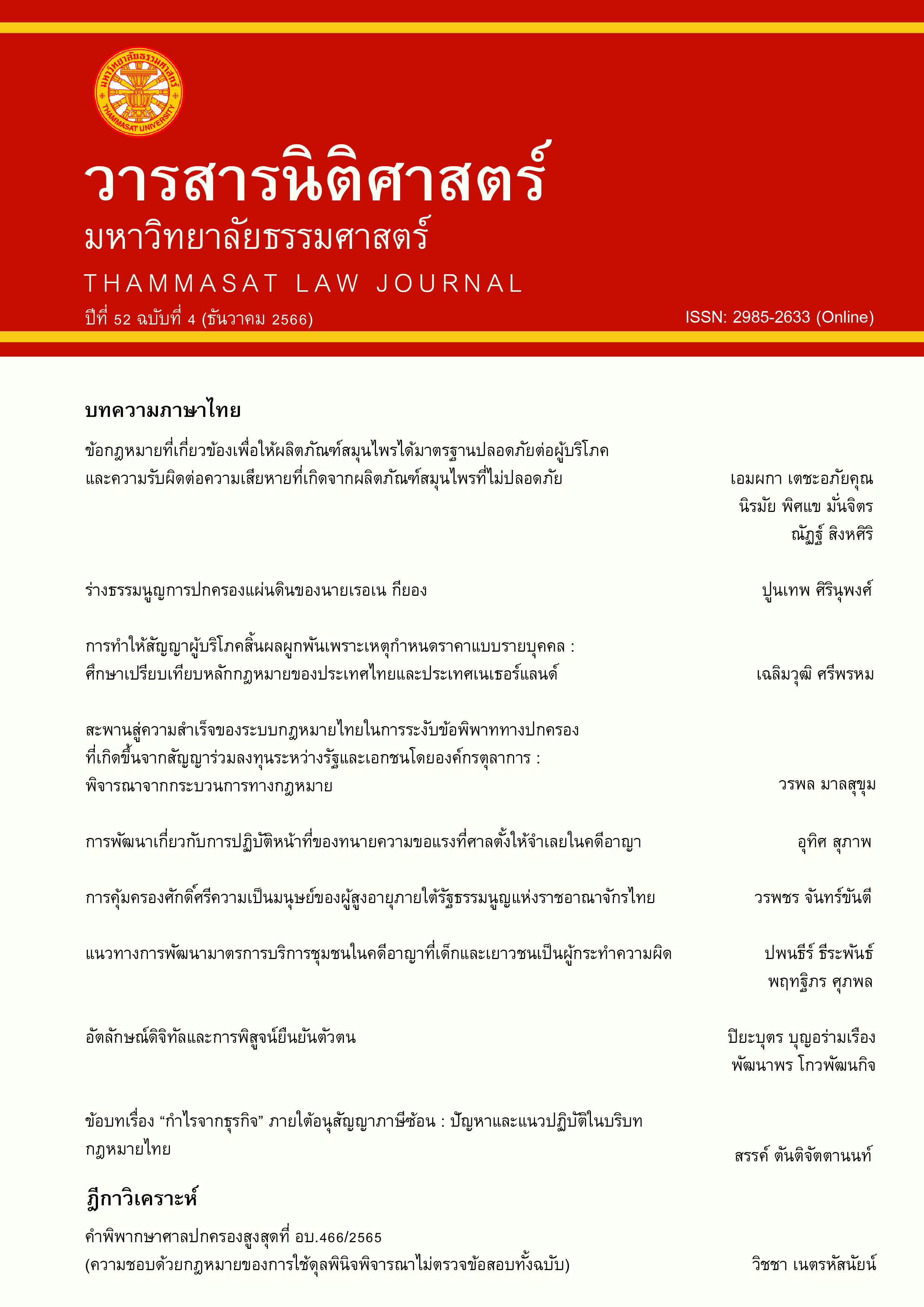
The Relevant Laws Concerning the Standardization of Herbal Products to Ensure Consumer Safety and Address Liability for Harm Caused by Unsafe Herbal Products
Keywords:
herbal product, consumer, responsibility, damageAbstract
The use of herbal products for health benefits is increasingly popular and widespread. Consequently, Thailand has enacted the Herbal Product Act of 2019 to control, regulate, and oversee the production of herbal products, ensuring quality and standards. However, the law does not explicitly address liability and the process of compensation for consumers who experience harm from using unsafe herbal products. This legal issue highlights the need to safeguard consumer safety, define legal responsibilities, and establish processes for compensating individuals harmed by the use of unsafe herbal products in the future.
References
คำพิพากษาศาลฎีกาที่ 4829/2558.
คำพิพากษาศาลฎีกาที่ 4567/2561.
นนทวัชร์ นวตระกูลพิสุทธิ์, กฎหมายคุ้มครองผู้บริโภค (พิมพ์ครั้งที่ 2, โครงการตำราและเอกสารประกอบการสอน คณะนิติศาสตร์ มหาวิทยาลัยธรรมศาสตร์ 2563).
มานิตย์ จุมปา, คำอธิบายกฎหมายความรับผิดต่อความเสียหายที่เกิดขึ้นจากสินค้าที่ไม่ปลอดภัย (สำนักพิมพ์แห่งจุฬาลงกรณ์มหาวิทยาลัย 2554).
สำนักงานคณะกรรมการกฤษฎีกา, ‘บันทึกสำนักงานคณะกรรมการกฤษฎีกาประกอบร่างพระราชบัญญัติความรับผิดต่อความเสียหายที่เกิดขึ้นจากสินค้าที่ไม่ปลอดภัย พ.ศ. ... เรื่องเสร็จที่ 525/2550'.
อุดม รัฐอมฤต, คeอธิบายกฎหมายลักษณะพยานหลักฐาน (พิมพ์ครั้งที่ 8, สำนักพิมพ์วิญญูชน 2563).
เอมผกา เตชะอภัยคุณ และคณะ, ‘การศึกษาถอดบทเรียนการดำเนินคดีผู้บริโภคในประเทศไทยโดยการมีส่วนร่วมขององค์กรภาคประชาสังคม โครงการวิเคราะห์ระบบการคุ้มครองผู้บริโภคด้านกฎหมายประเด็นการคุ้มครองสิทธิผู้บริโภคของประเทศไทยและการพัฒนากลไกทางกฎหมายที่เพิ่มประสิทธิภาพการคุ้มครองผู้บริโภค’ (รายงานผลการวิจัยเสนอต่อสภาองค์กรของผู้บริโภค 2566).
เอื้ออารีย์ อิ้งจะนิล, หลักกฎหมายมหาชนทางเศรษฐกิจ (สำนักพิมพ์วิญญูชน 2566).
Australian Competition & Consumer Commission, ‘Mandatory standards’ <https://www.productsafety.gov.au/product -safety-laws/safety-standards-bans/mandatory-standards> สืบค้นเมื่อ 14 สิงหาคม 2566.
Hyeong Gun Lee, Eileen Jaiyoung Shin and Hyun Ah Song, ‘Pharmaceutical Advertising Laws and Regulations Korea 2022-2023’ (ICLG, 13 July 2022) <https://iclg.com/practice-areas/pharmaceutical-advertising-laws-and-regulations/korea> สืบค้นเมื่อ 14 สิงหาคม 2566.
Lorraine Conway, ‘Consumer protection: Unfair Trading Regulations’ (House of Commons Library, 26 November 2021) <https://researchbriefings.files.parliament.uk/documents/SN04678/SN04678.pdf> สืบค้นเมื่อ 23 พฤษภาคม 2566.
Medicines and Healthcare Products Regulatory Agency (MHRA), 'A guide to what is a medicinal product' (2020) <https://assets.publishing.service.gov.uk/government/uploads/system/uploads/attachment_data/file/872742/GN8_FINAL_10_03_2020__combined_.pdf> สืบค้นเมื่อ 14 สิงหาคม 2566.
Ministry of Food and Drug Safety, ‘Biopharmaceuticals and Herbal Medicines Bureau’ (mfds.go.kr) <https://www.mfds.go.kr/eng/wpge/m_22/de011012l001.do> สืบค้นเมื่อ 14 สิงหาคม 2566.
Peter Cartwright, ‘Redress Compliance and Choice: enhanced consumer measures and retreat from punishment in the consumer rights Act 2015’ (2016) 75 (2) Cambridge Law Journal 281.
Rod Freeman, Edward Turtle, Claire Temple, Sarah-Jane Dobson and Carol Roberts, ‘Product liability and safety in the UK (England and Wales): overview’ (Thomson Reuters, 11 July 2020) <https://uk.practicallaw.thomsonreuters.com/w-013-0564?transitionType=Default&contextData=(sc.Default)&firstPage=true#co_anchor_a992349> สืบค้นเมื่อ 23 พฤษภาคม 2566.
Therapeutic Goods Administration (TGA), 'Australian regulatory guidelines for complementary medicines' (2018) <https://www.tga.gov.au/sites/default/files/australian-regulatory-guidelines-complementary-medicines-argcm.pdf> สืบค้นเมื่อ 14 สิงหาคม 2566.
Wolrd Health Organization, 'WHO global report on traditional and complementary medicine' (2019) <https://apps.who.int/iris/handle/10665/312342> สืบค้นเมื่อ 14 สิงหาคม 2566.
Hastings v Finsbury Orthopaedics Ltd and Anor [2022] UKSC 19.
Downloads
Published
Issue
Section
License
Copyright (c) 2023 Thammasat Law Journal

This work is licensed under a Creative Commons Attribution-NonCommercial-NoDerivatives 4.0 International License.
The manuscripts published in the Law Journal is the copyright of the Law Journal, Thammasat University
Any article or opinion appeared in the Law Journal will solely be under the responsibility of the author The Faculty of Law, Thammasat University and the editors do not need to reach in agreement or hold any responsibility.

