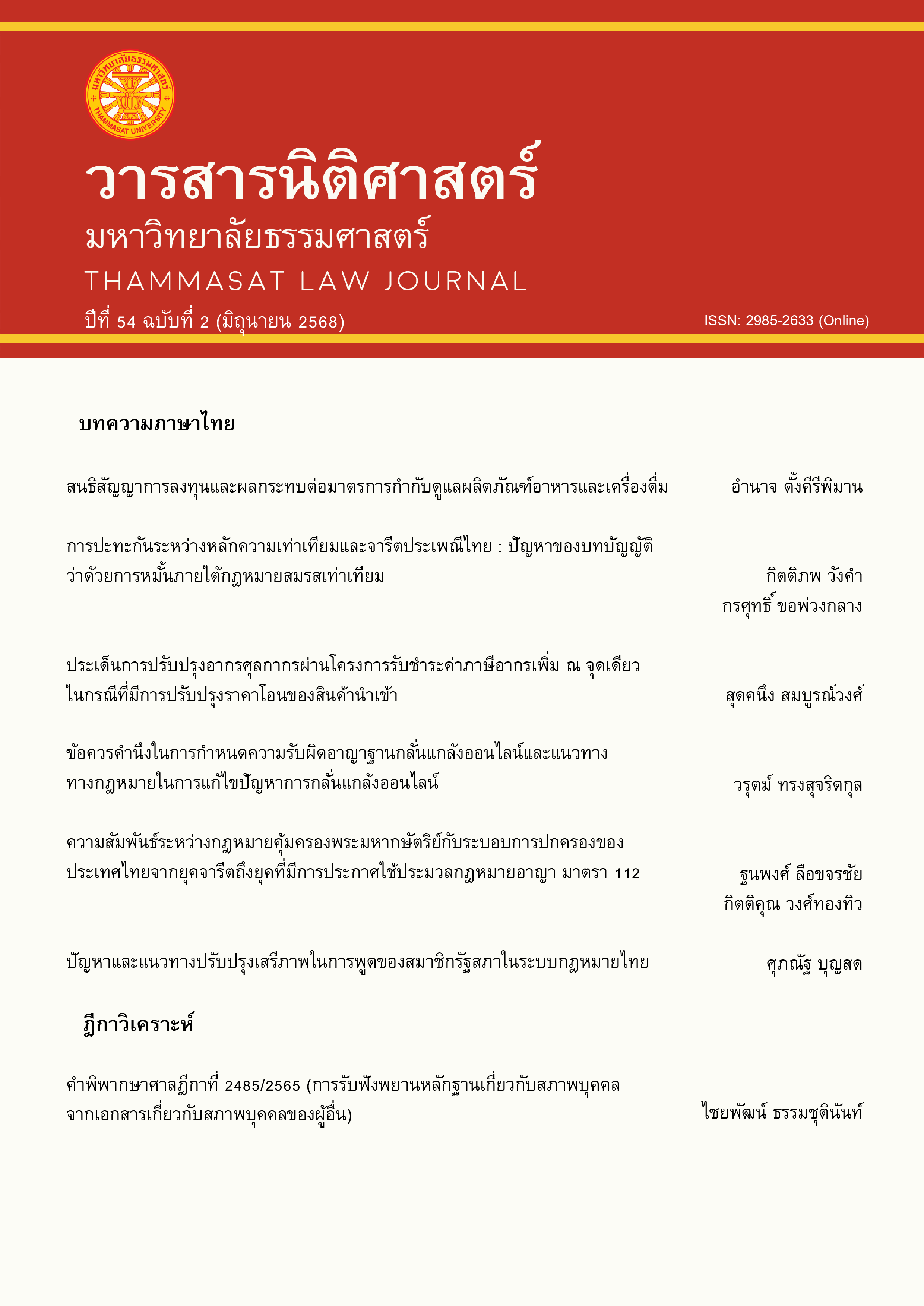
ปัญหาและแนวทางปรับปรุงเสรีภาพในการพูดของสมาชิกรัฐสภาในระบบกฎหมายไทย
Keywords:
Freedom of Speech of a member of parliament, National assembly of Thailand, DemocracyAbstract
Freedom of speech is a fundamental privilege and immunity that plays a crucial role in enabling members of parliament to perform their duties of debate and voting freely without interference from other institutions. This privilege ensures that statements made by members of parliament during parliamentary or committee meetings cannot be subject to legal proceedings in court. In Thailand, the constitution has recognized the privilege and immunity regarding the freedom of speech of parliamentary members since the Provisional Constitution of the Kingdom of Siam, B.E. 2475 (1932), up to the current Constitution of the Kingdom of Thailand, B.E. 2560 (2017). However, this privilege and immunity have evolved over time, reflecting the decline of democratic governance in Thailand. These developments can be categorized into three periods: The First Period: Under the Provisional Constitution of the Kingdom of Siam, B.E. 2475 (1932), the privilege and immunity of freedom of speech for parliamentary members were absolute, covering only their statements and voting in parliament. The Second Period (1932–1992): During this time, the privilege and immunity of parliamentary members were expanded to provide absolute protection to parliamentary committees and individuals involved in parliamentary processes. The Third Period (1992–Present): The privilege and immunity of parliamentary members’ freedom of speech have become less absolute. If parliamentary sessions are broadcast via radio, television, or other media, and if the statements made by members during these sessions severely violate ethical standards or constitute legal offenses, especially if they involve defamatory remarks against external individuals, such statements may be used as grounds for legal action in court by affected individuals.
References
ภาษาอังกฤษ
Paul Evan, ‘Privilege, Exclusive Cognisance and the Law’ in Alexander Horne and Gavin Drewry (eds) Parliament and the Law (Hart Publishing 2018)
Bui Ngoc Son and Kevin Tan (eds) Constitutional Foundings in Southeast Asia (Hart Publishing 2019)
Economist intelligence unit (EIU), Democracy index 2024: what’s wrong with representative democracy? 2024.
Elena Griglio, Parliamentary Oversight of the Executives: Tools and Procedures in Europe (Hart Publishing 2022)
UNHRC ‘General comment No. 34’ (12 September 2011) UN Doc CCPR/C/GC/34.
The Leader of the House of Commons and others, Parliamentary privilege, (The Stationery Office Limited 2012)
Hans kelsen, The Essence and Value of Democracy (Nadia Urbinati and Carlo Invernizzi Accetti eds, Brian Graf tr, Rowman & Littlefield, Inc, 2013)
J.P. Joseph Maingot, Parliamentary privilege in Canada (Mcgill-Gueen’s University Press, 1982)
Marc Van der Hulst, ‘The Parliamentary mandate: A global comparative study’ (Submitted to Inter-Parliamentary Union Geneva 2000)
Marilla Crespo Allen. Parliamentary immunity in the Member States of the European Community and in the European parliament, Working papers submitted at European parliament. Luxemburg. 1993.
Weizhong Yi, ‘Research on parliamentary privilege’ (Doctor of Law Thesis Humboldt-University 1972) .
ภาษาไทย
เดือน บุนนาค และไพโรจน์ ชัยนาม, คำอธิบายรัฐธรรมนูญ (รวมทั้งกฎหมายการเลือกตั้งด้วย) (ภาค 2 รัฐธรรมนูญสยาม,นิติสาส์น 2477)
The Momentum, ‘‘ชวน’ ปิดไมค์ ‘อมรัตน์’ ไม่ให้อภิปรายเรื่องสถาบันฯ ย้ำหน้าที่ประธานต้องรักษากฎระเบียบ’ (มปป.) <https://themomentum.co/report-chuan-mic/> สืบค้นเมื่อ 30 มิถุนายน 2567.
คำพิพากษาชั้นวินิจฉัยอุทธรณ์ ศาลฎีกาที่ อม.9/2566.
คำพิพากษาศาลฎีกา แผนกคดีอาญาของผู้ดำรงตำแหน่งทางการเมืองที่ คจม.1/2567.
คำพิพากษาศาลฎีกาที่ 1927/2528.
คำพิพากษาศาลฎีกาที่ 1927/2528.
คำพิพากษาศาลฎีกาที่ 5730/2550.
คำพิพากษาศาลฎีกาที่ 5782/2540.
คำวินิจฉัยศาลรัฐธรรมนูญที่ 3/2567.
บวรศักดิ์ อุวรรณโณ, ‘ปัญหาการตีความรัฐธรรมนูญและทฤษฎีความเป็นกฎหมายสูงสุดของรัฐธรรมนูญ’ (2527) ฉบับที่ 3 วารสารนิติศาสตร์, 1 – 41.
สภาผู้แทนราษฎร, รายงานการประชุมชุดที่ 25 ปีที่ 3 ครั้งที่ 16 (31 กันยายน 2564 - 3 สิงหาคม 2564)
—— รายงานการประชุมชุดที่ 25 ปีที่ 3 ครั้งที่ 16 เล่มที่ 2 (31 สิงหาคม 2564 - 3 กันยายน 2564)
หยุด แสงอุทัย, คำอธิบายรัฐธรรมนูญแห่งราชอาณาจักรไทย (พ.ศ. 2511) เรียงมาตรา และคำอธิบายรัฐธรรมนูญทั่วไปโดยย่อ(บำรุงสาส์น 2511) .
—— หลักรัฐธรรมนูญและกฎหมายเลือกตั้งทั่วไป. กรุงเทพมหานคร: มหาวิทยาลัยธรรมศาสตร์. 2513.
หลวงประเจิดอักษรลักษณ์, กฎหมายรัฐธรรมนูญ (มหาวิทยาลัยวิชาธรรมศาสตร์และการเมือง 2577)
Downloads
Published
Issue
Section
License
Copyright (c) 2025 Thammasat Law Journal

This work is licensed under a Creative Commons Attribution-NonCommercial-NoDerivatives 4.0 International License.
The manuscripts published in the Law Journal is the copyright of the Law Journal, Thammasat University
Any article or opinion appeared in the Law Journal will solely be under the responsibility of the author The Faculty of Law, Thammasat University and the editors do not need to reach in agreement or hold any responsibility.

