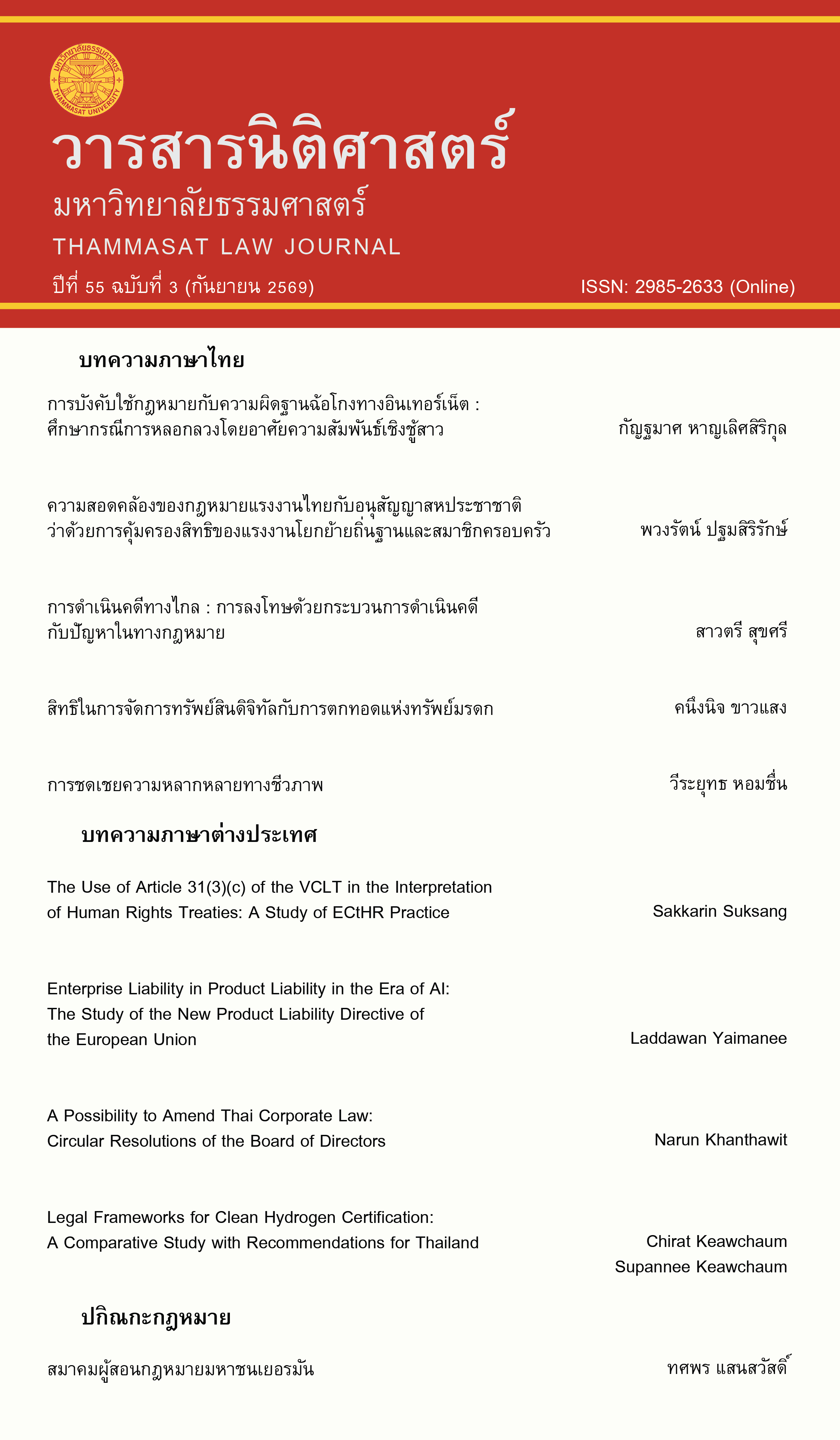
Enterprise Liability in Product Liability in the Era of AI: The Study of the New Product Liability Directive of the European Union
Keywords:
AI, Artificial Intelligence, enterprise liability, product liability, European Union, AI liabilityAbstract
Artificial intelligence (AI) represents a novel innovation on a global scale, providing significant convenience across various aspects of human life. However, the unique characteristics of AI—its complexity, opacity, and autonomy from human control—fundamentally distinguish it from traditional products. These distinct features inevitably lead to new and complex legal challenges regarding liability, diverging significantly from the conventional frameworks established under existing legal systems. Consequently, it is essential to reconsider and reform the legal framework governing liability for defective products and services in light of these technological advancements.
This article focuses on analysing the theory of enterprise liability in relation to defective products, particularly those involving AI. It examines how enterprise liability might be applied to AI-related harms. The legal framework of the European Union Directive 2024/2853 on product liability serves as the primary case study, investigating the extent to which the EU Directive aligns with the principles of enterprise liability and how theoretical foundations have been utilised to inform recent reforms.
The analysis also examines the EU’s recent reforms aimed at addressing AI-specific challenges, including the redefinition of the term “economic operator,” the expansion of the definition of “product” to encompass both tangible and intangible items, and the extension of liability rules to certain services. Furthermore, the article considers presumptions regarding the burden of proof and product defectiveness, which are intended to alleviate evidential difficulties for claimants. These reforms are assessed in terms of both their strengths and limitations.
Subsequently, the article considers whether Thailand should adopt elements of the EU’s approach to revise its Liability for Damages Arising from Unsafe Products Act B.E. 2551 (2008). The findings suggest that Thailand’s legal framework on liability for defective products should be expanded in several key areas. For example, the definition of “economic operator” should be broadened to include businesses involved in the development and provision of AI, the definition of “product” should be extended to cover both movable and immovable items, whether tangible or intangible, and the scope of the law should be broadened to encompass services alongside products. Additionally, Thai law should introduce legal presumptions regarding product defectiveness and shift the burden of proof to the operator in cases involving AI-related products and services. The definition of “damage” should also be expanded to cover non-material harms, such as loss or destruction of data.
Crucially, the Thai legal system must also consider including a “development risks defence” for manufacturers, which would provide an exemption from liability where, at the time of placing the product or service on the market, the risks could not reasonably have been known based on the existing scientific or technical knowledge.
These recommendations aim to align Thai law with the principles of enterprise liability and strike a fair balance between the interests of producers and consumers in the era of artificial intelligence.
References
Calabresi G, The Cost of Accidents : A Legal and Economic Analysis (Yale University Press 1970)
Dignum V, Responsible Artificial Intelligence How to Develop and Use AI in a Responsible Way (Springer 2019)
Keating GC, 'Enterprise Liability: Collective Responsibility and Commutative Justice', Reasonableness and Risk: Right and Responsibility in the Law of Torts (Oxford University Press 2022)
Council B, 'Should robots be citizens?' <https://www.britishcouncil.org/anyone-anywhere/explore/digital-identities/robots-citizens> accessed 31 May 2024
Organisation TEC, 'REVISION OF THE PRODUCT LIABILITY DIRECTIVE Time to ensure effective and comprehensive protection for
consumers damaged by defective products.' <https://www.beuc.eu/sites/default/files/publications/BEUC-X-2023-023_Revision_of_the_product_liability_directive.pdf> accessed 24 October 2023
Technologies TEGoLaN, LIABILITY FOR ARTIFICIAL INTELLIGENCE AND OTHER EMERGING DIGITAL TECHNOLOGIES (European Commission 2019)
Mik E, AI as a Legal Person? (Oxford University Press 2021)
Commission E, Proposal for a Directive of the European Parliament and of the Council on liability for defective products (28 September 2022)
Buiten M, de Streel A and Peitz M, 'The law and economics of AI liability' (2023) 48 Computer Law & Security Review 105794
Chesterman S, 'ARTIFICIAL INTELLIGENCE AND THE LIMITS OF LEGAL PERSONALITY' (2020) 69 International & Comparative Law Quarterly 819
Keating GC, 'The Idea of Fairness in the Law of Enterprise Liability' (1997) 95 Michigan Law Review 1266
Li S, Faure M and Havu K, 'Liability Rules for AI-Related Harm: Law and Economics Lessons for a European Approach' (2022) 13 European Journal of Risk Regulation 618
Bauer M, ECIPE Webinar: The Economic Impacts of the Reform of the EU’s Product Liability Directive (The European Centre for International Political Economy 25 May 2023)
Directive (EU) 2024/2853 of the European Parliament and of the Council of 23 October 2024 on liability for defective products and repealing Council Directive
, 'OPEN LETTER TO THE EUROPEAN COMMISSION ARTIFICIAL INTELLIGENCE AND ROBOTICS' (2018) <http://www.robotics-openletter.eu/> accessed 14 Febuary 2023
Mucci T, 'What is an AI developer?' (IBM, 2025) <https://www.ibm.com/think/topics/ai-developer> accessed 17 May 2025
OpenAI, 'Our structure' (OpenAI, 2025) <https://openai.com/our-structure/> accessed 10 May 2025
Downloads
Published
Issue
Section
License
Copyright (c) 2026 Thammasat Law Journal

This work is licensed under a Creative Commons Attribution-NonCommercial-NoDerivatives 4.0 International License.
The manuscripts published in the Law Journal is the copyright of the Law Journal, Thammasat University
Any article or opinion appeared in the Law Journal will solely be under the responsibility of the author The Faculty of Law, Thammasat University and the editors do not need to reach in agreement or hold any responsibility.

