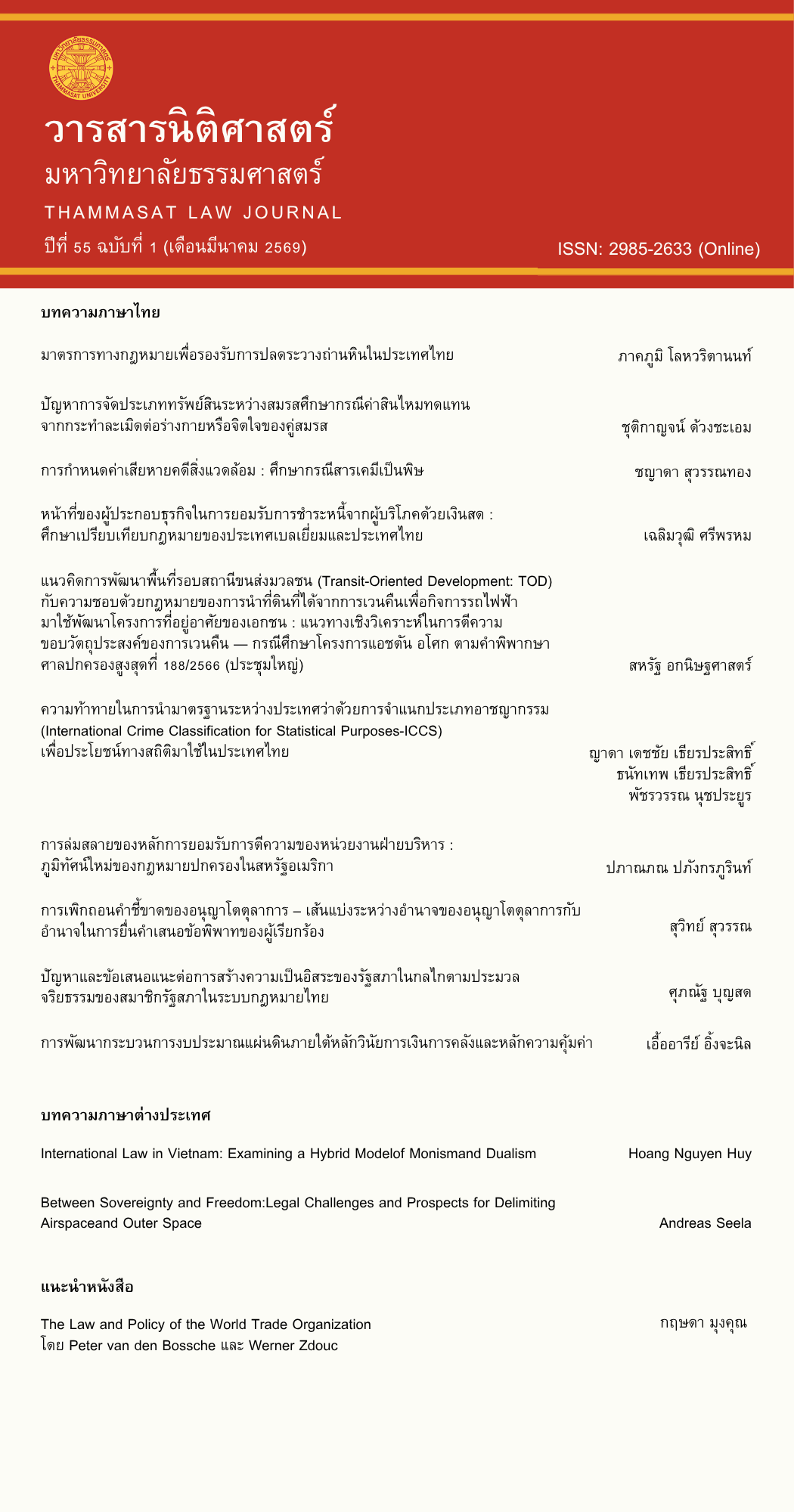
Legal measures for supporting Coal Phase-out in Thailand
Keywords:
coal phase-out, power generation, sustainable development, just transition, climate changeAbstract
Currently, every region around the world is facing the problems of climate change. They will inevitably affect the lives of humans and Thailand is also an affected country by climate the change crisis. For this reason, this has resulted in international cooperation to tackle the problem of global climate change called the Paris Agreement. According to the Paris Agreement, a global goal has been set to attempt to control the increase in temperature to not more than 1.5 degrees Celsius compared to pre-industrial periods. To achieve this goal, every country in the world must work together to reduce greenhouse gas emissions to net zero by the middle of this century. One of many measures that some countries adopt to help reduce greenhouse gas emissions is the abandonment of using coal as a fuel for power generation. However, banning coal will inevitably affect labour and employment related to coal power plants. Therefore, when developing legal measures to support the coal phase-out, just transition shall be taken into account.
This research aims to investigate whether legal measures in Thailand are currently sufficient to facilitate the coal phase-out and, if so, to what extent the pathways for improving or amending Thailand's laws to support the concrete coal phase-out and achieve sustainable development goals are. The methodology employed in the research is based on desk-based analysis emphasising two legal techniques; doctrinal analysis coupled with comparative analysis of law. A comparative study of laws is conducted by comparing Thai law with German law and Canadian law. It mainly uses documentary research to study information from international conventions, relevant Thai and international laws and policies, books, articles, statistical data, reports, and other documents and information in online databases. These are used to analyse and develop proposals for improving Thai laws regarding coal phase-out.
The research study found that the current government policy to phase out of using coal in Thailand still needs more clarity. It inevitably makes banning coal as a fuel for electricity production impossible. The government should, therefore, clearly provide a policy for the abandonment of coal for use as a fuel for electricity production in the national policy. Furthermore, specific legislation should be enacted to support the coal phase-out policy. Such law should consist of two essential parts; firstly, it should include measures to accelerate the coal phase-out. Secondly, the law should provide measures to support a just transition for affected workers. In addition, the government should promote more use of renewable energy for generating power to replace the ban on the coal use to ensure it does not affect the national energy security.
Downloads
Published
Issue
Section
License
Copyright (c) 2026 Thammasat Law Journal

This work is licensed under a Creative Commons Attribution-NonCommercial-NoDerivatives 4.0 International License.
The manuscripts published in the Law Journal is the copyright of the Law Journal, Thammasat University
Any article or opinion appeared in the Law Journal will solely be under the responsibility of the author The Faculty of Law, Thammasat University and the editors do not need to reach in agreement or hold any responsibility.

