
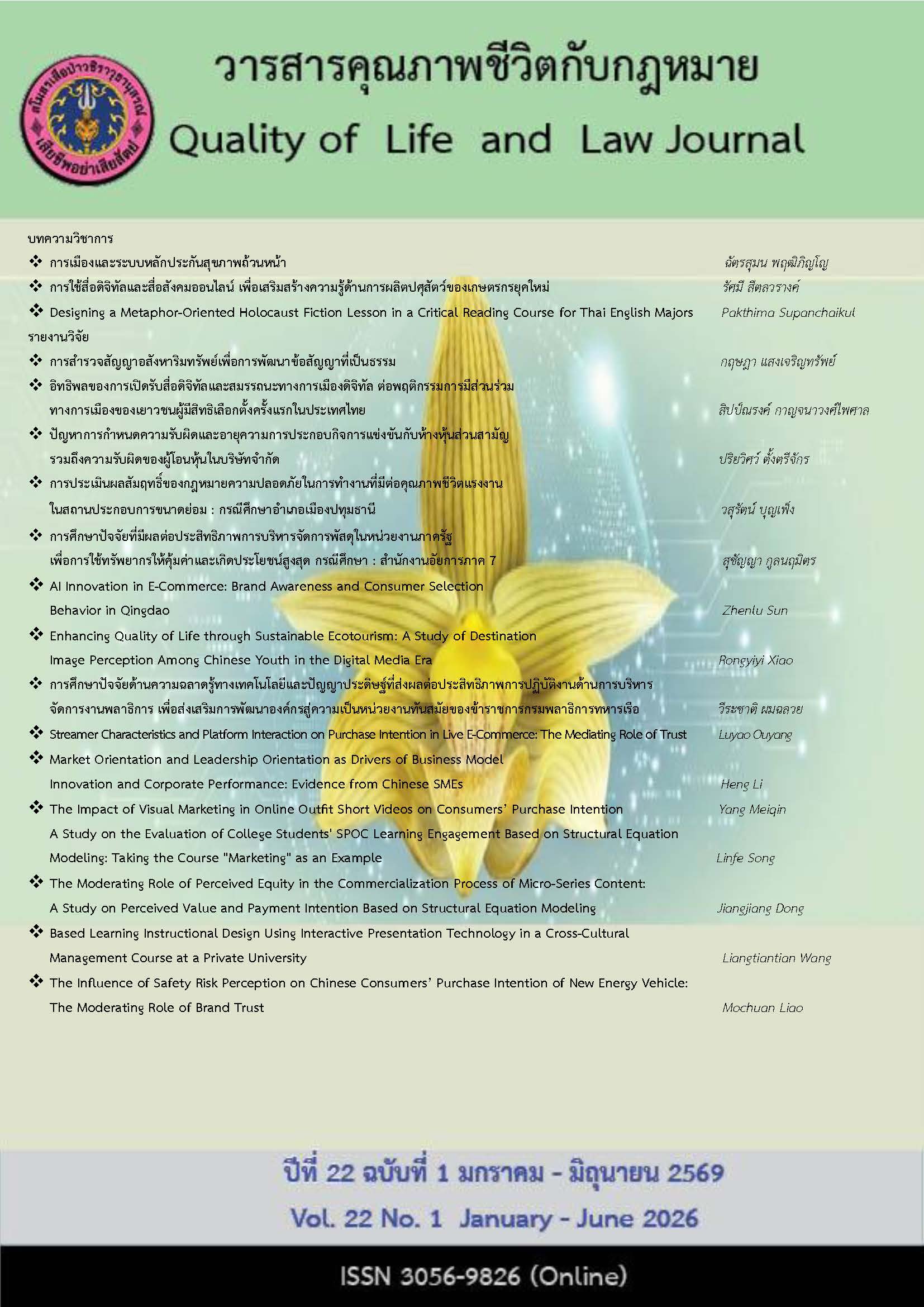
The Influence of Digital Media Exposure and Digital Political Competence on the Political Participation of First-time Voters in Thailand
Article Sidebar
Main Article Content
Abstract
The objectives of this research were to examine the consistency of a causal model of factors influencing the political participation of first-time voters in Thailand with empirical data, to analyze the mediating effects of digital political competence and political attitudes on the relationship between digital media exposure and political participation, to test the measurement invariance of the political behavior model across multi-groups between first-time voters in Bangkok and regional areas, and to propose policy recommendations for enhancing digital citizenship and appropriate political communication mechanisms for Thai youth based on empirical evidence. A quantitative approach was employed, collecting data from 700 voters nationwide via a multi-stage, systematic sampling design. Data were analyzed using Structural Equation Modeling (SEM) and Multi-group Analysis.
The results indicated that the causal model provided an excellent fit to the empirical data (χ²/df = 1.854, GFI = 0.962, CFI = 0.985, TLI = 0.978, RMSEA = 0.042, SRMR = 0.031). Digital media exposure exerted a significant direct effect on political participation and a significant indirect effect through digital political competence and political attitudes, functioning as partial mediators. Furthermore, the measurement invariance test confirmed scalar invariance across groups, with no significant differences in causal paths between urban and regional cohorts.
These findings lead to policy recommendations emphasizing proactive digital competence development and political attitude adjustment to foster sustainable digital citizenship.
Article Details

This work is licensed under a Creative Commons Attribution-NonCommercial-NoDerivatives 4.0 International License.
- บทความหรือข้อคิดเห็นใดๆ ในวารสารคุณภาพชีวิตกับกฎหมายเป็
- กองบรรณาธิการไม่สงวนสิทธิ์
References
เกศนรินทร์ อัยกร. (2565). ความเชื่อมั่นของประชาชนต่อองค์กรปกครองส่วนท้องถิ่น: แนวคิด ทิศทาง และกลไกการเสริมสร้างในศตวรรษที่ 21. วิทยาการบริหารภาครัฐสมัยใหม่, 3(1), 13–27.
ฐิติพรรณ ธนานันต์วาณิช. (2568). การจัดการภาครัฐในยุคดิจิทัล: แนวทางและความท้าทาย. วารสารพุทธนวัตกรรมและการจัดการ, 8(4), 293–305.
ปวรนันท์ ธัมมัญญุตานันท์. (2568). บทบาทของสื่อสังคมออนไลน์ในการขับเคลื่อนประเด็นสาธารณะและการเปลี่ยนแปลงทางสังคม. วารสารสหวิทยาการ มหาวิทยาลัยชินวัตร, 2(3), 69–89.
วีรศักดิ์ จินารัตน์. (2567). ผลกระทบของการใช้สื่อสังคมที่มีผลต่อความรอบรู้ทางการเมืองและการมีส่วนร่วมทางการเมืองของกลุ่มคนเจเนอเรชัน Y และ Z ในประเทศไทย. Journal of Arts Management, 8(2), 547–563.
เสกศักดิ์ อยู่ดี จิรวัฒน์ ศรีเรือง ประกฤษฎิ์ รักษ์วงศ์. (2568). การเมืองในยุคดิจิทัล. วารสารสังคมศาสตร์และวัฒนธรรม, 9(4), 199–212.
สำนักงานคณะกรรมการการเลือกตั้ง. (2566). รายงานผลการเลือกตั้งสมาชิกสภาผู้แทนราษฎรเป็นการทั่วไป พ.ศ. 2566. https://www.ect.go.th/
สำนักบริหารการทะเบียน กรมการปกครอง กระทรวงมหาดไทย. (2565). สถิติจำนวนประชากรจำแนกตามช่วงอายุ รายจังหวัด ประจำปี พ.ศ. 2565. https://stat.bora.dopa.go.th/
อธิวัฒน์ สอนเนย ธนบดี แจ่มแจ้ง. (2568). อิทธิพลของการเปิดรับสื่อและการรู้เท่าทันสื่อต่อพฤติกรรมการสื่อสารทางการเมืองของประชาชน ในภาคเหนือตอนล่างของประเทศไทย. วารสารสหศาสตร์การพัฒนาสังคม, 3(4), 1036–1053.
Ajzen I. (1991). The theory of planned behavior. Organizational Behavior and Human Decision Processes, 50(2), 179–211. https://doi.org/10.1016/0749-5978(91)90020-T
Bennett W. L., Segerberg, A. (2013). The logic of connective action: Digital media and the personalized politics of collective action. Cambridge University Press. https://doi.org/10.1017/CBO9781139196147
Boulianne, S. (2020). Twenty years of digital media effects on civic and political participation. Communication Research, 47(7), 947–966. https://doi.org/10.1177/0093650218808186.
Cheung G. W., Rensvold R. B. (2002). Evaluating goodness-of-fit indexes for testing measurement invariance. Structural Equation Modeling: A Multidisciplinary Journal, 9(2), 233–255. https://doi.org/10.1207/S15328007SEM0902_5.
Gil de Zúñiga H., Veenstra A., Vraga E., Shah D. (2010). Digital democracy: Reimagining pathways to political participation. Journal of Information Technology & Politics, 7(1), 36–51. https://doi.org/10.1080/19331680903316742.
Hair J. F., Black W. C., Babin, B. J., Anderson R. E. (2019). Multivariate data analysis (8th ed.). Cengage Learning.
Kanchanawongpaisan S., Paijit C. (2024). Navigating the Future of Quantitative Research: The Power of Structural Equation Modeling. Multidisciplinary Journal of Shinawatra University, 1(3), 1–13.
Kenski K., Stroud N. J. (2006). Connections between Internet use and political efficacy, knowledge, and participation. Journal of Broadcasting & Electronic Media, 50(2), 173–192. https://doi.org/10.1207/s15506878jobem5002_1.
Norris P. (2001). Digital divide: Civic engagement, information poverty, and the Internet worldwide. Cambridge University Press. https://doi.org/10.1017/CBO9781139164887.
Verba S., Schlozman K. L., Brady H. E. (1995). Voice and equality: Civic voluntarism in American politics. Harvard University Press.
Vraga E. K., Thorson K., Kligler-Vilenchik N., Choi A. B. (2015). Feeling qualified, taking action: The role of political efficacy in making sense of the 2012 election in social media. New Media & Society, 17(8), 1333–1350. https://doi.org/10.1177/1461444814521438.
Xenos M., Vromen A., Loader B. D. (2014). The great equalizer? Patterns of social media use and youth political engagement in three advanced democracies. Information, Communication & Society, 17(2), 151–167. https://doi.org/10.1080/1369118X.2013.871318.
