The Investigation of Problems and Translation Strategies from Thai into English of Sakon Nakhon Rajabhat University Students
DOI:
https://doi.org/10.57260/csdj.2025.269252Keywords:
Translation strategies, Translation problemsAbstract
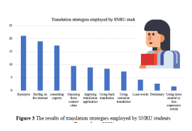
The main objectives of this study were to explore the difficulties that SNRU students encountered when translating sentences and to examine the translation strategies they used when translating from Thai into English. Using the purposive sampling method, 74 SNRU students were chosen to participate in this study. These students were divided into three major disciplines of study: 32 B.E. students, 21 B.A. students, and 21 B.Ed. students. Semi-structured interview questions and a questionnaire were used to collect data. The questionnaire was used to examine quantitative data, which was then presented as percentages. Content analysis was used to analyze qualitative data which are collected from semi-structured interview. Three inter-raters were asked to verify data from the semi-structured interview. The findings showed that five types of translation issues were identified. Word choice problems were the most common, accounting for 30%, followed by grammatical issues at 24.75%. Rhetorical and cultural translation challenges were also frequently encountered, making up 17.36%. Pragmatic problems were the least frequent, representing 10.60% of the issues. In addition, the study identified several strategies used by participants to overcome translation challenges, some of which were innovative while others were familiar. In comparison to the other newly revealed strategies, the most common strategy was translating using internet resources.
Downloads
References
ASEAN Secretariat. (2021). ASEAN Digital Integration Index Report 2021. ASEAN Secretariat. Retrieved from https://asean.org/book/asean-digital-integration-index-report-2021/
Baker, M. (1992). In other words: A course book of translation. New York: Routledge.
Boonyasaquan, S. (2006). An analysis of collocational violations in translation. Journal of Humanities, 27(2), 79-91. Retrieved from https://ejournals.swu.ac.th/index.php/hm/article/view/618
Chanthong, P., & Kaowiwattanakul, S. (2024). A Study of Strategies for Translating English Idioms in Subtitles from Riverdale Series into Thai. World Journal of English Language, 14(3), 231-241. Retrieved from https://www.sciedupress.com/journal/index.php/wjel/article/view/24879
Crystal, D. (2003). English as a Global Language. Cambridge University Press.
Erlingsson, C., & Brysiewicz, P. (2017). A Hands-on Guide to Doing Content Analysis. African Journal of Emergency Medicine, 7(3), 93-99. Retrieved from https://www.sciencedirect.com/science/article/pii/S2211419X17300423?via%3Dihub
Farghal, M., & Obeidat, H. (1995). Collocations: A neglected variable in EFL. IRAL – International Review of Applied Linguistics in Language Teaching, 33(4), 315–331. Retrieved from https://www.degruyterbrill.com/document/doi/10.1515/iral.1995.33.4.315/html
Graddol, D. (2006). English Next: Why Global English May Mean the End of 'English as a Foreign Language'. British Council.
Huang, L. S. (2001). Knowledge of English collocations: An analysis of Taiwanese EFL learners. Texas Papers in Foreign Language Education, 6(1), 113-132. Retrieved from https://eric.ed.gov/?id=ED465288
House, J. (2014). Translation Quality Assessment: Past and Present. Routledge.
Junining, E., & Kusuma, V. A. M. C. (2020). Translation Strategies for Translating a News Article. LiNGUA, 15(1), 80-90. Retrieved from https://ejournal.uin-malang.ac.id/index.php/humbud/article/view/9562
Kiraly, D. (2014). A Social Constructivist Approach to Translator Education: Empowerment from Theory to Practice. St. Jerome Publishing.
Koonkaew, A. (2019). New Measurement and evaluation. Bangkok: Chulalongkorn University Press.
Laksana, S. (2016). How to Write Good Research Proposal and Research Report. Retrieved from http://www.education.au.edu/wpcontent/uploads/2016/09/HowWriteResearch2016.pdf
Laviosa, S. (2014). Translation and Language Education: Pedagogic Approaches Explored. Routledge.
Mathieu, P. (2003). Teaching translation: Towards a basic methodology. (In B. J. Baer & K. Koby, Trans.). Kent, Ohio: Kent State University Press.
Mellinger, C. D., & Thomas, A. H. (2017). Quantitative Research Methods in Translation and Interpreting Studies. London, Routledge.
Napu, N., & Hansan, R. (2019). Translation Problems Analysis of Students’ Academic Essay. International Journal of Linguistics, Literature and Translation (IJLLT), 2(5), 1-11. Retrieved from https://www.neliti.com/publications/290347/translation-problems-analysis-of-students-academic-essay
Newmark, P. (1988). Approaches to Translation. London: Phoenix.
Sneddon, J. (2003). The Indonesian Language, Its History and Role in Modern Society. Sydney: NSW Press.
Wankong, A. (2016). English Teaching in the 21st Century. Journal of Yanasangvorn Research Institute, 7(2), 303-314. Retrieved from https://so04.tci-thaijo.org/index.php/yri/article/view/184935
Downloads
Published
How to Cite
Issue
Section
Categories
License
Copyright (c) 2025 Community and Social Development Journal

This work is licensed under a Creative Commons Attribution-NonCommercial-NoDerivatives 4.0 International License.