Fostering Cross-Cultural Understanding Through Southeast Asian Multicultural Literature: Insights from Preservice ESL Teachers’ Learning Experiences
DOI:
https://doi.org/10.57260/csdj.2025.275240Keywords:
Cross-cultural understanding, Culturally responsive teaching, Learning experiences, Preservice ESL teachers, Southeast Asian multicultural literatureAbstract
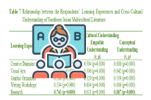
This study investigated the relationship between culturally diverse learning experiences and cross-cultural understanding in the teaching of Southeast Asian multicultural literature among preservice teachers of English as a Second Language (ESL). Guided by the framework of culturally responsive teaching, it examined how specific instructional activities such as creative dramatics, visual arts projects, graphic organizers, writing workshops, and research tasks relate to the critical, empathic, and conceptual dimensions of cross-cultural understanding. The study employed a quantitative descriptive-correlational design and gathered data from 107 preservice ESL teachers enrolled in a state university in the Southern Tagalog region of the Philippines through a validated researcher-made questionnaire. The results indicated that all five learning activities were perceived as highly relevant, with research tasks and creative dramatics receiving the highest mean scores. Cross-cultural understanding was also found to be highly manifested, with empathic and conceptual understanding registering higher levels than critical understanding. Statistical analysis revealed a significant positive relationship between the relevance of culturally diverse learning experiences and the level of cross-cultural understanding. The findings affirm the pedagogical value of integrating culturally responsive strategies in literature instruction to promote intercultural awareness and appreciation. These results suggest that ESL teacher education programs should strengthen the integration of multicultural literature in the curriculum to enhance both literary competence and intercultural competence. Incorporating such approaches in teacher training may better prepare future educators to design inclusive, culturally sensitive learning environments, thereby contributing to the broader goals of equity, respect for diversity, and global citizenship in education.
Downloads
References
Bañez, R. M. (2016). Recency or relevance: A quest for pedagogical framework in teaching Philippine and world literature in senior high school. Asia Pacific Journal of Multidisciplinary Research, 4(4), 78–86. https://www.researchgate.net/publication/363404449
Bañez, R. M. (2024). Rhetorical construct of the self: An exploration of writings of teacher education students with delayed college enrollment. Asia Pacific Journal of Educators and Education, 39(1), 121-142. https://doi.org/10.21315/apjee2024.39.1.5
Bañez, R. M., & Callo, E. C. (2022). ASEAN identity in higher education through literary pedagogy perceived by teaching personnel at universities in Southern Tagalog Region, the Philippines. Humanities, Arts and Social Sciences Studies, 22(3), 1–15. https://so02.tci-thaijo.org/index.php/hasss/article/view/245064
Banks, J. A., & McGee, C. A. (Eds.). (2020). Multicultural education: Issues and perspectives. (10th ed.). Wiley. https://doi.org/10.1080/14675986.2020.1766194
Baumert, J., Becker, M., Jansen, M., & Köller, O. (2023). Cultural identity and the academic, social, and psychological adjustment of adolescents with immigration background. Journal of Youth and Adolescence, 53, 294–315. https://doi.org/10.1007/s10964-023-01853-z
Castellví, J., Díez-Bedmar, M.-C., & Santisteban, A. (2020). Pre-service teachers’ critical digital literacy skills and attitudes to address social problems. Social Sciences, 9(8), 134. https://doi.org/10.3390/socsci9080134
Chattamvelli, R., & Shanmugam, R. (2023). Descriptive statistics for scientists and engineers: Applications in R. Springer. https://doi.org/10.1007/978-3-031-32330-0
Ezell, S., & Daly, A. (2023). Honoring multiple identities using multicultural literature. https://files.eric.ed.gov/fulltext/EJ1367387.pdf
Gilmetdinova, A. M. (2020). Designing multilingual and multicultural curriculum. Vestnik of Samara State Technical University. Psychological and Pedagogical Sciences, 17(3), 6-23. https://doi.org/10.17673/vsgtu-pps.2020.3.1
Hoy, W. K., & Adams, C. M. (2023). Quantitative research in education: A primer. (2nd ed.). SAGE Publications. https://doi.org/10.4135/9781071984307
Karácsony, P., Pásztóová, V., Vinichenko, M. V., & Huszka, P. (2022). The impact of the multicultural education on students’ attitudes in business higher education institutions. Education Sciences, 12(3), 173. https://doi.org/10.3390/educsci12030173
Miksza, P., Shaw, J. T., Richerme, L. K., Hash, P. M., & Hodges, D. A. (2023). Quantitative descriptive and correlational research. In Music education research: An introduction. Oxford University Press. https://doi.org/10.1093/oso/9780197639757.003.0012
Muega, M. A. G. (2016). Inclusive education in the Philippines: Through the eyes of teachers, administrators, and parents of children with special needs. Social Science Diliman: A Philippine Journal of Society and Change, 12(1), 1–24. https://journals.upd.edu.ph/index.php/socialsciencediliman/article/view/5230
Paetsch, J., Heppt, B., & Meyer, J. (2023). Pre-service teachers’ beliefs about linguistic and cultural diversity in schools: The role of opportunities to learn during university teacher training. Frontiers in Education, 8, Article 1236415. https://doi.org/10.3389/feduc.2023.1236415
Rushanthan, S., & Rushanthan, S. (2023). The impact of diverse literary texts on students’ literature knowledge and cultural understanding: A comparative study. International Journal of Advanced Multidisciplinary Research Studies, 3(4), 595–599. https://www.multiresearchjournal.com/download-update/file-archive-1690869623.pdf/id-1472
Tarrayo, V. N., Hernandez, P. S., & Claustro, J. S. (2020). Teachers and research practices: Perspectives from English language educators in a Philippine university. Australian Journal of Teacher Education, 45(12), Article 5. https://doi.org/10.14221/ajte.202v45n12.5
Walker, A. (2023). Transformative potential of culturally responsive teaching: Examining preservice teachers’ collaboration practices centering refugee youth. Education Sciences, 13(6), Article 621. https://doi.org/10.3390/educsci13060621
Yousef, K. (2024). Exploring the impact of cultural diversity in global projects: A comparative analysis of virtual and face-to-face teamwork. International Journal of Cross Cultural Management, 24(2), 411–430. https://doi.org/10.1177/14705958241253754
Zhang, S., & Jin, A. (2025). The empowerment of ideological and political education for youth in the new era through literary and artistic means. Journal of International Education and Development, 9(1), 21–25. https://doi.org/10.47297/wspiedWSP2516-250004.20250901
Downloads
Published
How to Cite
Issue
Section
Categories
License
Copyright (c) 2025 Community and Social Development Journal

This work is licensed under a Creative Commons Attribution-NonCommercial-NoDerivatives 4.0 International License.