Navigating Identity and Education: A Qualitative Study of the Experiences of Muslim Learners in Philippine Public Junior High School
DOI:
https://doi.org/10.57260/csdj.2026.279051Keywords:
Multicultural education, Cultural identity, Minority students, Inclusive education, Religious diversityAbstract
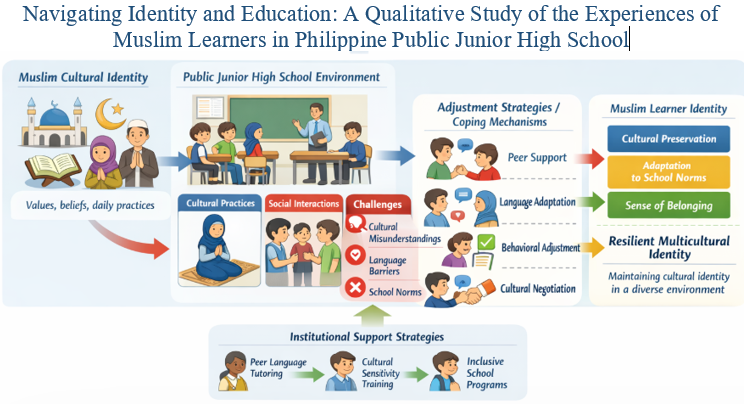
This study explored the lived experiences of Muslim learners in a public junior high school in Tanauan City, Philippines. The research examined how Muslim students navigated their cultural identity, social interactions, and learning experiences within a predominantly non-Muslim school environment. Despite increasing attention to multicultural education, limited research had examined the everyday experiences of Muslim learners in Philippine public schools, particularly outside predominantly Muslim regions. Understanding these experiences was important in a country shaped by a long history of conflict, peace-building initiatives, and ongoing efforts toward social cohesion and inclusive development.
A qualitative research design was employed to capture the participants’ lived experiences. Data were gathered through face-to-face semi-structured interviews were conducted with six Muslim students enrolled at Tanauan City Integrated High School during the 2022–2023 academic year. The data were analyzed through thematic analysis to identify patterns and meanings in the participants’ narratives.
The analysis generated six major themes: cultural practices, social interactions, encountered challenges, adjustment strategies, teachers’ classroom management styles, and school climate. The findings revealed that Muslim culture strongly shaped the learners’ values and daily practices. At the same time, the students experienced cultural misunderstandings, language barriers, and the need to adapt to unfamiliar school norms. Despite these challenges, the learners demonstrated resilience and maintained their cultural identity while interacting with non-Muslim peers and teachers. Their experiences reflected the principles of the Salad Bowl Theory, which emphasized the coexistence of diverse cultural identities within a multicultural society.
This study contributed to the growing literature on multicultural education in the Philippine context by highlighting how minority students negotiated identity, belonging, and adaptation in mainstream school settings. The findings also underscored the role of inclusive educational practices in promoting intercultural understanding, peace, and social harmony. The study recommended peer language tutoring, teacher orientation on cultural sensitivity, and institutional support programs to better address the needs of Muslim learners.
Downloads
References
Abo-Zena, M. M., & Hassan, A. (2024). Reflecting personal, family, and community ethnographies to understand how fasting Ramadan fuels the religious development of Muslim youth. Journal of Islamic Faith and Practice, 5(1), 53-83. https://doi.org/10.18060/28094
Alvarez, A. (2014). The place of culture-based reasons in public debates. Human Affairs, 24(2), 232-247. https://doi.org/10.2478/s13374-014-0222-0
Aslan, S. (2022). An Analysis of the Primary School Teachers' Classroom Management Styles in Terms of Some Variables. International Online Journal of Education and Teaching, 9(2), 955-970. https://iojet.org/index.php/IOJET/article/view/1627
Banks, J. A. (2004). Handbook of research on multicultural education. (2nd ed.). San Francisco, CA: Jossey-Bass.
Berray, M. (2019). A critical literary review of the melting pot and salad bowl assimilation and integration theories. Journal of Ethnic and Cultural Studies, 6(1), 142-151. https://www.jstor.org/stable/48710211
Blanco, K. I. F. (2024). From Alienation to Rootedness: Discrimination against Indigenous Peoples in the Philippines through Education. AUILR, 39(3), 517-545. https://digitalcommons.wcl.american.edu/auilr/vol39/iss3/6
Braun, V., & Clarke, V. (2019). Reflecting on reflexive thematic analysis. Qualitative research in sport, exercise and health, 11(4), 589-597. https://doi.org/10.1080/2159676X.2019.1628806
Butina, M. (2015). A narrative approach to qualitative inquiry. Clinical laboratory science, 28(3), 190-196. https://doi.org/10.29074/ascls.28.3.190
Caingcoy, M. (2023). Culturally responsive pedagogy: A systematic overview. Diversitas Journal, 8(4), 3203-3212. http://dx.doi.org/10.2139/ssrn.4842773
Chen, B., Tabassum, H., & Saeed, M. A. (2019). International Muslim students: Challenges and practical suggestions to accommodate their needs on campus. Journal of International Students, 9(4), 933-953. https://doi.org/10.32674/jis.v9i3.753
Gunderson, P. (2024). Unveiling the Layers of Social Inequality: A Multidimensional Analysis. Journal of International Social Research, 17(111), 1-4. https://www.sosyalarastirmalar.com/articles/unveiling-the-layers-of-social-inequality-a-multidimensional-analysis.pdf
Halse, C., & Kennedy, K. J. (2021). Multiculturalism in turbulent times. Routledge.
Jamal, A., Lorenzetti, L., Dhingra, S., Baldwin, C., & Ganshorn, H. (2023). What it means to be a Muslim youth in Canada: a scoping review of empirical studies. Qualitative Research Journal, 23(1), 83-101. https://doi.org/10.1108/QRJ-06-2022-0079
Kutsyuruba, B., Klinger, D. A., & Hussain, A. (2015). Relationships among school climate, school safety, and student achievement and well‐being: a review of the literature. Review of Education, 3(2), 103-135. https://doi.org/10.1002/rev3.3043
Noreen, S. (2019). Women in Pakistan as Subjects of Reorm to'Reformists': A Feminist Historical Analysis of Al-Huda Inernational. https://www.etd.ceu.edu/2019/noreen_saima.pdf
Palfrey, J. (2017). Safe spaces, brave spaces: Diversity and free expression in education. https://tinyurl.com/y68vrdsz
Qumseya, T. G. (2018). Toward a better understanding of the cultural identity negotiation: The experiences of minority youth in multicultural societies. (Doctoral dissertation, Open Access Te Herenga Waka-Victoria University of Wellington).
Williams, V. R. (2020). Indigenous Peoples: An Encyclopedia of Culture, History, and Threats to Survival [4 volumes]. Bloomsbury Publishing USA.
Yang, W., & Zhong, R. (2024). Internationalization of Curriculum: Developing Cross-Cultural Competence in Teacher Education Programs through Service Learning. Eurasian Journal of Educational Research (EJER), 111, 285-307. https://ejer.com.tr/article-view/?id=1809
Downloads
Additional Files
Published
How to Cite
Issue
Section
Categories
License
Copyright (c) 2026 Community and Social Development Journal

This work is licensed under a Creative Commons Attribution-NonCommercial-NoDerivatives 4.0 International License.