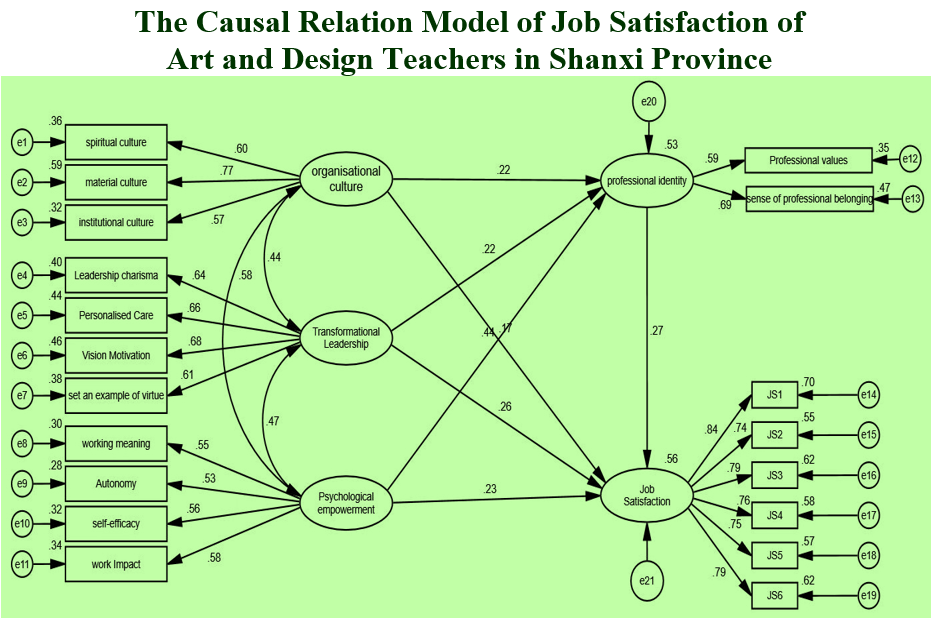
The Causal Relation Model of Job Satisfaction of Art and Design Teachers in Shanxi Province
DOI:
https://doi.org/10.57260/csdj.2026.279195Keywords:
Art and design teachers, Job satisfaction, Professional identity, Organizational culture, Transformational leadership, Psychological empowermentAbstract
The objectives of this study are: 1) to investigate the factors influencing the job satisfaction of art and design teachers in Shanxi Province, and 2) to explore guidelines for enhancing their job satisfaction. The research employs a mixed-method approach, combining qualitative interviews and quantitative survey analysis, collecting data from 443 art and design teachers from the top 20 universities in Shanxi Province.
The results indicate that organizational culture, transformational leadership, and psychological empowerment have a significant positive impact on job satisfaction. Notably, psychological empowerment indirectly enhances job satisfaction by strengthening professional identity. Structural Equation Modeling (SEM) analysis shows that the model fits well, with all indicators meeting statistical standards.
The study suggests that university administrators should strengthen psychological empowerment, foster a positive organizational culture, and enhance teachers' professional identity through transformational leadership to improve job satisfaction.
Downloads
References
Babbie, E. (2020). The Practice of Social Research. (15th ed.). Cengage Learning.
Bass, B. M. (1985). Leadership and performance beyond expectations. Free Press.
Brown, R. A., Walters, J., Jones, A., & Akinsola, O. (2017). Rural social work: Recruitment, job satisfaction, burnout, and turnover. Contemporary Rural Social Work Journal, 9(1), 12-12. https://doi.org/10.61611/2165-4611.1148
Chaaban, Y., Al-Thani, H., & Du, X. (2021). A narrative inquiry of teacher educators’ professional agency, identity renegotiations, and emotional responses amid educational disruption. Teaching and Teacher Education, 108, 103522. https://doi.org/10.1016/j.tate.2021.103522
Deng, N. (2025). The Key Factors of Part-Time Art Teachers’ Self-Efficacy and Job Satisfaction in Chengdu, China. AU-GSB E-JOURNAL, 18(1), 116-126. https://doi.org/10.14456/augsbejr.2025.12
Jayanti, S. S., Adams, D., & Radzi, N. M. (2024). From leadership to allegiance: The interplay of middle leadership, teacher job satisfaction, and commitment in schools. International Journal of Educational Management, 38(5), 1342-1356. https://doi.org/10.1108/IJEM-01-2024-0057
Kline, R. B. (2015). Principles and Practice of Structural Equation Modeling. Guildford Press.
Lu, M., Luo, J., Chen, W., & Wang, M. (2019). The influence of job satisfaction on the relationship between professional identity and burnout: A study of student teachers in Western China. Curr Psychol, 41, 289–297. https://doi.org/10.1007/s12144-019-00565-7
Mgaiwa, S. J. (2023). Leadership styles of academic deans and department heads: University dons' perspectives on how they affect their job satisfaction. International Journal of Educational Management, 37(5), 1088-1103. https://doi.org/10.1108/IJEM-09-2022-0367
Sirait, L., Sudarno, Junaedi, A. T., Purwati, A. A., & Deli, M. M. (2022). Leadership style, motivation, and organizational culture on job satisfaction and teacher performance. Journal of Applied Business and Technology, 3(2), 115-129. https://doi.org/10.35145/jabt.v3i2.94
Sothinathan, J. S., Adams, D., & Radzi, N. M. (2024). From leadership to allegiance: The interplay of middle leadership, teacher job satisfaction, and commitment in schools. International Journal of Educational Management, 38(5), 1342-1356. https://doi.org/10.1108/IJEM-01-2024-0057
State Council. (2018). Opinions on comprehensively deepening the reform of the teaching workforce in the new era. Beijing, China.
Tabachnick, B., & Fidell, L. (2013). Using Multivariate Statistics. Boston, MA: Pearson Education Inc.
Yuan, T., & Dizon, C. S. (2024). Influencing Factors and Strategies for Improving University Teachers' Job Satisfaction. Journal of Education and Educational Research, 10(2), 216-220. https://doi.org/10.54097/rnja9p32
Yumei, M., & Yee, C. M. (2025). Teacher Job Satisfaction in China, 2021 To 2025: Roles, Determinants, and Outcomes Across Primary, Secondary, and Tertiary Education. International Journal of Research and Innovation in Social Science, 9(10), 3372-3385. https://doi.org/10.47772/IJRISS.2025.910000276
Downloads
Published
How to Cite
Issue
Section
Categories
License
Copyright (c) 2026 Community and Social Development Journal

This work is licensed under a Creative Commons Attribution-NonCommercial-NoDerivatives 4.0 International License.