
The Influence of Distributed Leadership on Teachers' Work Well- Being
DOI:
https://doi.org/10.57260/csdj.2026.279216Keywords:
Distributed leadership, Work well-being, Teacher cooperation, Self-efficacy, Higher education, University lecturersAbstract
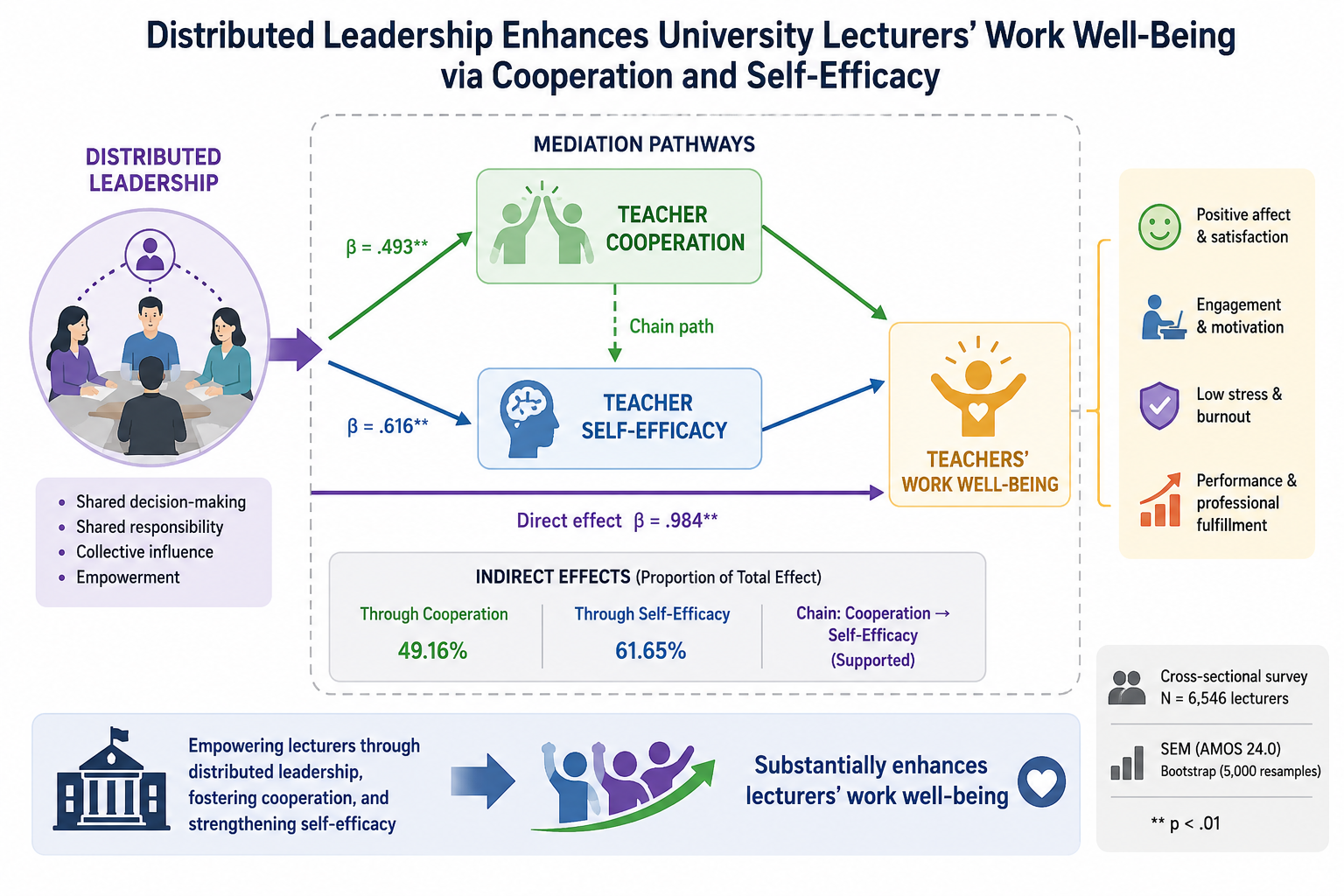
Teacher work well-being is a critical determinant of instructional quality and institutional effectiveness in higher education, yet the mechanisms linking leadership practices to lecturers' well-being remain insufficiently understood. Drawing on Distributed Leadership Theory and Social Cognitive Theory, this study examined 1) the direct effect of distributed leadership on university lecturers' work well-being, 2) the mediating roles of teacher cooperation and self-efficacy, and 3) the chain mediating effect through these two variables. A cross-sectional survey was conducted with 6,546 university lecturers selected through combined convenience and cluster sampling from higher-education institutions. Four validated instruments were administered: the distributed leadership scale, teacher work well-being scale, teacher cooperation scale, and teacher self-efficacy scale. Data were analyzed using descriptive statistics, Pearson correlation, structural equation modeling (SEM) with AMOS 24.0, and bootstrap mediation testing (5,000 resamples). Distributed leadership exerted a significant positive direct effect on lecturers' work well-being (β = .984, p < .01). Both teacher cooperation (β = .493) and self-efficacy (β = .616) significantly mediated this relationship, with the indirect path through self-efficacy (61.65% of total effect) being stronger than the path through cooperation (49.16%). The chain mediation pathway distributed leadership, teacher cooperation, self-efficacy, work well-being was also supported. Findings underscore that empowering university lecturers through distributed leadership, while simultaneously fostering collaborative culture and bolstering self-efficacy, can substantially enhance their work well-being. Implications for university administration and teacher development policy are discussed.
Downloads
References
Bandura, A. (1997). Self-efficacy: The exercise of control. W. H. Freeman.
Brislin, R. W. (1986). The wording and translation of research instruments. In W. J. Lonner & J. W. Berry (Eds.), Field methods in cross-cultural research (pp. 137–164). Sage.
Gao, W. (2024). A third-party perspective on teacher well-being assessment: A study of German teacher classroom observation tools based on the PERMA model. Education Guide.
Harris, A. (2004). Distributed leadership and school improvement: Leading or misleading?. Educational Management Administration & Leadership, 32(1), 11–24. https://doi.org/10.1177/1741143204039297
Hulpia, H., Devos, G., & Rosseel, Y. (2009). Development and validation of scores on the Distributed Leadership Inventory. Educational and Psychological Measurement, 69(6), 1013–1034. https://doi.org/10.1177/0013164409344490
Kaniuka, T. S. (2012). Toward an understanding of how teachers change during school reform: Considerations for educational leadership and school improvement. Journal of Educational Change, 13, 327–346. https://doi.org/10.1007/s10833-012-9184-3
Klusmann, U., Aldrup, K., Roloff, J., Lüdtke, O., & Hamre, B. K. (2022). Does instructional quality mediate the link between teachers' emotional exhaustion and student outcomes? A large-scale study using teacher and student reports. Journal of Educational Psychology, 114(6), 1442–1460. https://doi.org/10.1037/edu0000703
Leithwood, K., & Mascall, B. (2008). Collective leadership effects on student achievement. Educational Administration Quarterly, 44(4), 529–561. https://doi.org/10.1177/0013161X08321221
Li, X., Liang, D., & Gao, F. (2024). The influence of growth thinking on teachers' professional growth: Mediating effect of teaching efficacy and perseverance. Teacher Education Forum. China.
Hickey, N., Flaherty, A., & McNamary, P. M. (2024). Challenges to the sustainability of Irish post-primary school leadership: The role of distributed leadership. Journal of Educational Administration, 62(3), 341–354. https://doi.org/10.1108/JEA-05-2023-0108
Mather, B. R., & Visone, J. D. (2024). Peer observation to foster collective teacher efficacy: teachers' perceptions about collegial visits. Journal of Professional Capital and Community, 9(2), 85–104. https://doi.org/10.1108/JPCC-08-2023-0057
Mifsud, d. (2024). A systematic review of school distributed leadership: Research purposes, concepts, and approaches in the field between 2010 and 2022. Journal of Educational Administration and History, 56(2), 154–179. https://doi.org/10.1080/00220620.2022.2158181
Mudhar, G., Ertesvag, S. K., & Pakarinen, E. (2024). Patterns of teachers' self-efficacy and attitudes toward inclusive education associated with teacher emotional support and collegial collaboration. European Journal of Special Needs Education, 39(3), 446–462. https://doi.org/10.1080/08856257.2023.2233297
Murphy, G., & Brennan, T. (2024). Enacting distributed leadership in Ireland: Assessing primary school principals' developmental needs using constructive developmental theory. Educational Management Administration & Leadership, 52(3), 666–685. https://doi.org/10.1177/1741143222108685
Ross, J. A. (1994). The impact of an in-service to promote cooperative learning on the stability of teacher efficacy. Teaching and Teacher Education, 10(4), 381–394. https://doi.org/10.1016/0742-051X(94)90020-5
Selenius, H., & Hau, H. G. (2024). A scoping review on the psychometric properties of the Teacher Efficacy for Inclusive Practices (TEIP) scale. Scandinavian Journal of Educational Research, 68(4), 792–802. https://doi.org/10.1080/00313831.2023.2185811
Shi, X., Jiao, X., & Jia, X. (2005). Development of the Teacher Self-Efficacy Scale. Psychological Development and Education. China.
Skaalvik, E. M., & Skaalvik, S. (2014). Teacher self-efficacy and perceived autonomy: Relations with teacher engagement, job satisfaction, and emotional exhaustion. Psychological Reports, 114(1), 68–77. https://doi.org/10.2466/14.02.PR0.114k14w0
Spillane, J. P. (2006). Distributed leadership. Jossey-Bass.
Spillane, J. P., Halverson, R., & Diamond, J. B. (2004). Towards a theory of leadership practice: A distributed perspective. Journal of Curriculum Studies, 36(1), 3–34. https://doi.org/10.1080/0022027032000106726
Tschannen-Moran, M., & Hoy, A. W. (2001). Teacher efficacy: Capturing an elusive construct. Teaching and Teacher Education, 17(7), 783–805. https://doi.org/10.1016/S0742-051X(01)00036-1
Yu, H. (2024). The impact of work pressure and work resources on rural compulsory education teachers' personal teaching efficacy. Education Guide.
Wang, C., Chen, Z., & Yang, X. (2012). Construction of the Teacher Cooperation Scale and reliability/validity test. Teacher Education Research.
Zhang, L., & Tian, X. (2011). Compilation and validation of the Teachers' Work Well-Being Scale. Psychological Research.
Downloads
Additional Files
Published
How to Cite
Issue
Section
Categories
License
Copyright (c) 2026 Community and Social Development Journal

This work is licensed under a Creative Commons Attribution-NonCommercial-NoDerivatives 4.0 International License.