Language Policy Implementation Strategies of English Education in Higher Education Institutions in Jiangsu Province of China
DOI:
https://doi.org/10.57260/csdj.2026.279220Keywords:
Language policy, Implementation strategy, English education, Higher education institution (HEI), Jiangsu provinceAbstract
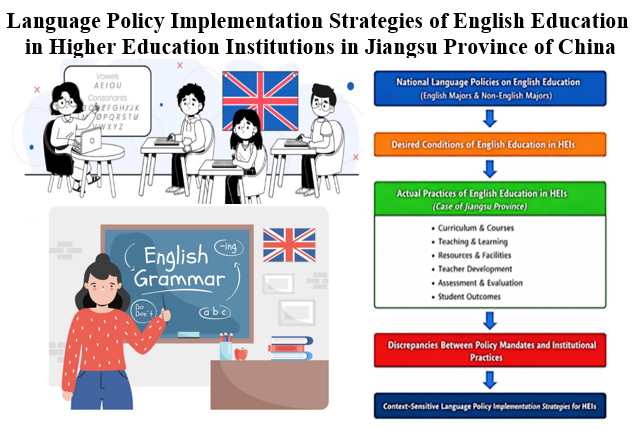
This research examines the implementation of national language policies on English education in higher education institutions (HEIs) in Jiangsu Province, China. The objectives of this study are threefold: 1) to analyze the desired conditions of English education as articulated in national policy documents, 2) to investigate the actual practices of English education in HEIs through a case study of institutions in Jiangsu Province, and 3) to identify discrepancies between policy mandates and institutional practices and to propose appropriate implementation strategies. This study adopts a qualitative research design integrating critical discourse analysis, content analysis, and N-gram analysis. The analysis is based on two national policy documents and English education–related information collected from the official websites of 20 sampled HEIs in Jiangsu Province. This integrated methodological approach enables a systematic comparison between national policy expectations and institutional practices.
The findings indicate that national policies articulate comprehensive goals for English education, emphasizing talent cultivation, cross-cultural competence, and quality assurance. However, variations exist in the ways these policies are implemented at the institutional level. Discrepancies are identified in curriculum development, resource allocation, teacher development, evaluation mechanisms, and student outcomes, reflecting challenges in translating national policy mandates into diverse local contexts.
The study concludes that flexible and context-sensitive implementation strategies are necessary to narrow the gap between national language policy expectations and HEI-based practices. The study proposes recommendations to enhance policy implementation through adaptive monitoring mechanisms, strengthened curriculum and resource support, balanced teacher development, improved evaluation systems, and the promotion of cross-cultural competence. The findings contribute to a clearer understanding of language policy implementation in higher education and provide practical implications for policymakers and institutional administrators.
Downloads
References
Awuor, Q. E. (2019). Language policy in education: The practicality of its implementation and way forward. Journal of Language, Technology & Entrepreneurship in Africa, 10(1), 94-109. http://erepo.usiu.ac.ke/11732/5763
Baker, W. (2011). Intercultural awareness: Modelling an understanding of cultures in intercultural communication through English as a lingua franca. Language and Intercultural Communication, 11(3), 197-214. https://doi.org/10.1080/14708477.2011.577779
Deng, S. (2021). Exploration of teacher agency in the implementation of the ESP language education policy in a Chinese university. Theory and Practice in Language Studies, 11(3), 302-307. https://doi.org/10.17507/tpls.1103.10
Eddy, H., & Mukminin, A. (2012). Global, national, and local goals: English language policy implementation in an Indonesian international standard school. Excellence in Higher Education, 3(2), 69-78. https://doi.org/10.5195/ehe.2012.66
Gempeso, H. D. P., & Mendez, J. D. S. (2021). Constructive alignment of mother tongue-based multilingual education (MTB MLE) language policy implementation to the practices of a multilingual classroom. English Language Teaching Educational Journal, 4(2), 125-137. https://doi.org/10.12928/eltej.v4i2.4234
Graham, K. M., & Yeh, Y. F. (2023). Teachers’ implementation of bilingual education in Taiwan: Challenges and arrangements. Asia Pacific Education Review, 24, 461-472. https://doi.org/10.1007/s12564-022-09791-4
Guerrero, A. L., & Camargo-Abello, M. (2023). Teachers’ agency in the implementation of an early childhood education policy program in schools in Bogotá, Colombia. International Journal of Child Care and Education Policy, 17(1), Article 2. https://doi.org/10.1186/s40723-023-00104-9
Haryanto, E. (2013). Language policy: Administrators and teachers’ view on English as medium of instruction implementation in Indonesia. Language Policy, 4(2), 48-56. https://iiste.org/Journals/index.php/JEP/article/viewFile/4068/4103
Jones, J. M., & Barkhuizen, G. (2011). “It is two-way traffic”: teachers’ tensions in the implementation of the Kenyan language-in-education policy. International Journal of Bilingual Education and Bilingualism, 14(5), 513-530. https://doi.org/10.1080/13670050.2010.532540
Kaur, K., & Lim-Ratnam, C. (2023). Implementation of formative assessment in the English language classroom: Insights from three primary schools in Singapore. Educational Research for Policy and Practice, 22, 215-237. https://doi.org/10.1007/s10671-022-09327-y
Kazakbaeva, R. (2023). From language of enemy to language of opportunity: Understanding teacher resistance to curriculum change in English language teaching and learning in Kyrgyzstan. Journal of Educational Change, 24, 317-343. https://doi.org/10.1007/s10833-021-09445-z
Li, C. (2022). Perpetuating student inequality? The discrepancy and disparity of global citizenship education in Chinese rural & urban schools. Asia Pacific Education Review, 23, 389-401. https://doi.org/10.1007/s12564-021-09708-7
Liyanage, I., & Walker, T. (2023). English teachers’ identity-agency and curriculum reform policies in the People’s Republic of China (PRC). Educational Research for Policy and Practice, 22, 427-441. https://doi.org/10.1007/s10671-023-09343-6
Lu, X. (2022). Implementation of English language education policy in Hong Kong kindergartens: Perspectives of stakeholders. In 2021 International Conference on Social Development and Media Communication (SDMC 2021) (pp. 425-429). Dordrecht: Atlantis Press. https://doi.org/10.2991/assehr.k.220105.080
Lytra, V., & Gelir, I. (2023). Negotiating monolingual official language policy at the nexus of locally situated language practices and dominant language ideologies in a language minority context. International Journal of Early Childhood, 55, 313–329. https://doi.org/10.1007/s13158-023-00368-9
May, S. (2002). Accommodating multiculturalism and biculturalism in Aotearoa New Zealand: Implication for language education. Waikato Journal of Education, 8, 5-26. https://hdl.handle.net/10289/6256
Mbaka, N. W., Peter, C. A., & Karuri, M. (2013). Implementation status of Kenya’s language in education policy: A case study of selected primary schools in Chuka Division, Meru South District, Kenya. Journal of Education and Practice, 4(23), 97-104. https://www.iiste.org/Journals/index.php/JEP/article/view/8403
Mokibelo, E. (2016). Implementation of the language-in-education policy and achieving education for all goals in Botswana primary schools. Universal Journal of Educational Research, 4(1), 157-164. https://doi.org/10.13189/ujer.2016.040120
Oh, S., & Kim, T. Y. (2024). Changes in English education during the pre-and post-Kim Jong Un eras in North Korea: A comparative textbook analysis. Asia Pacific Educ. Rev. 25, 1245–1260 (2024). https://doi.org/10.1007/s12564-022-09808-y
Okoro, E. (2019). Intercultural communication competence in multinational competitiveness: Literature review and synthesis. Journal of Business and Economic Policy, 6(2), 1-9. https://jbep.thebrpi.org/journal/index/2398
Owojecho, F. (2020). Implementation challenges of national language policy in Nigeria: The roles of the indigenous languages. International Journal of Language and Literary Studies, 2(1), 270-279. https://doi.org/10.36892/ijlls.v2i1.183
Rasti, A. (2023). Rendering Iran language-in-education policy problematic: A CDA poststructural approach. New Zealand Journal of Educational Studies, 58, 493-508. https://doi.org/10.1007/s40841-023-00292-5
Ricklefs, M. A. (2022). “Politics at its finest”: Language management and ideologies affecting the education of minoritized students. SN Social Sciences, 2, 61. https://doi.org/10.1007/s43545-022-00359-y
Rubino, A., & Hajek, J. (2024). The impact of policy settings on language education in Australian schools: A comparative analysis of language enrolments and attrition in New South Wales and Victoria. Current Issues in Language Planning, 25(3), 306-329. https://doi.org /10.1080/14664208.2024.2305514
Sager, F., & Gofen, A. (2022). The polity of implementation: Organizational and institutional arrangements in policy implementation. Governance, 35(2), 347-364. https://doi.org/10.1111/gove.12677
Sarmurzin, Y., Amanzhol, N., Toleubayeva, K., Zhunusova, M., Amanova, A., & Abiyr, A. (2024). Challenging aspects of Kazakhstan’s trilingual education policy: Evidence from a literature review. Asia Pacific Educ. Rev. 25, 801–811. https://doi.org/10.1007/s12564-023-09823-7
Savio, N., & Nikolopoulos, K. (2009). Forecasting the economic impact of new policies. Foresight, 11(2), 7–18. https://doi.org/10.1108/14636680910950110
Savio, N., & Nikolopoulos, K. (2010). Forecasting the effectiveness of policy implementation strategies. International Journal of Public Administration, 33(2), 88-97. https://doi.org /10.1080/01900690903241765
Scarino, A. (2014). Situating the challenges in current languages education policy in Australia–unlearning monolingualism. International Journal of Multilingualism, 11(3), 289-306. https://doi.org/10.1080/14790718.2014.921176
Sinagatullin, I. M. (2013). Education in a diverse society necessitates the implementation of an equitable language policy: The Russian experience. International Journal of Educational Reform, 22(1), 103-113. https://doi.org/10.1177/105678791302200106
Spolsky, B. (2004a). Language Policy. Cambridge: Cambridge University Press.
Spolsky, B. (2004b). Language practices, ideology and beliefs, and management and planning. Language Policy. Cambridge: Cambridge University Press.
Spolsky, B. (2012). The Cambridge Handbook of Language Policy. Cambridge: Cambridge University Press.
Spolsky, B. (2019). A modified and enriched theory of language policy (and management). Language Policy, 18, 323-338. https://doi.org/10.1007/s10993-018-9489-z
Sun, T., & Buripakdi, A. (2024). Cultural education in transition: Re-envisaging national English curricula of China from a global citizenship perspective. Asia-Pacific Edu Res 33, 1433–1444. https://doi.org/10.1007/s40299-024-00824-7
Ugwu, E. O. (2020). Language policy and planning in Nigeria: Moving beyond rhetoric. Language Problems and Language Planning, 44(1), 1-19. https://doi.org/10.1075/lplp.00053.okw
Vanbuel, M. (2022). How stakeholders see the implementation of language education policy: A Q-study. Current Issues in Language Planning, 23(1), 57-76. https://doi.org/10.1080/14664208.2021.1928427
Vanbuel, M., & Van den Branden, K. (2020). Each primary school a school-based language policy? The impact of the school context on policy implementation. Language and Education, 35(1), 42-59. https://doi.org/10.1080/09500782.2020.1803352
Vanbuel, M., & Van den Branden, K. (2023). Examining the implementation of language education policies in mainstream primary schools. Language policy, 22, 201-222. https://doi.org/10.1007/s10993-022-09631-6
Waslander, S., Hooge, E. H., & Theisens, H. C. (2023). Getting policy done in educational practice: What happens when multiple central government policies meet clusters of organization routines in schools. Journal of Educational Change, 24, 605-630. https://doi.org/10.1007/s10833-022-09460-8
Woo, E. (2023). Narrating the Belt and Road education policy: A critical policy discourse analysis. Higher Education Policy, 36, 677-699. https://doi.org/10.1057/s41307-022-00279-9
Downloads
Published
How to Cite
Issue
Section
Categories
License
Copyright (c) 2026 Community and Social Development Journal

This work is licensed under a Creative Commons Attribution-NonCommercial-NoDerivatives 4.0 International License.