
A Causal Model of Professional Key Competencies of Higher Vocational Students
DOI:
https://doi.org/10.57260/csdj.2026.279352Keywords:
Professional key competencies, Higher vocational education, Influencing factors, Causal modelAbstract
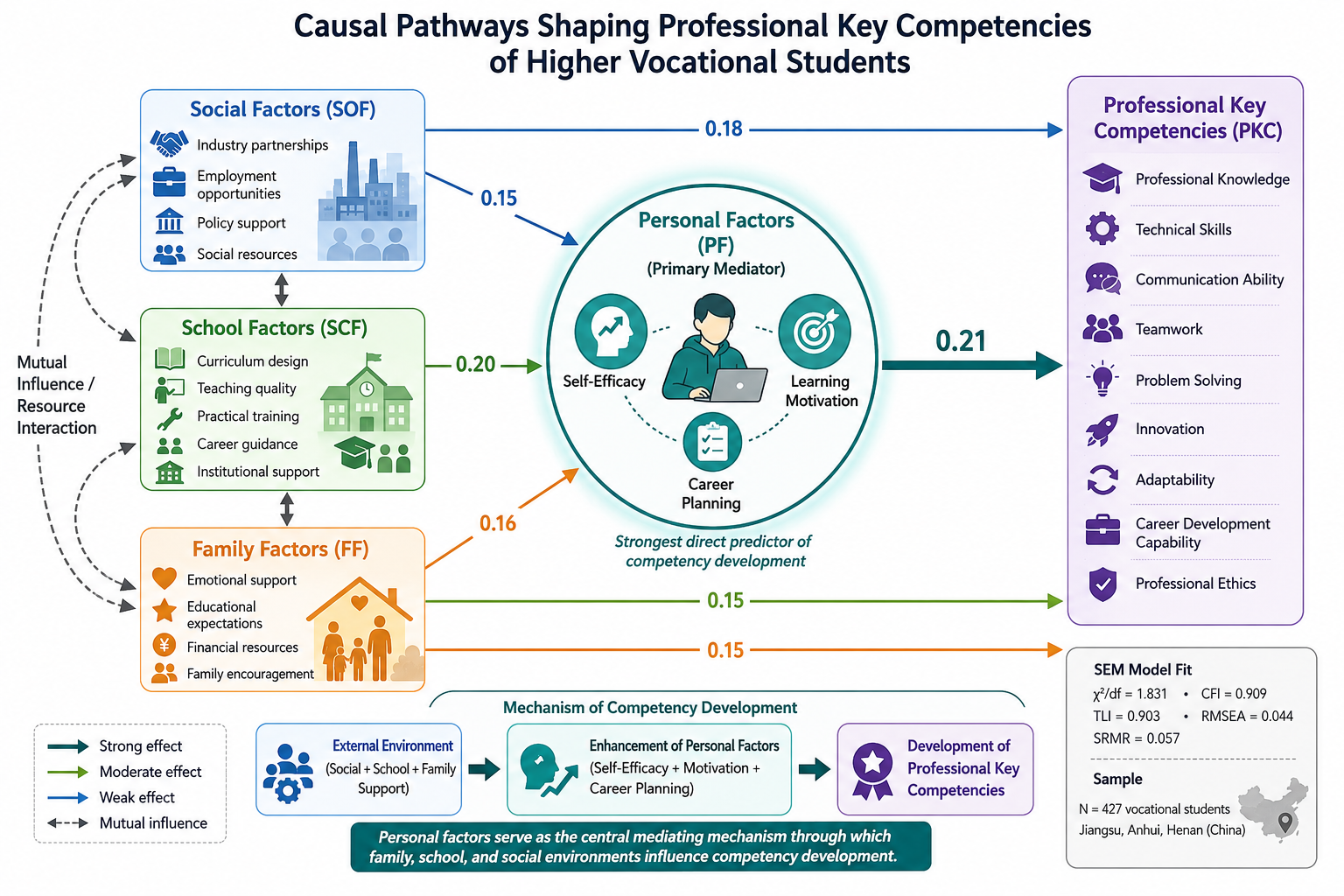
This study aims to construct a causal model of professional key competencies for higher vocational students by examining the influence of personal, family, school, and social factors. Using a quantitative approach, data were collected through a structured questionnaire from 427 higher vocational students selected by systematic random sampling from six institutions in Jiangsu, Anhui, and Henan provinces, China. Content validity was verified by five experts using the Index of Item-Objective Congruence (IOC), and internal-consistency reliability was confirmed (Cronbach’s α = 0.809–0.936). Structural Equation Modeling (SEM) was employed to analyze causal relationships. The hypothesized model fit the empirical data well (χ²/df = 1.831, CFI = 0.909, TLI = 0.903, RMSEA = 0.044, SRMR = 0.057). The findings reveal that personal factors, including self-efficacy, learning motivation, and career planning, exert the most significant direct impact on competency development. Family, school, and social factors influence professional competencies indirectly, primarily through their effect on personal factors. Institutional support, curriculum design, and industry collaboration were identified as key areas requiring enhancement. The study highlights the importance of a multi-faceted approach to competency cultivation, integrating personal motivation, family support, structured educational programs, and strong industry partnerships. Recommendations are provided for students, families, educators, and policymakers to enhance vocational education outcomes. The study contributes an empirically validated causal model demonstrating that personal factors are the central mediator through which family, school, and social factors shape the professional key competencies of higher vocational students, providing an evidence-based foundation for vocational education reform in China.
Downloads
References
Bandura, A. (1986). Social foundations of thought and action: A social cognitive theory. Prentice-Hall.
Bandura, A. (1998). Exploration of self-efficacy: The exercise of control. W. H. Freeman.
Baartman, L. K. J., & de Bruijn, E. (2011). Integrating knowledge, skills, and attitudes: Conceptualising learning processes towards vocational competence. Educational Research Review, 6(2), 125-134. https://doi.org/10.1016/j.edurev.2011.03.001
Biggs, J., & Tang, C. (2011). Teaching for quality learning at university: What the student does. McGraw-Hill Education.
Billett, S. (2011). Vocational education: Purposes, traditions, and prospects. Springer.
Binkley, M., Erstad, O., Herman, J., Raizen, S., Ripley, M., Miller-Ricci, M. et al. (2012). Defining Twenty-First Century Skills. In Assessment and Teaching of 21st Century Skills. Dordrecht: Springer.
Boud, D., & Solomon, N. (2001). Work-based learning: A new higher education? McGraw-Hill Education. Buckingham: SRHE and Open University Press.
Bronfenbrenner, U. (1979). The ecology of human development: Experiments by nature and design. Harvard University Press.
Bronfenbrenner, U., & Morris, P. A. (2006). The bioecological model of human development. Handbook of Child Psychology, 1, 793-828. https://doi.org/10.1002/9780470147658.chpsy0114
Deci, E. L., & Ryan, R. M. (2000). The "what" and "why" of goal pursuits: Human needs and the self-determination of behavior. Psychological Inquiry, 11(4), 227-268. https://doi.org/10.1207/S15327965PLI1104_01
Dietrich, J., & Kracke, B. (2009). Career-Specific Parental Behaviors in Adolescents’ Development. Journal of Vocational Behavior, 75(2), 109-119. https://doi.org/10.1016/j.jvb.2009.03.005
Eccles, J. S. (1999). The development of children ages 6 to 14. The Future of Children, 9(2), 30-44. https://pubmed.ncbi.nlm.nih.gov/10646256/
Eccles, J. (2009). Who Am I and What Am I Going to Do with My Life? Personal and Collective Identities as Motivators of Action. Educational Psychologist, 44, 78-89. https://doi.org/10.1080/00461520902832368
Fan, W., & Chen, M. (2001). Parental involvement and students' academic achievement: A meta-analysis. Educational Psychology Review, 13, 1-22. https://doi.org/10.1023/A:1009048817385
Garg, R., Kauppi, C., Lewko, J., & Urajnik, D. (2002). A structural model of educational aspirations. Journal of Career Development, 29(2), 87-108. https://doi.org/10.1177/089484530202900202
Greenhaus, J. H., Callanan, G. A., & Godshalk, V. M. (2010). Career management. Sage Publications.
Hanushek, E. A., Schwerdt, G., Woessmann, L., & Zhang, L. (2017). General education, vocational education, and labor-market outcomes over the lifecycle. The Journal of Human Resources, 52(1), 48-87. https://doi.org/10.3368/jhr.52.1.0415-7074R
Heckman, J. J. (2006). Skill formation and the economics of investing in disadvantaged children. Science, 312(5782), 1900-1902. https://doi.org/10.1126/science.1128898
Lent, R. W., Brown, S. D., & Hackett, G. (1994). Toward a unifying social cognitive theory of career and academic interest, choice, and performance. Journal of Vocational Behavior, 45(1), 79-122. https://doi.org/10.1006/jvbe.1994.1027
Lent, R. W., Brown, S. D., & Hackett, G. (2000). Contextual supports and barriers to career choice: A social cognitive analysis. Journal of Counseling Psychology, 47(1), 36-49. https://doi.org/10.1037/0022-0167.47.1.36
Lent, R. W., Ezeofor, I., Morrison, M. A., Penn, L. T., & Ireland, G. W. (2019). Applying the social cognitive model of career self-management to career exploration and decision-making. Journal of Vocational Behavior, 112, 1-12. https://doi.org/10.1016/j.jvb.2019.03.005
Mulder, M. (2017). Competence-based vocational and professional education: A global overview. Springer International Publishing.
OECD. (2005). The definition and selection of key competencies: Executive summary. OECD Publishing.
OECD. (2018). Future of education and skills 2030: The future we want. OECD Publishing.
Powell, J. J., & Solga, H. (2011). Why are higher education participation rates in Germany so low? Institutional barriers to higher education expansion. Journal of Education and work, 24(1), 49-68. https://doi.org/10.1080/13639080.2010.534445
Rychen, D. S., & Salganik, L. H. (2003). Key Competencies for a Successful Life and Well-Functioning Society. Hogrefe & Huber, Gottingen.
Savickas, M. L. (2002). Career Construction. In D. Brown (Ed.), Career Choice and Development (Vol. 149, p. 205). Jossey-Bass.
Schunk, D. H., & DiBenedetto, M. K. (2021). Self-Efficacy and Human Motivation. Advances in Motivation Science, 8, 153-179. https://doi.org/10.1016/bs.adms.2020.10.001
Siraj, I., & Huang, R. (2020). Operationalizing Bronfenbrenner’s PPCT model in researching human development: Commentary on Xia, Li and Tudge. Human Development, 64(1), 21–25. https://doi.org/10.1159/000508341
Super, D. E. (1953). A theory of vocational development. American Psychologist, 8(5), 185-190. https://doi.org/10.1037/H0056046
Super, D. E. (1980). A Life-Span, Life-Space Approach to Career Development. Journal of Vocational Behavior, 16, 282-298. https://doi.org/10.1016/0001-8791(80)90056-1
Trowler, V. (2010). Students Engagement Literature Review. The Higher Education Academy.
Tudge, J. R., Mokrova, I., Hatfield, B. E., & Karnik, R. B. (2009). Uses and misuses of Bronfenbrenner’s bioecological theory of human development. Journal of Family Theory & Review, 1(4), 198-210. https://doi.org/10.1111/j.1756-2589.2009.00026.x
Tynjala, P. (2008). Perspectives into Learning at the Workplace. Educational Research Review, 3, 130-154. https://doi.org/10.1016/j.edurev.2007.12.001
Voogt, J., & Roblin, N. P. (2012). A Comparative Analysis of International Frameworks for 21st Century Competences: Implications for National Curriculum Policies. Journal of Curriculum Studies, 44(3), 299-321. https://doi.org/10.1080/00220272.2012.668938
Wang, M. T., & Eccles, J. S. (2013). School Context, Achievement Motivation, and Academic Engagement: A Longitudinal Study of School Engagement Using a Multidimensional Perspective. Learning and Instruction, 28, 12-23. https://doi.org/10.1016/j.learninstruc.2013.04.002
Zimmerman, B. J. (2000). Attaining Self-Regulation: A Social Cognitive Perspective. San Diego, CA: Academic Press.
Downloads
Additional Files
Published
How to Cite
Issue
Section
Categories
License
Copyright (c) 2026 Community and Social Development Journal

This work is licensed under a Creative Commons Attribution-NonCommercial-NoDerivatives 4.0 International License.