
A Meta-Analysis of Technical and Vocational Education and Training (TVET) Studies Across Continents
DOI:
https://doi.org/10.57260/csdj.2026.279569Keywords:
Technical and vocational education and training (TVET), Labor force participation, Meta-analysis, Policy interventions, PhilippinesAbstract
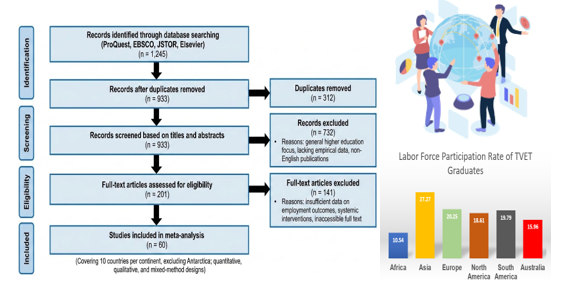
Technical and Vocational Education and Training (TVET) plays a critical role in enhancing employability and supporting economic development. However, global disparities exist in labor force participation, policy implementation, and system effectiveness, highlighting the need for cross-continental analysis. This study aimed to conduct a systematic meta-analysis of international TVET research to 1) evaluate labor force participation of TVET graduates, 2) identify innovative policies and systemic interventions that strengthen TVET outcomes, and 3) propose strategies suitable for enhancing the Philippine TVET system. A systematic review and meta-analysis were conducted on 60 studies published between 2016 and 2022. Data were sourced from four academic databases: ProQuest, EBSCO, JSTOR, and Elsevier. Inclusion criteria targeted studies focused on TVET programs or graduates reporting employment outcomes or systemic interventions. Qualitative data were analyzed using MAXQDA, while quantitative data were synthesized to determine labor force participation across continents. Labor force participation of TVET graduates varied by region, with Asia reporting the highest rate (27.27%) and Africa the lowest (10.54%). Effective policies identified include strong governance, public-private partnerships, competency-based training, recognition of prior learning, and ICT-supported monitoring. For the Philippines, adopting these strategies can improve alignment with labor market needs and enhance graduate employability. The study demonstrates that context-specific policies, systemic interventions, and strategic partnerships are essential for improving TVET outcomes globally and locally. Evidence-based strategies can strengthen the Philippine TVET system, ensure labor market relevance, and promote workforce readiness.
Downloads
References
Boateng, C. (2012). Restructuring vocational and technical education in Ghana: The role of leadership development. International Journal of Humanities and Social Science, 2(4), 108–114. https://ijhss.thebrpi.org/journals/Vol_2_No_4_Special_Issue_February_2012/15.pdf
Grosch, M. (2017). Developing a competency standard for TVET teacher education in ASEAN countries. Jurnal Pendidikan Teknologi dan Kejuruan, 23(3), 279–287. https://journal.uny.ac.id/index.php/jptk/article/view/13418
Hanni, M. (2019). Financing of education and technical and vocational education and training (TVET) in Latin America and the Caribbean (No. 44599). Economic Commission for Latin America and the Caribbean (ECLAC). https://repositorio.cepal.org/handle/11362/44599
Hasim, A. S., Ali, R., & Ismail, K. (2016). Higher TVET educational model as basis for global curriculum: The UniKL experience. Journal of Modern Education Review, 6(7), 461–469. http://www.academicstar.us/UploadFile/Picture/2017-1/201712233432470.pdf
Hassan, S., Shamsudin, M. F., & Mustapha, I. (2019). The effect of service quality and corporate image on student satisfaction and loyalty in TVET higher learning institutes (HLIs). Journal of Technical Education and Training, 11(4), 77–85. https://publisher.uthm.edu.my/ojs/index.php/JTET/article/view/3989
Hussain, N. H., Ismail, K. M., Nor, N. M., Mulop, N., & Mohamed, Z. (2015). Knowledge expansion in engineering education: Engineering technology as an alternative. Asian Journal of Technology Management, 8(1), 37–46. https://doi.org/10.12695/ajtm.2015.8.1.4
Kirior, H. (2017). Improving the TVET curriculum as a strategy for better performance. Africa Journal of Technical and Vocational Education and Training, 2(1), 22–30. https://doi.org/10.69641/afritvet.2017.2132
Leidholm, C., & Manda, L. (2013). Technical and vocational education and training for young people in low- and middle-income countries: A systematic review and meta-analysis. Empirical Research in Vocational Education and Training, 5(3). https://doi.org/10.1186/1877-6345-5-3
Mariano, R. P. & Tantoco, L. F. (2023). Assessment of Employability Skills of TechnicalVocational Education and Training (TVET) Graduates: Basis for an Enhancement Program. International Journal of Multidisciplinary: Applied Business and Education Research, 4(5), 1734-1747. http://dx.doi.org/10.11594/ijmaber.04.05.34
Nawi, F. A. M., Tambi, A. M. A., Samat, M. F., & Mustapha, W. M. W. (2020). A review on the internal consistency of a scale: The empirical example of the influence of human capital investment on Malcom Baldridge quality principles in TVET institutions. Asian People Journal (APJ), 3(1), 19–29. https://doi.org/10.37231/apj.2020.3.1.121
Orbeta, A. C. (2016). TVET impact evaluations in the Philippines: Evidence and policy implications. Philippine Institute for Development Studies.
OECD. (2018). Seven questions about apprenticeships: Answers from international experience. OECD Reviews of Vocational Education and Training, OECD Publishing. https://doi.org/10.1787/9789264302488-en
Oketch, M. O. (2017). Cross-country comparison of TVET systems, practices and policies, and employability of youth in Sub-Saharan Africa. W. Bertelsmann Verlag.
Othman, N. (2019). Vocational education and training in Brunei Darussalam. In M. Paryono (Ed.), Vocational Education and Training in ASEAN Member States (pp. 1–23). Springer.
Oviawe, J. I., Uwameiye, R., & Uddin, P. S. (2017). Bridging skill gap to meet technical, vocational education and training school-workplace collaboration in the 21st century. International Journal of Vocational Education and Training Research, 3(1), 7–14. https://doi.org/10.11648/j.ijvetr.20170301.12
Pambudi, N. A., & Harjanto, B. (2020). Vocational education in Indonesia: History, development, opportunities, and challenges. Children and Youth Services Review, 115, 105092. https://doi.org/10.1016/j.childyouth.2020.105092
Schröder, T. (2019). A regional approach for the development of TVET systems in the light of the 4th industrial revolution: The regional association of vocational and technical education in Asia. International Journal of Training Research, 17(1), 83–95. https://doi.org/10.1080/14480220.2019.1629728
Smith, E. (2022). Australian TVET teacher training: Once flourishing but now neglected. In J. Gessler & A. Siemer (Eds.), Technical and Vocational Teacher Education and Training in International and Development Co-Operation (pp. 435–451). Springer.
UNESCO. (2001). Revised recommendation concerning technical and vocational education. UNESCO Digital Library. https://unesdoc.unesco.org/ark:/48223/pf0000126050
UNESCO. (2022). Transforming technical and vocational education and training for successful and just transitions: UNESCO strategy 2022-2029. UNESCO Digital Library. https://unesdoc.unesco.org/ark:/48223/pf0000383360
TESDA. (2021). National Technical Education and Skills Development Plan (NTESDP) 2018-2022. Technical Education and Skills Development Authority.
World Bank. (2021). Skilled for life? Key findings from the World Bank on TVET. World Bank Group.
Downloads
Published
How to Cite
Issue
Section
Categories
License
Copyright (c) 2026 Community and Social Development Journal

This work is licensed under a Creative Commons Attribution-NonCommercial-NoDerivatives 4.0 International License.