
An Assessment of Samae Dam Chicken (Gallus gallus) Production and Technology Transfer for Community Economic Development
DOI:
https://doi.org/10.57260/csdj.2026.279768Keywords:
Development, Community, Technology transfer, Samae Dam (Gallus gallus), ChickenAbstract
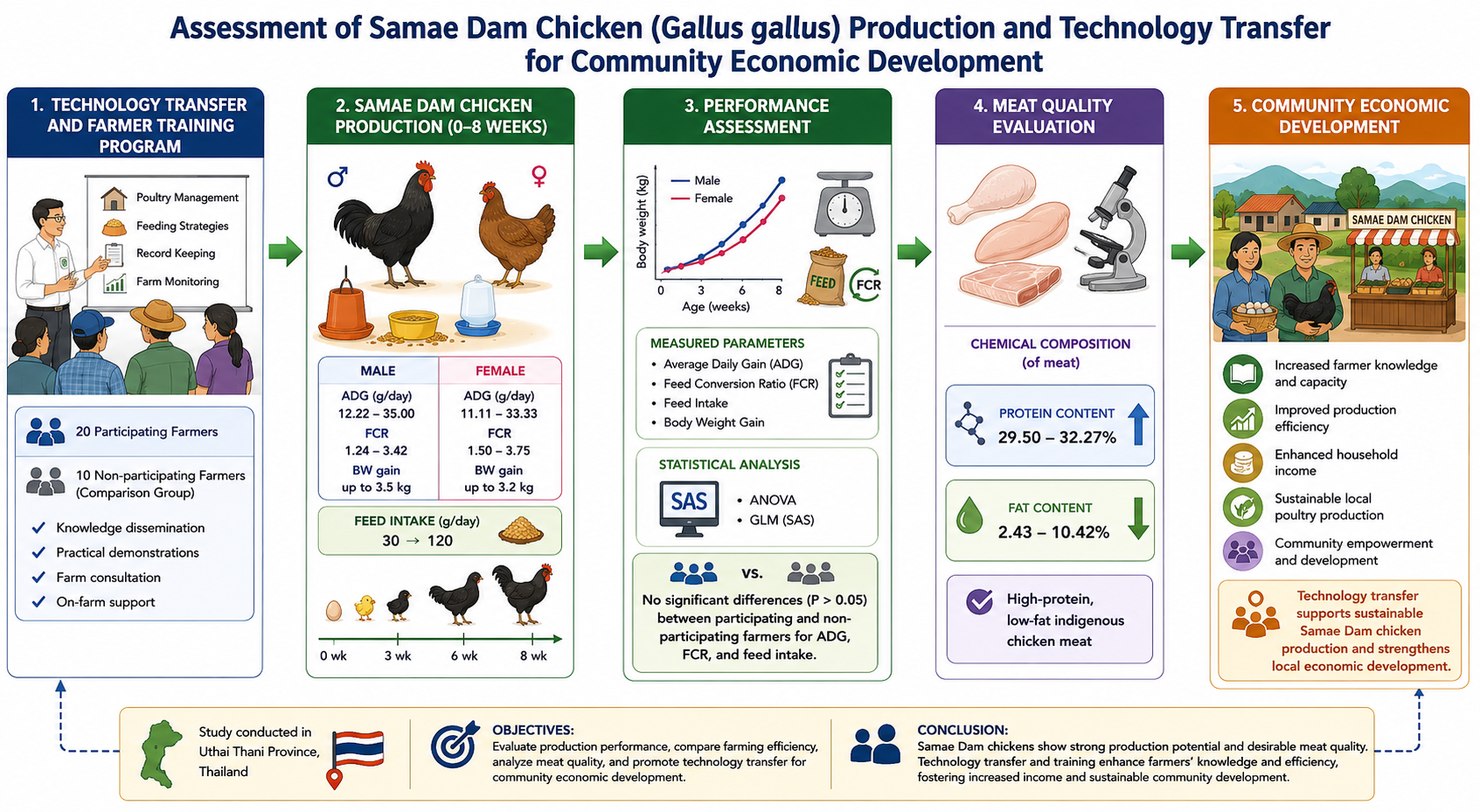
The objectives of this study were to evaluate the production performance of Samae Dam chickens during 0–8 weeks of age, compare production efficiency between farmers participating and not participating in the technology transfer program, determine the physical and chemical composition of Samae Dam chicken meat, and promote technology transfer for Samae Dam chicken production to support community economic development in Uthai Thani Province, Thailand. The methodology comprised two parts: secondary data collection and field research. Participants included 20 farmers in the technology transfer program and 10 farmers in a non-participating comparison group. Data were gathered through in-depth interviews, focus group discussions, participatory observation, and on-farm records. Statistical analysis, including Analysis of Variance (ANOVA) and Generalized Linear Models (GLM) via SAS software, was used to compare production efficiency between the two groups. The production performance of approximately 200 Samae Dam (Gallus gallus) chickens aged 0–8 weeks was evaluated based on average daily gain (ADG), feed conversion ratio (FCR), feed intake, and body weight gain. For males and females, respectively, the ADG at ages 0–3, 3–6, 6–8, and 0–8 weeks were 12.22 and 11.11 g/d, 32.22 and 20.00 g/d, 35.00 and 33.33 g/d, and 14.58 and 13.33 g/d. The corresponding FCR values for males and females at 0–3, 3–6, 6–8, and 0–8 weeks were 2.45 and 2.70, 1.24 and 2.00, 1.40 and 1.50, and 3.42 and 3.75, respectively. Feed intake for males and females at 0–3, 3–6, 6–8, and 0–8 weeks was 30, 40, 50, and 120 g/d, respectively. Body weight gain for males and females at 0–3, 3–6, 6–8, and 0–8 weeks was 1,100 and 1,000 g/head, 1,900 and 1,800 g/head, 2,100 and 2,000 g/head, and 3,500 and 3,200 g/head, respectively. Chemical analysis of the meat revealed high protein (29.50–32.27%) and low fat content (2.43–10.42%). Regarding farming efficiency, no statistically significant differences (P>0.05) were found in ADG, FCR, or feed intake between participating and non-participating farmers. The study concludes that Samae Dam (Gallus gallus) chickens possess strong production potential and desirable meat quality. Furthermore, technology transfer and training programs can enhance farmers' knowledge and efficiency, fostering increased income and sustainable community economic development.
Downloads
References
Abdelqader, A., Wollny, C. B. A., & Gauly. M. (2007). Characterization of local chicken production systems and their potential under different levels of management practice in Jordan. Tropical Animal Health and Production, 39, 155-164. https://doi:10.1007/s11250-007-9000-x
Ahlers, C., Alders, R. G., Bagnol, B., Cambaza, A. B., Harun, M., Mgomezulu, R., Msami, H., Pym, B., Wegener, P., Wethli, E., & Young, M. (2009). Improving village chicken Production: A manual for field workers and trainers. https://www.aciar.gov.au/sites/default/files/legacy/node/11129/mn139_improving_village_chicken_production_a_manu_59315.pdf
Badubi, S., Rakereng, S. M., & Marumo, M. (2006). Morphological characteristics and feed Resources available for indigenous chickens in Botswana. Livestock Research for Rural Development, 18, 3. http://www.lrrd.org/lrrd18/1/badu18003.htm
Bett, R. C., Bhuiyan, A. K. F. H., Khan, M. S., Silva, G. L. L. P., Thuy, L. T., Sarker, S. C., Abeykoon, M. N. D., Nguyen, T. T. H., Sadef, S., Kariuki, E., Baltenweck, I., Poole, J., Mwai, O., & Ibrahim, M. N. M. (2014). Indigenous chicken production in the South and South East Asia. Livestock Research for Rural Development, 26(12), 229. https://lrrd.cipav.org.co/lrrd26/12/bett26229.html
Bungsrisawat, P., Tumwasorn, S., Loongyai, W., Nakthong, S., & Sopannarath. P. (2018). Genetic parameters of some carcass and meat quality traits in Betong chicken (KU line). Agriculture and Natural Resources, 52(3), 274–279. https://doi.org/10.1016/j.anres.2018.09.010
Cabarles, J. C. (2013). Production potentials of native chicken (Gallus gallus domesticus L.) of Western Visayas, Philippines. Tropical Animal Health and Production, 45(2), 405-410. https://hdl.handle.net/20500.12852/883
Chankong, J., & Chuaychu-noo, N. (2021). Production potential and economic, social, and environmental impacts of Khaolak black bone chicken, Trang province. Prawarun Agric. J, 18(1), 80–87. https://doi.org/10.14456/paj.2021.10
Chantong, W., & Kaneene, J. B. (2011). Poultry raising system and highly pathogenic avian Influenza outbreaks in Thailand: the situation, associations and impact. The Southeast Asian Journal of Tropical Medicine and Public Health, 42(3), 596-608. https://pubmed.ncbi.nlm.nih.gov/21706938/
Dana, N., Van Der Waaij, L. H., Dessie, T., & Van Arendonk, J. A. M. (2010). Production Objectives and trait preferences of village poultry producers of Ethiopia: implications for designing breeding schemes utilizing indigenous chicken genetic resources. Tropical Animal Health and Production, 42, 1519-1529. https://link.springer.com/article/10.1007/s11250-010-9602-6
Das, C., Roy, B. C., Oshima, I., Miyachi, H., Nishimura, S., Iwamoto, H., & Tabata, S. (2010). Collagen content and architecture of the pectoralis muscle in male chicks and broilers reared under various nutritional conditions. Animal Science Journal, 81(2), 252–263. https://doi.org/10.1111/j.1740-0929.2009.00730.x
Demeke, S., (2003). Growth performance and survival of local and white leghorn chickens under scavenging and intensive systems of management in Ethiopia. Livest. Res. Rural Develoр, 15(11), 83. http://lrrd.cipav.org.co/lrrd15/11/deme1511.htm
Dorji, N., Daungjinda, M., & Phasuk, Y. (2011). Genetic characterization of Thai indigenous chickens compared with commercial lines. Tropical Animal Health and Production, 43, 779-785. https://pubmed.ncbi.nlm.nih.gov/21153563/
FAO. (2014). Food and Agriculture Organization of The United Nations, Rome, Italy. https://www.fao.org/4/w8989e/W8989E00.htm
Frankham, R., Ballou, J. D., & Briscoe, D. A. (2002). Introduction to Conservation Genetics. Cambridge University Press, Cambridge, UK. https://www.cambridge.org/core/books/introduction-to-conservation- genetics/F1F8EDB8B86A1790A406064296878B23
Henning, J., Khin, A., Hla, T., & Meers ,J. (2006). Husbandry and trade of indigenous chickens in Myanmar, Results of a participatory rural appraisal in the Yangon and the Mandalay divisions. Tropical Animal Health and Production, 38, 611-618. https://link.springer.com/article/10.1007/s11250-006-4425-1
Jaturasitha, S., Srikanchai, T., Kreuzer, M., & Wike, M. (2008). Differences in carcass and meat characteristics between chicken indigenous to northern Thailand (black-boned and Thai native) and imported extensive breeds (Bresse and Rhode Island Red). Poultry Science, 87(1), 160-169. https://pubmed.ncbi.nlm.nih.gov/18079466/
Javed, K., Farooq, M., Mian, M. A., Durrani, F. R., & Shah, M. (2003). Flock size and egg production performance of backyard chicken reared by rural women in Peshawar, Pakistan. Livestock Research for Rural Development, 15(11), 80. http://www.lrrd.org/lrrd15/11/jave1511.htm
Kong, H. S., Oh, J. D., Lee, J. H., Jo, K. J., Sang, B. D., Choi, C. H., Kim, S. D., Lee, S. J., Yeon, S. H., Jeon, G. J., & Lee, H. K. (2006). Genetic variation and relationships of Korean native chickens and foreign breeds using 15 microsatellite markers. Asian-Australasian Journal of Animal Sciences, 19(11), 1546–1550. https://doi.org/10.5713/ajas.2006.1546
Magothe, T. M., Muhuyi, W. B., & Kahi, A. K. (2010). Influence of major genes for crested- head, frizzle-feather, and naked-neck on body weights and growth patterns of indigenous chickens reared intensively in Kenya. Trop. Anim. Health Prod, 42, 173–183. https://doi.org/10.1007/s11250-009-9403-y
Mapiye, C., & Sibanda, S. (2005). Constraints and opportunities of village chicken production systems in the smallholder sector of the Rushinga districts of Zimbabwe. Livestock Research for Rural Development, 17(10), 115. https://www.lrrd.cipav.org.co/lrrd17/10/mapi17115.htm
Mekchay, S., Supakankul, P., Assawamakin, A., Wilantho, A., Chareanchim, W., & Tongsima, S. (2014). Population structure of four Thai indigenous chicken breeds. BMC Genetics. 15, 40. https://pubmed.ncbi.nlm.nih.gov/24674423/
Moreki, J. C., Dikeme R., & Poroga B. (2010). The role of village poultry in food security and HIV/ AIDS mitigation in the Chobe District of Botswana. Livestock Resource for Rural Development, 22, 55. http://www.lrrd.org/lrrd22/3/more22055.htm
Norris, D., Ngambi, J. W., Benyi, K., Makgahlele, M. L., Shimelis, H. A., & Nesamvuni, E. A. (2007). Analysis of growth curves of indigenous male Venda and naked neck chickens. South African Journal of Animal Science, 37(1), 21–26. https://doi.org/10.4314/sajas.v37i1.4021
Okeno, T. O., Magothe, T. M., Kahi, A. K., & Peter, K. J. (2013). Breeding objectives for indigenous chicken: Model development and application to different production systems. Tropical Animal Health and Production, 45(1), 193-203. https://pubmed.ncbi.nlm.nih.gov/22644732/
SPSS. (1999). Statistical Package for Social Sciences. SPSS Inc., Chicago,IL.
Wiratsudakul, A., Paul, M. C., Bicout, D. J., Tiensin, T., Triampo, W., Chalvet-Monfray, K. (2014). Modeling the dynamics of backyard chicken flows in traditional trade networks in Thailand: implications for surveillance and control of avian influenza. Tropical Animal Health and Production, 46(5), 845-853. https://pubmed.ncbi.nlm.nih.gov/24668078/
Pakarat, P. (2018). Promoting careers for communities: a case study. Ban Phon Sai, Mueang Subdistrict, Mueang District, Loei Province. Journal of Peace Studies Perspective, 6(3), 925-935. https://so03.tci-thaijo.org/index.php/journal-peace/article/view/123585
Plaengkaew, S., Khumpeerawat, P., & Stalder, K. J. (2021). Using non-linear models to Describe growth curves for Thai black-bone chickens. Agriculture and Natural Resources, 55(6),1049–1056. https://li01.tci-thaijo.org/index.php/anres/article/view/253595
Rizzi, C., Contiero, B., & Cassandro, M. (2013). Growth patterns of Italian local chicken populations. Poultry Science, 92(8), 2226–2235. https://doi.org/10.3382/ps.2012-02825
Sharma, R., Sehrawat, R., Ahlawat, S., Sharma, V., Parmar, A., Thakur, M. S., Mishra, A. K., & Tantia, M. S. (2022). An attempt to valorize the only black meat chicken breed of India by delineating the superior functional attributes of its meat. Scientific Report, 12, 3555. https://doi.org/10.1038/s41598-022-07575-9
Sittivongsa, B. (2024). Career Development and Promotion of Local Wisdom in Raising Local Chickens Using Smart Farms in Udon Thani Province. Legal State Journal, 2(1), 1–12. https://so19.tci-thaijo.org/index.php/LSJ/article/view/271
Siriwadee, P., Wirot, L., Thanapol, P., & Wirawan, N. (2023). Genetic diversity among five native Thai chickens and Khiew-Phalee chickens in lower-northern Thailand using mitochondrial DNA barcodes. Biodiversitas. 24(4), 1962–1970. https://doi.org/10.13057/biodiv/d240404
Suwanasopee, T., Koonawootrittriron, S., Suwonsichon, T., Kayan, A., & Hongsakornprasert, S. (2019). Development of Thai Native Chicken for Meat Consumption. (Research Report submitted to Kasetsart University Research and Development Institute, Kasetsart University, Bangkok, Thailand).
Suyatno, S., Sujono, S., Winaya, A., Zalizar, L., & Pangestu, M. (2023). Characterization of qualitative and quantitative traits of four types of Indonesian native chickens as ancestors of new strains of local super laying hens. Jordan J. Biol. Sci, 16(2), 171–179. https://doi.org/10.54319/jjbs/160201
Tadelle, D., Million, T., Alemu, Y., & Peters, K. J. (2003). Village chicken production systems in Ethiopia: 2. Use pattern and performance valuation, and chicken products and socio-economic functions of chicken. Livestock Research for Rural Development, 15, 10. http://www.lrrd.org/lrrd15/1/tadeb151.htm
Tompić, T., Dobša, J., Legen, S., Tompić, N., & Medić, H. (2011). Modeling the growth pattern of in-season and off-season Ross 308 broiler breeder flocks. Poultry Science, 90(12), 2879–2887. https://doi.org/10.3382/ps.2010-01301
Tongsiri, S., Jeyaruban, G. M., Hermesch, S., Van Der Werf, J. H. J., Li, L., & Chormai, T. (2019). Genetic parameters and inbreeding effects for production traits of Thai native chickens. Asian-Australasian Journal of Animal Sciences, 32(7), 930–938. https://doi.org/10.5713/ajas.18.0690
Van Der Werf, J. H. J. (2022). Sustainable animal genetic improvement. E3S Web Conference, 335, 00001. https://doi. org/10.1051/e3sconf/202233500001
Downloads
Additional Files
Published
How to Cite
Issue
Section
License
Copyright (c) 2026 Community and Social Development Journal

This work is licensed under a Creative Commons Attribution-NonCommercial-NoDerivatives 4.0 International License.