Creative Textile Product Development from Spent Coffee Grounds: Integrating Natural Dyeing and Local Wisdom for Community Development
DOI:
https://doi.org/10.57260/csdj.2026.281602Keywords:
Spent coffee grounds, Natural dye, Creative textiles, Sustainability, Local wisdomAbstract
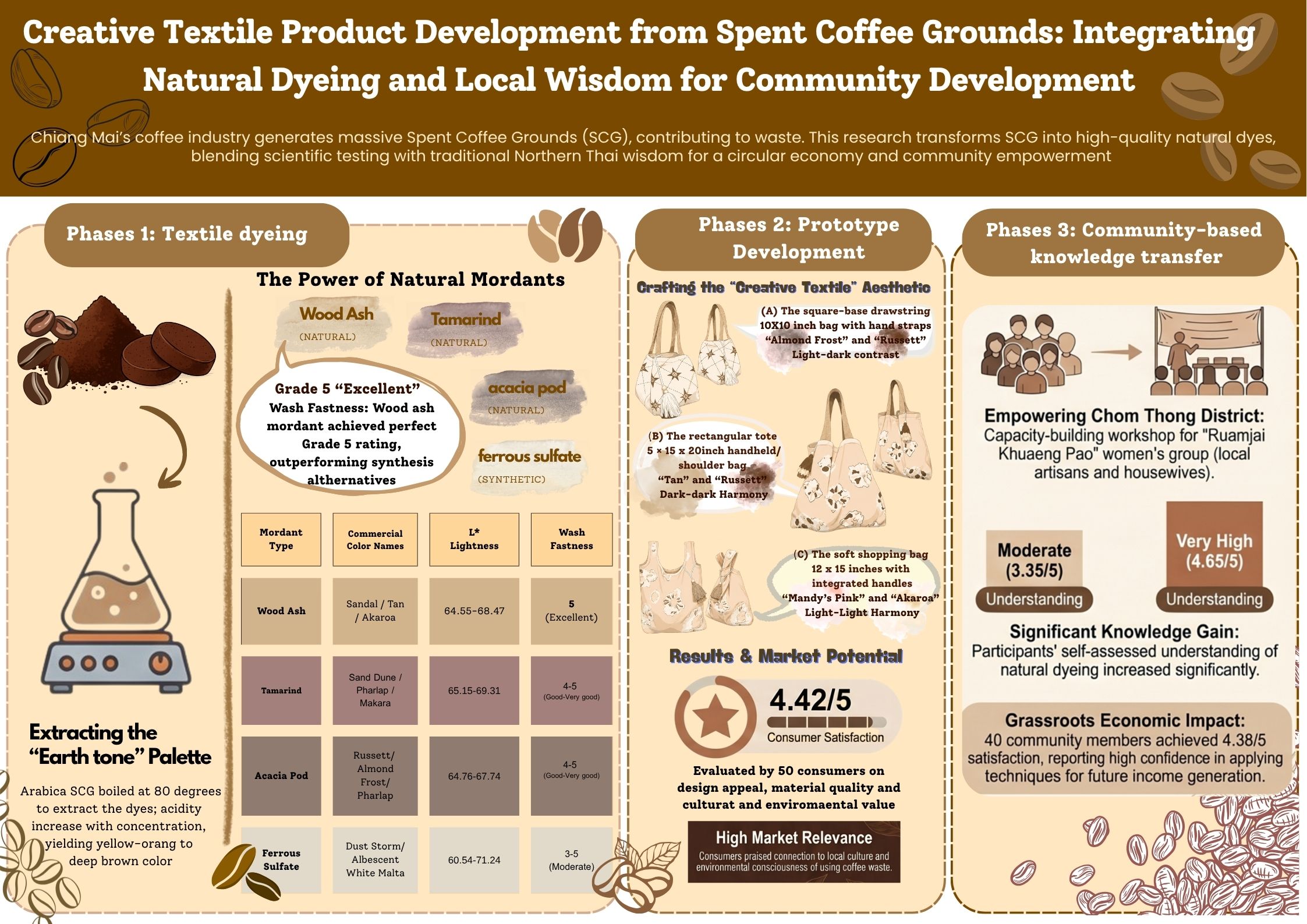
This applied research aimed to explore the potential of spent coffee grounds (SCG) derived from Arabica collected from local coffee shop in Chom Tong District, Chiang Mai Province, Thailand, as a natural dye source and their application in the development of creative textile products reflecting the local identity of Chiang Mai Province. The study integrated local wisdom with modern textile techniques and community base-design approach. The dye was extracted by boiling SCG and applied to cotton yarn using both natural mordants including wood ash, tamarind, and acacia pods and a synthetic mordants for comparison. The dyed yarns were analyzed using the CIELAB and Munsell color systems and tested for wash fastness according to ISO 105 C06 standards. Results revealed a wide range of earthy shades, with the highest lightness value recorded at L* at 71.24±2.09 and good to excellent fastness levels (grades 4–5), especially with natural mordants. The developed prototypes, designed as tote bags, received positive evaluations from 3 experts and 50 consumers, with an average satisfaction score of 4.42±0.43 out of 5. A community workshop involving 40 purposively selected members of local women’s groups in Chom Thong District, Chiang Mai Province, whose occupations and local resources were closely associated with the availability and utilization of SCG, was conducted, achieving a high satisfaction level of 4.38 ± 0.66. The study demonstrates that SCG can be transformed into a valuable renewable resource, promoting grassroots economic development, cultural sustainability, and eco-friendly textile innovation within communities.
Downloads
References
Ahmed, H., Abolore, R. S., Jaiswal, S., & Jaiswal, A. K. (2024). Toward Circular Economy: Potentials of Spent Coffee Grounds in Bioproducts and Chemical Production. Biomass, 4(2), 286–312. https://doi.org/10.3390/biomass4020014
Bae, J., & Hong, K. H. (2019). Optimized dyeing process for enhancing the functionalities of spent coffee dyed wool fabrics using a facile extraction process. Polymers, 11(4), 574. https://doi.org/10.3390/polym11040574
Banmuang. (2019). Mae Ing Shibori natural-dyed fabrics gain popularity and boost local income. https://www.banmuang.co.th/news/region/174110
Becker, P., Howarth, S., & Wrobel, I. C. (2024). Eco-Friendly Dyeing Processes of Nylon 6.6 Woven Fabrics with Used Coffee Grounds (UCG). Sustainability, 16(20), 8919. https://doi.org/10.3390/su16208919
Boonnam, J., & Nawakitphaitoon, N. (2022). Innovation of Cultural Knowledge and Local Wisdom Management for Community Development in Nakhon Si Thammarat Province. Journal of Buddhistic Sociology, 7(2), 103-114. https://so06.tci-thaijo.org/index.php/BSJ/article/view/254635
Charoenlarp, K., Surakul, K., Sitthinopphan, P., Raksuan, K., Takai, S., Bunnak, N., & Lertlam, A. (2017). Tie-dye fabrics with natural dyes from coffee grounds. RMUTT Research Journal, 10(1), 1–10. https://li01.tci-thaijo.org/index.php/researchjournal2rmutto/issue/view/9815
Chiangmaiwecare. (2021). Chiang Mai, the city of coffee – tasting one shop a day for 7 years. https://shorturl.asia/U0FMQ
Choomchit, J., & Peksri, A. (2023). Development of Home Textile Products from Cotton Fabric Dyed with Sappan Wood. Journal of Science and Technology Mahasarakham University, 42(5), 187-199. https://li01.tci-thaijo.org/index.php/scimsujournal/article/view/256037
Dailynews Online. (2023). Extracting natural dye powder and applying it in creative textile printing. https://www.dailynews.co.th/news/2018496/
Hong, K. H., (2018). Effects of tannin mordanting on coloring and functionalities of wool fabrics dyed with spent coffee grounds. Hong Fash Text, 5(33), 1-11. https://doi.org/10.1186/s40691-018-0151-3
Inpakdee, P., & Soodsang, T. (2025). The Design and Development of Community Textile Products from Banana Fiber Blends as Commercial Prototypes. Community and Social Development Journal, 26(1), 112–125. https://doi.org/10.57260/csdj.2025.273272
Johnson, K., Liu, Y., & Lu, M. (2022). A Review of Recent Advances in Spent Coffee Grounds Upcycle Technologies and Practices. Frontiers in Chemical Engineering, 4, 1-15. https://doi: 10.3389/fceng.2022.838605
Komonsirichok, Y., Sutakcom, O., & Mitpaeng, T. (2024). Development of Fabric Surface Texture and Design Natural Dyed Hand-Woven Patternsin the Northern Region. Community and Social Development Journal, 25(1), 28–44. https://doi.org/10.57260/rcmrj.2024.264128
Melaku, A., Demeke, G., Aschale, M., Alemayehu, F., & Semegn, G. (2023). Extraction and Characterization of Natural Dye Stuff from Spent Coffee Ground and Bio-Mordant from Mango Bark. Journal of natural fibers, 20(2), 2276725. https://doi.org/10.1080/15440478.2023.2276725
Melles, G. (2020). Participatory Co-design for Sustainable Development. In W. Leal Filho,
A. Azul, L. Brandli, A. Lange Salvia, & T. Wall (Eds.), Partnerships for the Goals: Encyclopedia of the UN Sustainable Development Goals. Springer, Cham. https://doi.org/10.1007/978-3-319-71067-9_47-1
Pongwiritthon, R., & Syers, K. (2016). Guidelines for Sustainable Chiang Mai Tourism Development according to The Attitude of Tourists. Journal of Humanities and Social Sciences Thonburi University, 10(22), 60–66. https://so03.tci-thaijo.org/index.php/trujournal/article/view/56427
Ratten, V., Ramirez-Pasillas, M., & Lundberg, H. (2019). Managing sustainable innovation. Routledge, London. https://doi.org/10.4324/9780429264962
Selanok, A., Phengchai, T., & Songpanya, M. (2018). Study of Applying Coffee Grounds as Raw Material for Spa Product Design. Journal of Asia Design & Research, 1(1), 45–53. https://so02.tci-thaijo.org/index.php/JADeR/article/view/157168
Setthayanond, J., Tooptompong, P., Suwanruji, P., & Srisuwan, P. (2025). Dyeing characteristics and performance of natural dye derived from spent coffee ground on cotton, silk and nylon fabrics using eco-friendly dyeing process. Chiang Mai Journal of Science, 52(1), e2025002. https://doi.org/10.12982/CMJS.2025.002
Sirimongkolchai, S., Srikalyanukun, M., & Sinlapawattana, P. (2021). Extraction and preliminary quality analysis of oil extracted from spent coffee grounds. In S. Unnangkas (Ed.), The 2nd National Conference on Science, Technology, and Innovation (pp. 757–765). Faculty of Science and Technology, Maejo University.
Tangmankongvorakul, N., & Preedasuriyachai, P. (2015). A Study on How to Utilize Coffee Residue and Tea Residue for The Production of Briquettes. Srinakharinwirot University Journal of Sciences and Technology, 7(13), 15–26. https://ph02.tci-thaijo.org/index.php/swujournal/article/view/54432
Tehrani, M., Ghaheh, F. S., Beni, Z. T., & Rahim, M. (2023). Extracted dyes' stability as obtained from spent coffee grounds on silk fabrics using eco‑friendly mordants. Environmental Science and Pollution Research, 30, 68625–68635. https://doi.org/10.1007/s11356-023-27157-0
Tourism Authority of Thailand. (2025). Chiangmai. https://www.tourismthailand.org/Destinations/Provinces/Chiang-Mai/101
Downloads
Additional Files
Published
How to Cite
Issue
Section
Categories
License
Copyright (c) 2026 Community and Social Development Journal

This work is licensed under a Creative Commons Attribution-NonCommercial-NoDerivatives 4.0 International License.