Negotiating Cultural Identity: Fusion and Innovation in the Luolong Lion Dance of the Sichuan-Tibet Tea-Horse Road
DOI:
https://doi.org/10.57260/csdj.2025.282757Keywords:
Sichuan-Tibet tea horse road, Cultural integration, Han-Tibetan fusion dance, Luolong lion danceAbstract
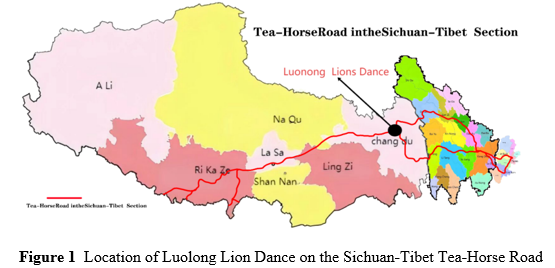
This qualitative research examines the Luolong Lion Dance, a culturally hybrid folk performance that originated along the Sichuan-Tibet Tea-Horse Ancient Road. The study aims to explore how the Han Chinese lion dance evolved through interaction with Tibetan religious, aesthetic, and musical traditions. Data collection was conducted through literature review, field observation, and interviews with local performers. Using the theory of cultural integration, the study found that the dance developed through three stages: contact, selection, and integration. The lion dance was initially brought to the Tibetan region through trade and migration. It was then selectively adapted to include rhythmic patterns from Tibetan pot dance and costume elements reflecting local beliefs. Eventually, a fully integrated form emerged, combining Han lion dance structure with Tibetan symbolic and stylistic features.
The research reveals that the Luolong Lion Dance is not a simple borrowing but a new cultural creation reflecting the dynamic coexistence of ethnic traditions. This offers new insights into how folk arts evolve as tools of identity negotiation and cultural sustainability. The findings contribute to performance studies and heritage preservation, and they highlight the potential of traditional dance to promote social cohesion in multiethnic communities. While statistical data was not the focus due to the qualitative nature of the research, the study emphasizes the frequency and consistency of cultural elements shared across communities. This work provides valuable knowledge for scholars, cultural practitioners, and policymakers interested in intercultural understanding and community-based cultural preservation.
Downloads
References
Barth, F. (1969). Ethnic groups and boundaries: The social organization of culture difference. Little, Brown and Company.
Bourdieu, P. (1984). Distinction: A social critique of the judgement of taste. Harvard University Press.
Braun, V., & Clarke, V. (2006). Using thematic analysis in psychology. Qualitative Research in Psychology, 3(2), 77–101. https://doi.org/10.1191/1478088706qp063oa
Central Ethnic Affairs Work Conference. (2021). Xi Jinping's speech at the Central Ethnic Affairs Work Conference. People's Daily.
Danzeng, C. (2014). Xizang gewu gaisuo. Minzu Publishing House.
Durkheim, É. (1893). The division of labor in society. New York: Free Press.
Eriksen, T. H. (2010). Ethnicity and nationalism: Anthropological perspectives. (3rd ed.). Pluto Press.
Fei, X. T. (1999). Rural China. Peking University Press.
Foucault, M. (1972). The archaeology of knowledge . Tavistock Publications.
Geertz, C. (1973). The interpretation of cultures. Basic Books.
Gordon, M. M. (1964). Assimilation in American life: The role of race, religion, and national origins. Oxford University Press.
Hall, S. (1996). Introduction: Who needs 'identity'? In S. Hall & P. du Gay (Eds.), Questions of cultural identity. (pp. 1–17). SAGE.
Jones, E. (2019). Wenhua ronghe: Jiyu lishixue he jingjixue de wenhua piping. Zhejiang University Press.
Liu, C. (2021). Jin sanshi nian lai Chama Gudao yanjiu zongshu. A review of Tea Horse Road research in the past thirty years. Nongye Kaogu Agricultural Archaeology.
Liu, H., Zheng, Q., He, P., & Li, M. (2008). Xiandai lingdao baike quanshu: Keji yu wenhua juan. Encyclopedia of modern leadership: Volume on science and culture. Party School of the Central Committee of the CPC Press.
Lu, H. (2021). A discussion on the development of the Southwest Tea-Horse Ancient Road and inter-ethnic cultural exchange. IIARP International Conference.
Downloads
Published
How to Cite
Issue
Section
Categories
License
Copyright (c) 2025 Community and Social Development Journal

This work is licensed under a Creative Commons Attribution-NonCommercial-NoDerivatives 4.0 International License.