
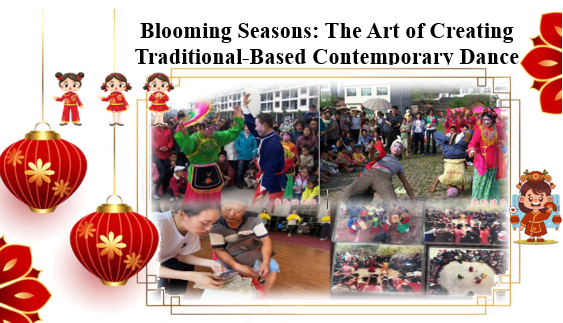
Blooming Seasons: The Art of Creating Traditional-Based Contemporary Dance
DOI:
https://doi.org/10.57260/csdj.2026.282762Keywords:
Mayang huadeng, Traditional-based contemporary dance, Blooming seasons, Creative transformation, Intangible cultural heritageAbstract
As one of the representative traditional dances of Hunan Province, China, Mayang Huadeng faces the challenge of integrating into contemporary society while preserving its cultural heritage. Taking innovation as the starting point, this research explores the creation of contemporary dance based on traditional Mayang Huadeng through practical investigation and artistic creation. The study examines traditional creative methods of Mayang Huadeng and develops contemporary dance works grounded in these traditions, ultimately establishing an approach for creating contemporary dance art rooted in traditional forms. Data collection involved literature review and fieldwork utilizing interviews and observations as primary research instruments. The researchers conducted creative practice research employing focus groups to gather expert feedback on the choreographic process. Through comprehensive analysis, this study presents a methodology for creating contemporary dance art that honors tradition while embracing innovation. The resulting dance work, 'Blooming Seasons,' demonstrates how traditional elements can be transformed through creative adaptation of movement vocabulary, innovative development of traditional forms, and balanced integration of collective heritage with individual artistic expression. This research contributes to the discourse on intangible cultural heritage preservation by proposing practical strategies for revitalizing traditional dance forms to meet contemporary aesthetic expectations while maintaining cultural authenticity.
Downloads
References
He, C. (2020). ‘The Most Traditional and the Most Pioneering’: New Concept Kun Opera. New Theatre Quarterl, 36(4), 223-236. https://doi.org/10.1017/S0266464X20000469
Hobsbawm, E., & Ranger, T. (1983). The Invention of Tradition. Cambridge and New York: Cambridge University Press.
Hongxian, S., & Yodwised, C. (2023). Studying Yunnan Huadeng and Constructing Yunnan Huadeng Course Plan for Teaching at Yunnan Arts University, China, Journal of Modern Learning Development, 8(10), 294-300. https://so06.tci-thaijo.org/index.php/jomld/article/view/263322
Huang, Z. (2024). To explore the artistic, cultural and education characteristics and inheritance of dance in of music and dance of silk road in the han and tang dynasties. Art and Education, 38, 122-131. https://artseduca.com/submissions/index.php/ae/article/view/249/72
Huang, R., Zhang, L., & Li, Y. (2025). Transforming dance education in China: enhancing sustainable development and cultural preservation. International Journal of Inclusive Education, 1-25. https://doi.org/10.1080/14647893.2025.2524151
Jian, Z., & Nicolas, A. (2021). Zhuang Opera- A study of Chinese Minority Arts in Guangxi Province, China. Turkish Journal of Computer and Mathematics Educatio, 12(6), 2900-2912. https://doi.org/10.17762/turcomat.v12i6.5799
Lin, J. (2025). Inheritance and Innovation of Puxian Opera: From the Perspective of Fieldwork — A Case Study of the Living Practice of Local Opera. Lecture Notes in Education, Arts, Management and Social Science, 3(5), 237-243. https://doi.org/10.18063/lne.v3i5.1107
Liu, S., & Chuangprakhon, S. (2024). Reviewing the current situation of Huadengxi Chinese folk songs in Yunnan province. Multidisciplinary Reviews, 7(5), 2024109. https://doi.org/10.31893/multirev.2024109
Luna, Z, & Shuib, T. R. B. (2025). Inheritance and Innovation: The Multi-Dimensional Charm and International Influence of Chinese Intangible Cultural Heritage. International Journal of Academic Research in Business and Social Sciences, 15(6), 1469-1476. http://dx.doi.org/10.6007/IJARBSS/v15-i6/25818
Mackerras (1992) study of integration and the dramas of China's minorities. Asian Theatre Journal, 9(1), 1-37. https://doi.org/10.2307/1124248
Mao, L., & Potiwetchakul, S. (2025). The Movement Characteristic and Cultural Connotation of Gujiazi in Anhui Huagudeng Dance. Journal of Dhamma for Life, 31(2), 521–531. https://so08.tci-thaijo.org/index.php/dhammalife/article/view/4386
Miao, P., Musib, A. F., & Chan, C. S. C. (2023). The Modern Heritage of Chinese Traditional Culture in the Perspective of Intangible Cultural Heritage Preservation - A Case Study of Henan Zhuizi. International Journal of Academic Research in Progressive Education and Development, 11(2), 1166-1181. https://url.in.th/sLPRj
Provincial Cultural Education Department. (2013). A Miao Village’s 'Duet' Enriches Colorful Life". China: Provincial Cultural Education Department.
Wang, X. (2015). A Case Study of Miao Village in China: Cultural Identity, Change and Conservation. Advances in Anthropology, 5, 126-135. https://doi.org/10.4236/aa.2015.52011
Wilcox, E. (2018). Dynamic Inheritance: Representative Works and the Authoring of Tradition in Chinese Dance. Journal of Folklore Research, 55(1), 77-111. https://doi.org/10.2979/jfolkrese.55.1.04
Yana, C. ., Yukolthonwong , S. ., & Lertsivaporn, J. . (2024). The History and Types of Chinese Folk Dance . Journal of Modern Learning Development, 9(11), 938–945. https://so06.tci-thaijo.org/index.php/jomld/article/view/292521
Zhang, Xiao., Zhang, A., Xu, J., & Ma, R. (2022). Documentation and Inheritance of Ancient Opera Stage Based on Multidisciplinary Approach and Digital Technology. Buildings, 12(7), 977. https://doi.org/10.3390/buildings12070977
Zhao, W., Xiao, D., Li, J., Xu, Z., & Tao, J. (2024). Research on Traditional Village Spatial Differentiation from the Perspective of Cultural Routes: A Case Study of 338 Villages in the Miao Frontier Corridor. Sustainability, 16(13), 5298. https://doi.org/10.3390/su16135298
Zong, X., Li, Q., & Shi, Q. (2025). A study of the impact mechanism of Chinese higher folk dance education on the traditional national cultural inheritance and innovation among young universities students: a deep exploration. Research in Dance Education, 1–25. https://doi.org/10.1080/14647893.2025.2465462
Downloads
Published
How to Cite
Issue
Section
Categories
License
Copyright (c) 2026 Community and Social Development Journal

This work is licensed under a Creative Commons Attribution-NonCommercial-NoDerivatives 4.0 International License.