
A Narrative Review on the Impacts of Digital Literacy and Social Capital on the Innovation Performance of Cultural Enterprises
DOI:
https://doi.org/10.57260/csdj.2025.282829Keywords:
Social capital, Digital literacy, Innovation performance, Cultural industry clusters, Collaborative innovation platformsAbstract
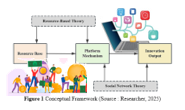
Amid the rapid global growth of the cultural and creative economy, China’s cultural industry has emerged as a key driver of regional economic transformation, fueled by policy support, digital technology, and consumption upgrades. Small and micro cultural enterprises, now accounting for over 84% of the sector, play a critical role in cultural innovation but face persistent structural challenges that hinder their innovation performance. This narrative review, based on Web of Science and Scopus literature, integrates Resource-Based Theory and Social Network Theory to propose a “Resource-Network-Platform” framework, revealing how digital literacy and social capital dynamically interact to enhance innovation performance within cultural industry clusters. Based on the dual logics of resources and networks, this study proposed an integrative theoretical model of innovation in SMEs of cultural enterprises so as to build foundation for future empirical studies. Findings highlight a dynamic coupling mechanism between internal capabilities and external networks, offering theoretical insights and practical guidance for cluster governance, platform development, and enterprise digital capacity building, while paving the way for cross-theoretical research in cultural industries. Unlike previous studies solely stand from a single perspective, this study emphasizes the dynamic, systemic value of theoretical intersections in explaining innovation mechanisms in SMEs.
Downloads
References
Alguezaui, S., & Filieri, R. (2010a). Investigating the role of social capital in innovation: sparse versus dense network. Journal of Knowledge Management. 14(6), 891-909. https://doi.org/10.1108/13673271011084925
Alguezaui, S., & Filieri, R. (2010b). Understanding knowledge sharing in interorganizational projects. International Journal of Project Management, 28(7), 638-649. https://doi.org/10.1016/j.ijproman.2009.12.004
Barney, J. B. (1991). Firm resources and sustained competitive advantage. Journal of Management, 17(1), 99–120. https://doi.org/10.1177/014920639101700108
Benbow, R. J., & Lee, C. (2019). Teaching-focused social networks among college faculty: Exploring conditions for the development of social capital. Higher Education, 78(1), 67–89. https://doi.org/10.1007/s10734-018-0274-1
Borgatti, S. P., & Halgin, D. S. (2011). On network theory. organization science. https://ssrn.com/abstract=2260993
Brown, K. G., & Van Buren, M. E. (2007). Applying a social capital perspective to the evaluation of distance training. In S. M. Fiore & E. Salas (Eds.), Toward a science of distributed learning. American Psychological Association. https://doi.org/10.1037/11582-003
Burt, R. S. (1992). Structural holes: The social structure of competition. Harvard University Press. https://doi.org/10.4159/harvard.9780674843714
Calvani, A., Cartelli, A., Fini, A., & Ranieri, M. (2008). Models and Instruments for assessing Digital Competence at School. Journal of e-learning and knowledge society, 4(3), 183-193. https://doi.org/10.20368/1971-8829/288
Cappiello, G., Giordani, F., & Visentin, M. (2020). Social capital and its effect on networked firm innovation and competitiveness. Industrial Marketing Management, 89, 422–430. https://doi.org/10.1016/j.indmarman.2020.03.007
Cetindamar, D., & Abedin, B. (2021). Understanding the role of employees in digital transformation: conceptualization of digital literacy of employees as a multi-dimensional organizational affordance. Journal of Enterprise Information Management, 34(6), 1649-1672. https://doi.org/10.1108/JEIM-01-2020-0010
Coleman, J. S. (1988). Social capital in the creation of human capital. American Journal of Sociology, 94(1), S95-S120. https://www.jstor.org/stable/2780243
Cui, W., Sun, C., & Chen, G. (2021). Distance Produces Beauty? The Influence of Government-Enterprise Relationship on Enterprise Financing and Innovation. Science of Science and Management of Science and Technology, 42(06), 81-101.
Deschênes, M., Dionne, L., & Parent, S. (2024). Supporting digital competency development for vocational education student teachers in distance education. Frontiers in Education, 9, 1452445. https://doi.org/10.3389/feduc.2024.1452445
ECDL Foundation. (2018). Digital literacy framework (Version 2.0). ECDL Foundation. https://ecdl.ro/uploads/articole/resources/files/ECDL_DigComp_Brochure_EN_2018.pdf
Eden, S., & Eshet-Alkalai, Y. (2013). How digital literacy shapes learning. Journal of Educational Computing Research, 49(1), 1–14. https://doi.org/10.2190/EC.49.1.a
Eshet, Y. (2012). Thinking in the digital era: A revised model for digital literacy. In P. Resta (Ed.), Proceedings of Society for Information Technology & Teacher Education International Conference (pp. 1–8). AACE.
Ganguly, A., Talukdar, A., & Chatterjee, D. (2019). Evaluating the role of social capital, tacit knowledge sharing, knowledge quality and reciprocity in determining innovation capability of an organization. Journal of Knowledge Management, 23(6), 1105-1135. https://doi.org/10.1108/JKM-03-2018-0190
García-Villaverde, P. M., Parra-Requena, G., & Molina-Morales, F. X. (2018). Structural social capital and knowledge acquisition: Implications of cluster membership. Entrepreneurship & Regional Development, 30(5-6), 530–561. https://doi.org/10.1080/08985626.2017.1407366
García-Villaverde, P. M., Ruiz-Ortega, M. J., Hurtado-Palomino, A., De La Gala-Velásquez, B., & Zirena-Bejarano, P. P. (2021). Social capital and innovativeness in firms in cultural tourism destinations: Divergent contingent factors. Journal of Destination Marketing & Management, 19, 100529. https://doi.org/10.1016/j.jdmm.2020.100529
Granovetter, M. S. (1973). The strength of weak ties. American Journal of Sociology, 78(6), 1360–1380. https://doi.org/10.1086/225469
Hashim, M. J., Osman, I., & Alhabshi, S. M. (2015). Effect of intellectual capital on organizational performance. Procedia—Social and Behavioral Sciences, 211, 207–214. https://doi.org/10.1016/j.sbspro.2015.11.085
Heitin, L. (2016). What is digital literacy? Education Week. https://www.edweek.org/teaching-learning/what-is-digital-literacy/2016/11
Huang, L.-T. (2016). Flow and social capital theory in online impulse buying. Journal of Bussiness Research, 69(6), 2277-2283. https://doi.org/10.1016/j.jbusres.2015.12.042
Inkpen, A. C., & Tsang, E. W. K. (2005). Social Capital, Networks, and Knowledge Transfer. The Academy of Management Review, 30(1), 146–165. https://www.jstor.org/stable/20159100
Ju, X., & Wang, G. (2023). How do network ties affect firm performance growth and its variability? The mediating roles of exploratory and exploitative knowledge utilization. Journal of Business Research, 160, 113781. https://doi.org/10.1016/j.jbusres.2023.113781
Kannadhasan, M., Charan, P., Singh, P., & N, S. (2018). Relationships among social capital, self-efficacy, and new venture creations. Management Decision, 56(1), 204–218. https://doi.org/10.1108/MD-04-2017-0304
Kim, N., & Shim, C. (2018). Social capital, knowledge sharing and innovation of small- and medium-sized enterprises in a tourism cluster. International Journal of Contemporary Hospitality Management, 30(6), 2417–2437. https://doi.org/10.1108/IJCHM-07-2016-0392
Lanham, R. A. (1995). Digital literacy. Scientific American, 273(3), 198-199.
Li, J., & Yu, Y. (2022). From collaborative research to new product development: why a central or brokered network position is not enough. Journal of Knowledge Management, 26(3), 615-641. https://doi.org/10.1108/JKM-06-2020-0473
Lyu, C., Peng, C., Yang, H., Li, H., & Gu, X. (2022). Social capital and innovation performance of digital firms: Serial mediation effect of cross-border knowledge search and absorptive capacity. Journal of Innovation & Knowledge, 7(2), 100187. https://doi.org/10.1016/j.jik.2022.100187
Makridis, C. A., & Wu, C. (2021). How social capital helps communities weather the COVID-19 pandemic. PLOS ONE, 16(1), e02545135. https://doi.org/10.1371/journal.pone.0245135
Martin, A., & Grudziecki, J. (2006). DigEuLit: Concepts and tools for digital literacy development. Innovation in Teaching and Learning in Information and Computer Sciences, 5(4), 249–267. https://doi.org/10.11120/ital.2006.05040249
Martínez-Cañas, R., Sáez-Martínez, F.J. and Ruiz-Palomino, P. (2012) Knowledge Acquisition’s Mediation of Social Capital-Firm Innovation. Journal of Knowledge Management, 16(1), 61-76. https://doi.org/10.1108/13673271211198945
Ministry of Commerce General Office. (2024). Notice on implementing the digital consumption enhancement action. Ministry of Commerce of the People’s Republic of China. https://www.gov.cn/zhengce/zhengceku/202404/content_7007260.htm
Mohammadyari, S., & Singh, H. (2015). Understanding the effect of e-learning on individual performance: The role of digital literacy. Computers & Education, 82, 11–25. https://doi.org/10.1016/j.compedu.2014.10.025
Nahapiet, J., & Ghoshal, S. (1998). Social capital, intellectual capital, and the organizational advantage. The Academy of Management Review, 23(2), 242–266. https://doi.org/10.2307/259373
Nambisan, S., Siegel, D., & Kenney, M. (2018). On open innovation, platforms, and entrepreneurship. Strategic Entrepreneurship Journal, 12(3), 354–368. https://doi.org/10.1002/sej.1300
Ng, W. (2012). Can we teach digital natives digital literacy?. Computers & Education, 59(3), 1065–1078. https://doi.org/10.1016/j.compedu.2012.04.016
Pearce, O. (2022). Impact Investing: Exploring a Common Language Between Stakeholders for the Advancement of the Arts & Cultural Field. Drexel University.
People's Daily Overseas Edition. (2023, June 20). China's SMEs exceed 52 million: An average of 23,800 new enterprises established per day in 2022. The State Council of the People's Republic of China. https://www.gov.cn/lianbo/bumen/202306/content_6887257.htm
Ramaswamy, V., & Gouillart, F. (2010). Building the co-creative enterprise. Harvard Business Review. https://venkatramaswamy.com/articles_files/2010-hbr.html
Santoso, H. B., Santoso, H., & Setiawan, R. (2019). Digital literacy skills for industrial revolution 4.0: A comprehensive review. International Journal of Advanced Science and Technology, 29(6), 7726–7733.
Singh, S. K., Mazzucchelli, A., Vessal, S. R., & Solidoro, A. (2021). Knowledge-based HRM practices and innovation performance: Role of social capital and knowledge sharing. Journal of International Management, 27(1), 100830. https://doi.org/10.1016/j.intman.2021.100830
Tang, C., Chen, W., & Peng, C. (2014). Social Capital, Failure Learning and Innovation Performance of Scientific Research Teams. Studies in Science of Science, 32(07), 1096-1105. https://www.oriprobe.com/journals/kxxyj/2014_7.html
Tang, D., Wei, F., Yang, N., Zhou, M., Liu, T., & Qin, B. (2014b). Learning Sentiment-Specific Word Embedding for Twitter Sentiment Classification. Proceedings of the 52nd Annual Meeting of the Association for Computational Linguistics, 1555-1565.
Teece, D. J., Pisano, G., & Shuen, A. (1997). Dynamic capabilities and strategic management. Strategic Management Journal, 18(7), 509–533. https://doi.org/10.1002/(SICI)1097-0266(199708)18:7<509::AID-SMJ882>3.0.CO;2-Z
Tsou, C.-C., Avtonomov, D., Larsen, B., Tucholska, M., Choi, H., Gingras, A.-C., & Nesvizhskii, A. I. (2015). DIA-Umpire: Comprehensive computational framework for data-independent acquisition proteomics. Nature Methods, 12, 258–264. https://doi.org/10.1038/nmeth.3255
Uhlaner, L. M., Matser, I. A., Berent-Braun, M. M., & Flören, R. H. (2015). Linking Bonding and Bridging Ownership Social Capital in Private Firms: Moderating Effects of Ownership–Management Overlap and Family Firm Identity. Family Business Review, 28(3), 260-277. https://doi.org/10.1177/0894486515568974
Watson, R., Wilson, H. N., Smart, P., & Macdonald, E. K. (2018). Harnessing difference: A capability-based framework for stakeholder engagement in environmental innovation. Business Strategy and the Environment, 35(2), 254-279. https://doi.org/10.1111/jpim.12394
Wen, J., Qualls, W. J., & Zeng, D. (2021). To explore or exploit: The influence of inter-firm R&D network diversity and structural holes on innovation outcomes. Technovation, 100, 102178. https://doi.org/10.1016/j.technovation.2020.102178
Willie, M. (2024). Leveraging digital resources: A Resource-Based View perspective. Golden Ratio of Human Resource Management, 5(1), 1–14. https://doi.org/10.52970/grhrm.v5i1.415
Woolcock, M. (1998). Social capital and economic development: Toward a theoretical synthesis and policy framework, 27(2), 151-208. http://hdl.handle.net/10919/67568
Downloads
Published
How to Cite
Issue
Section
Categories
License
Copyright (c) 2025 Community and Social Development Journal

This work is licensed under a Creative Commons Attribution-NonCommercial-NoDerivatives 4.0 International License.