
The Study of Educational Management in Internet New Media Majors in Chinese Universities
DOI:
https://doi.org/10.57260/csdj.2026.283418Keywords:
Internet new media education, Educational management, Institutional comparison, Curriculum reformAbstract
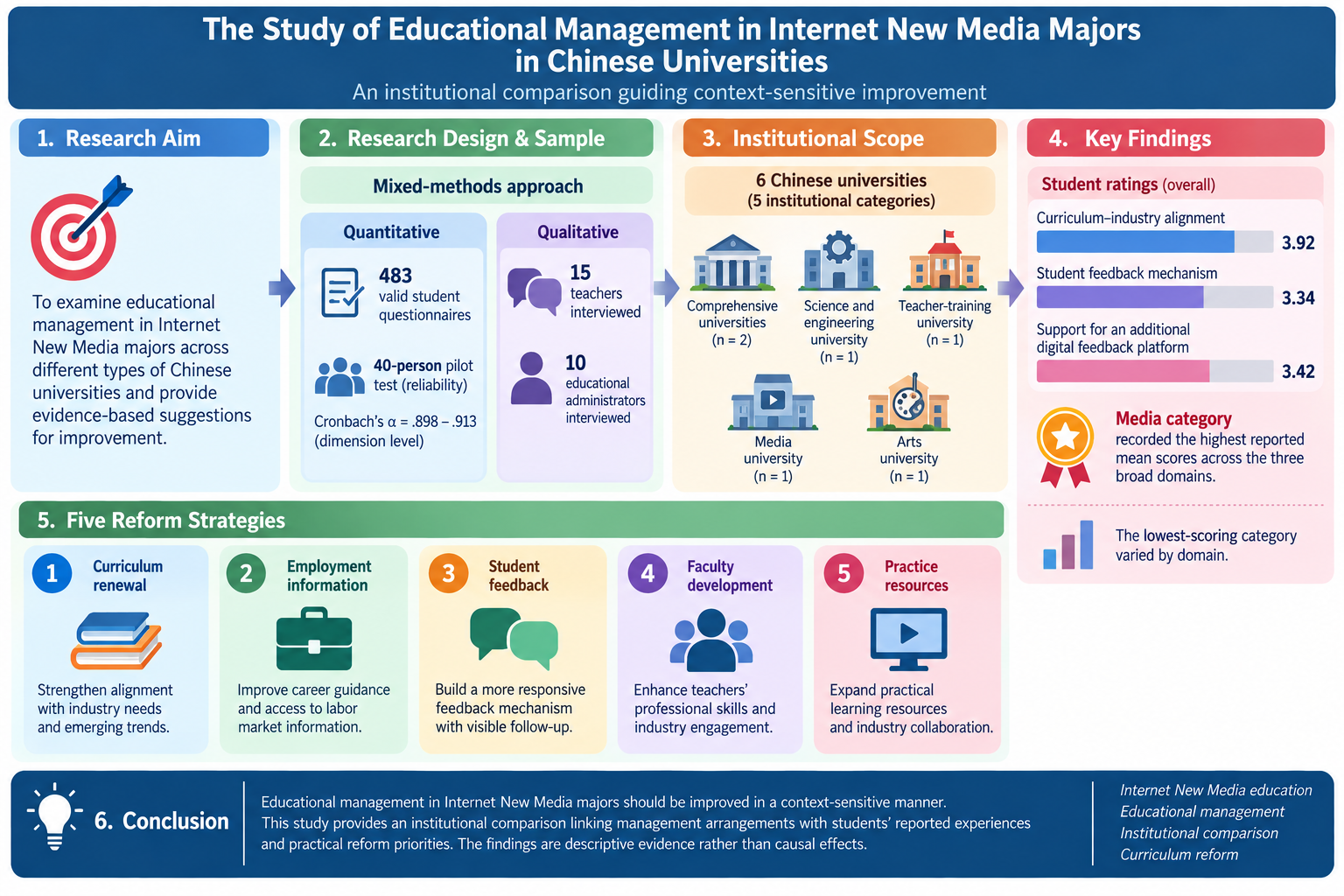
This study examines educational management in Internet New Media majors across six Chinese universities spanning five institutional categories: two comprehensive universities and one university in each of the science and engineering, teacher-training, media, and arts categories. A mixed-methods design combined 483 valid student questionnaires with interviews involving 15 teachers and 10 educational administrators. A 40-person pilot assessed questionnaire reliability, with dimension-level Cronbach’s alpha coefficients of .898–.913. Descriptive findings and interview accounts were integrated through a policy–practice–effectiveness framework. Students rated curriculum–industry alignment positively (M = 3.92), whereas the student feedback mechanism received a lower rating (M = 3.34). Support for an additional digital feedback platform was also comparatively low (M = 3.42), suggesting that responsiveness and visible follow-up require attention alongside technical access. The media category recorded the highest reported mean scores across the three broad domains, although the lowest-scoring category varied by domain. Five reform strategies addressed curriculum renewal, employment information, student feedback, faculty development, and practice resources. The study’s contribution is an institutional comparison that connects management arrangements with students’ reported experiences and practical reform priorities. The findings support context-sensitive improvement and should be interpreted as descriptive evidence rather than causal effects.
Downloads
References
Almulla, M. A. (2024). Investigating influencing factors of learning satisfaction in AI ChatGPT for research: University students perspective. Heliyon, 10(11), e32220. https://doi.org/10.1016/j.heliyon.2024.e32220
Astin, A. W. (1993). What matters in college? Four critical years revisited. Jossey-Bass.
Biggs, J., & Tang, C. (2011). Teaching for quality learning at university: What the student does. (4th ed.). Open University Press.
Cai, B., Zhu, Y., & Chen, T. (2020). Challenges faced by school education in the new media era. In Proceedings of the 2020 5th International Conference on Humanities Science and Society Development (ICHSSD 2020). Atlantis Press. https://doi.org/10.2991/assehr.k.200727.056
Carless, D., & Boud, D. (2018). The development of student feedback literacy: Enabling uptake of feedback. Assessment & Evaluation in Higher Education, 43(8), 1315–1325. https://doi.org/10.1080/02602938.2018.1463354
Chalkiadakis, A., Seremetaki, A., Kanellou, A., Kallishi, M., Morfopoulou, A., Moraitaki, M., & Mastrokoukou, S. (2024). Impact of artificial intelligence and virtual reality on educational inclusion: A systematic review of technologies supporting students with disabilities. Education Sciences, 14(11), 1223. https://doi.org/10.3390/educsci14111223
Chan, C. K. Y., & Hu, W. (2023). Students’ voices on generative AI: Perceptions, benefits, and challenges in higher education. International Journal of Educational Technology in Higher Education, 20, 43. https://doi.org/10.1186/s41239-023-00411-8
Che, Y. (2023). Innovative thinking on media education in vocational colleges and universities in the all-media era. Frontiers in Educational Research, 6(14), 109–115. https://doi.org/10.25236/FER.2023.061418
Cook-Sather, A. (2006). Sound, presence, and power: “Student voice” in educational research and reform. Curriculum Inquiry, 36(4), 359–390. https://doi.org/10.1111/j.1467-873X.2006.00363.x
Fabrigar, L. R., Wegener, D. T., MacCallum, R. C., & Strahan, E. J. (1999). Evaluating the use of exploratory factor analysis in psychological research. Psychological Methods, 4(3), 272–299. https://doi.org/10.1037/1082-989X.4.3.272
Fetters, M. D., Curry, L. A., & Creswell, J. W. (2013). Achieving integration in mixed methods designs—Principles and practices. Health Services Research, 48(6 Pt 2), 2134–2156. https://doi.org/10.1111/1475-6773.12117
Hemminki-Reijonen, U., Hassan, N. M. A. M., Huotilainen, M., Koivisto, J.-M., & Cowley, B. U. (2025). Design of generative AI-powered pedagogy for virtual reality environments in higher education. npj Science of Learning, 10, 31. https://doi.org/10.1038/s41539-025-00326-1
Hu, L. T., & Bentler, P. M. (1999). Cutoff criteria for fit indexes in covariance structure analysis: Conventional criteria versus new alternatives. Structural Equation Modeling: A Multidisciplinary Journal, 6(1), 1–55. https://doi.org/10.1080/10705519909540118
Huang, L. (2023). A review of the research on the development of new media education in China in the past twenty years. BCP Education & Psychology, 11, 32–40. https://doi.org/10.54691/paycd515
Nicol, D. J., & Macfarlane-Dick, D. (2006). Formative assessment and self-regulated learning: A model and seven principles of good feedback practice. Studies in Higher Education, 31(2), 199–218. https://doi.org/10.1080/03075070600572090
Rong, Q., Lian, Q., & Tang, T. (2022). Research on the influence of AI and VR technology for students’ concentration and creativity. Frontiers in Psychology, 13, 767689. https://doi.org/10.3389/fpsyg.2022.767689
Wang, M. (2020). An analysis of the innovation path of journalism and communication education in Chinese universities in the era of media convergence. Creative Education, 11(11), 2458–2466. https://doi.org/10.4236/ce.2020.1111180
Wenger, D., Hossain, M. S., & Senseman, J. R. (2025). AI and the impact on journalism education. Journalism & Mass Communication Educator, 80(1), 97–114. https://doi.org/10.1177/10776958241296497
Downloads
Additional Files
Published
How to Cite
Issue
Section
Categories
License
Copyright (c) 2026 Community and Social Development Journal

This work is licensed under a Creative Commons Attribution-NonCommercial-NoDerivatives 4.0 International License.