
Factors Influencing the Comprehensive Ability of Undergraduate Photography Students in Shanxi Province, China
DOI:
https://doi.org/10.57260/csdj.2026.283420Keywords:
Comprehensive ability, Photography education, Learning attitude, Photographic creation ability, Employment prospects, Path analysisAbstract
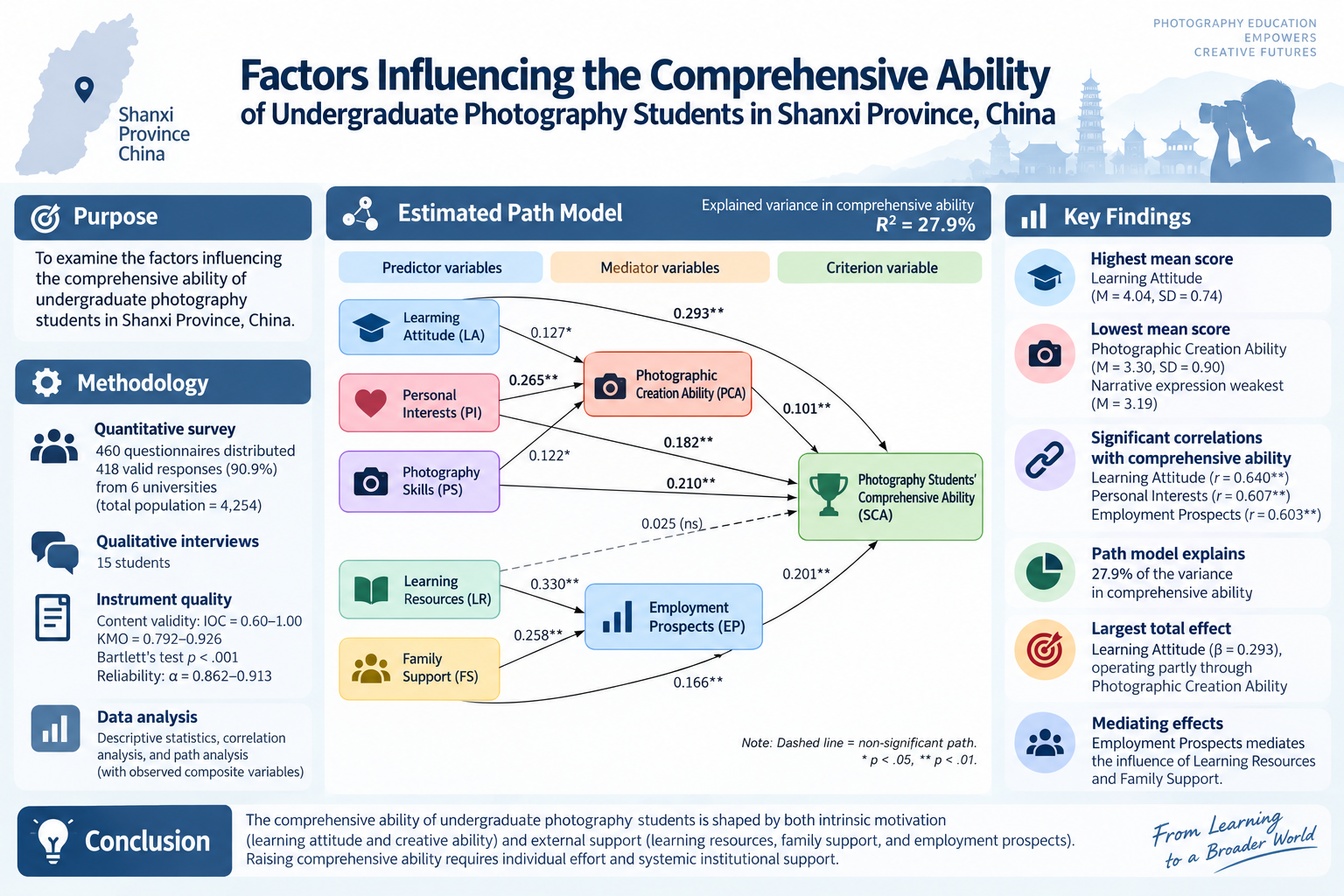
Photography education in China is shifting from a technique-centred model towards the cultivation of comprehensive professional competence, yet the factors that shape this competence in regional institutions remain under-examined. This study examined the factors influencing the comprehensive ability of undergraduate photography students in Shanxi Province. From a population of 4,254 students enrolled across six universities, 460 questionnaires were distributed and 418 valid responses were retained (90.90%), supplemented by semi-structured interviews with 15 students. Content validity was established through expert review (IOC = 0.60–1.00), the data were confirmed as suitable for factor extraction (KMO = 0.792–0.926; Bartlett’s test p < .001), and internal consistency was acceptable (α = 0.862–0.913). All variables scored at a moderate level or above. Learning Attitude was highest (M = 4.04, SD = 0.74) and Photographic Creation Ability lowest (M = 3.30, SD = 0.90), with narrative expression weakest (M = 3.19), indicating an imbalance between technical skill and reflective capacity. Comprehensive ability was significantly correlated with Learning Attitude, Personal Interests and Employment Prospects (r = 0.640, 0.607, 0.603, respectively; p < .01). A path model with observed composite variables accounted for 27.90% of the variance in comprehensive ability. Learning Attitude showed the largest total effect (β = 0.293), operating partly through Photographic Creation Ability, while Employment Prospects mediated the influence of Learning Resources and Family Support. The dual-mediator structure one internal and creative, the other external and market-oriented suggests that intrinsic motivation and industry alignment jointly shape competence, and that raising comprehensive ability requires both individual effort and systemic institutional support.
Downloads
References
Bandura, A. (1986). Social foundations of thought and action: A social cognitive theory. Prentice-Hall.
Bell, S. (2010). Project-based learning for the 21st century: Skills for the future. The Clearing House: A Journal of Educational Strategies, Issues and Ideas, 83(2), 39–43. https://doi.org/10.1080/00098650903505415 DOI: https://doi.org/10.1080/00098650903505415
Bronfenbrenner, U. (1979). The ecology of human development: Experiments by nature and design. Harvard University Press. DOI: https://doi.org/10.4159/9780674028845
Chen, J. (2024). Research on innovative models of photography education in higher education under the context of integrated media. International Journal of New Developments in Education, 6(6), 174–180. https://doi.org/10.25236/IJNDE.2024.060627 DOI: https://doi.org/10.25236/IJNDE.2024.060627
Davies, D., Jindal-Snape, D., Collier, C., Digby, R., Hay, P., & Howe, A. (2013). Creative learning environments in education—A systematic literature review. Thinking Skills and Creativity, 8, 80–91. https://doi.org/10.1016/j.tsc.2012.07.004 DOI: https://doi.org/10.1016/j.tsc.2012.07.004
Gardner, H. (1983). Frames of mind: The theory of multiple intelligences. Basic Books.
Harackiewicz, J. M., Smith, J. L., & Priniski, S. J. (2016). Interest matters: The importance of promoting interest in education. Policy Insights from the Behavioral and Brain Sciences, 3(2), 220–227. https://doi.org/10.1177/2372732216655542 DOI: https://doi.org/10.1177/2372732216655542
Myszkowski, N., Storme, M., Zenasni, F., & Lubart, T. (2014). Is visual aesthetic sensitivity independent from intelligence, personality and creativity? Personality and Individual Differences, 59, 16–20. https://doi.org/10.1016/j.paid.2013.10.021 DOI: https://doi.org/10.1016/j.paid.2013.10.021
Pekrun, R. (2006). The control-value theory of achievement emotions: Assumptions, corollaries, and implications for educational research and practice. Educational Psychology Review, 18, 315–341. https://doi.org/10.1007/s10648-006-9029-9 DOI: https://doi.org/10.1007/s10648-006-9029-9
Peppler, K., Dahn, M., & Ito, M. (2022). Connected arts learning: Cultivating equity through connected and creative educational experiences. Review of Research in Education, 46(1), 264–287. https://doi.org/10.3102/0091732X221084322 DOI: https://doi.org/10.3102/0091732X221084322
Sweller, J. (1988). Cognitive load during problem solving: Effects on learning. Cognitive Science, 12(2), 257–285. https://doi.org/10.1207/s15516709cog1202_4 DOI: https://doi.org/10.1207/s15516709cog1202_4
Wang, J., Lee, M. A., & Lee, T. C. M. (2022). When might we break the rules? A statistical analysis of aesthetics in photographs. PLOS ONE, 17(7), e0269152. https://doi.org/10.1371/journal.pone.0269152 DOI: https://doi.org/10.1371/journal.pone.0269152
Zhang, J., Du, X., Zhang, X., & Bai, X. (2023). The development of visual aesthetic sensitivity in students in China. Frontiers in Psychology, 14, 1071487. https://doi.org/10.3389/fpsyg.2023.1071487 DOI: https://doi.org/10.3389/fpsyg.2023.1071487
Downloads
Additional Files
Published
How to Cite
Issue
Section
Categories
License
Copyright (c) 2026 Community and Social Development Journal

This work is licensed under a Creative Commons Attribution-NonCommercial-NoDerivatives 4.0 International License.