
Restoring Life Balance through Lanna Rituals: The Symbolic Power of Apology and Healing
DOI:
https://doi.org/10.57260/csdj.2025.284088Keywords:
Lanna rituals, Life balance, Apology, Symbolic healing, Mental health, Spiritual well-beingAbstract
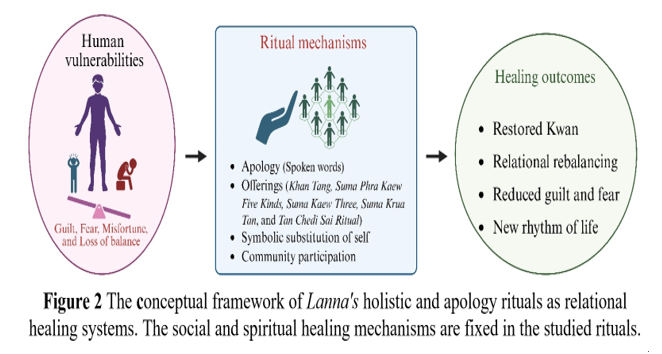
The present study aimed to analyze the forms, meanings, and healing mechanisms of Lanna holistic and apology rituals as cultural systems for restoring relational and spiritual balance in Northern Thailand. The research focused on understanding how these rituals, such as Tan Chedi Sai (Sand Pagoda Offering), Khan Tang, Suma Kaew Sam, Suma Phra Kaew Ha Jamphuak, and Suma Krua Tan, function to relieve guilt, fear, and spiritual instability through structured acts of apology, offering, and community participation. A qualitative approach was employed, incorporating in-depth interviews, participant observation, and symbolic content analysis across three provinces: Chiang Mai, Lamphun, and Lampang. Data were analyzed within the frameworks of medical anthropology and symbolic healing theory. The findings revealed that Lanna apology rituals operate as relational healing systems that transform human suffering, particularly moral distress and relational imbalance, into meaningful experiences of reconciliation. These ceremonies integrate symbolic actions, language, and rhythmic participation to restore life force, mindfulness, and ethical balance. The results indicate that such rituals complement biomedical and psychological care by addressing spiritual and relational dimensions of suffering often beyond the reach of modern health systems. The study suggests that the incorporation of Lanna rituals into community mental health and wellness initiatives could strengthen culturally grounded approaches to mental health promotion and collective strength in Thai society.
Downloads
References
Bhugra, D., & Ventriglio, A. (2024). Are rituals important for mental health?. International Journal of Social Psychiatry, 70(2), 235-236. https://doi.org/10.1177/00207640241232192 DOI: https://doi.org/10.1177/00207640241232192
Champawan, S. (2024). Spiritual Health Bolstering Rituals in Lanna Traditions. Journal of Thai Studies, 20(2), 269648. https://doi.org/10.58837/CHULA.JTS.20.2.7 DOI: https://doi.org/10.58837/CHULA.JTS.20.2.7
Chen, Y., Kim, E. S., & Vander, W. T. J. (2021). Religious-service attendance and subsequent health and well-being throughout adulthood: evidence from three prospective cohorts. International Journal of Epidemiology, 49(6), 2030-2040. https://doi.org/10.1093/ije/dyaa120 DOI: https://doi.org/10.1093/ije/dyaa120
Chutiyami, M., Cutler, N., Sangon, S., Thaweekoon, T., Nintachan, P., Napa, W., Kraithaworn, P., & River, J. (2025). Community-Engaged Mental Health and Wellbeing Initiatives in Under-Resourced Settings: A Scoping Review of Primary Studies. Journal of Primary Care & Community Health, 16, 21501319251332723. https://doi.org/10.1177/21501319251332723 DOI: https://doi.org/10.1177/21501319251332723
Clarke, J. M., & Waring, J. (2018). The transformative role of interaction rituals within therapeutic communities. Sociology of Health & Illness, 40(8), 1277-1293. https://doi.org/10.1111/1467-9566.12773 DOI: https://doi.org/10.1111/1467-9566.12773
Csordas, T. J. (1994). The sacred self: A cultural phenomenology of charismatic healing. California, USA: University of California Press. https://www.ucpress.edu/books/the-sacred-self/paper
Fisher, J. (2011). The Four Domains Model: Connecting Spirituality, Health and Well-Being. Religions, 2(1), 17-28. https://doi.org/10.3390/rel2010017 DOI: https://doi.org/10.3390/rel2010017
Hayes, S. C. (2002). Buddhism and acceptance and commitment therapy. Cognitive and Behavioral Practice, 9(1), 58-66. https://doi.org/10.1016/S1077-7229(02)80041-4 DOI: https://doi.org/10.1016/S1077-7229(02)80041-4
Hobson, N. M., Schroeder, J., Risen, J. L., Xygalatas, D., & Inzlicht, M. (2018). The Psychology of Rituals: An Integrative Review and Process-Based Framework. Personality and Social Psychology Review, 22(3), 260-284. https://doi.org/10.1177/1088868317734944 DOI: https://doi.org/10.1177/1088868317734944
Hood, R. W., Hill, P. C., & Spilka, B. (2018). The psychology of religion: An empirical approach. (5th ed.). New York: Guilford Press.
Jitae, S. (2020). Traditional Lanna rituals on the dimensions of mental health promotion. Disease Control Journal, 46(3), 219-212. https://he01.tci-thaijo.org/index.php/DCJ/article/view/222378
Keng, S. L., Smoski, M. J., & Robins, C. J. (2011). Effects of mindfulness on psychological health: a review of empirical studies. Clinical Psychology Review, 31(6), 1041-1056. https://doi.org/10.1016/j.cpr.2011.04.006 DOI: https://doi.org/10.1016/j.cpr.2011.04.006
Kleinman, A. (1980). Patients and healers in the context of culture: An exploration of the borderland between anthropology, medicine, and psychiatry. California, USA: University of California Press. https://www.ucpress.edu/books/patients-and-healers-in-the-context-of-culture/paper DOI: https://doi.org/10.1525/9780520340848
Koenig, H. G. (2012). Religion, spirituality, and health: the research and clinical implications. ISRN Psychiatry, 2012(1), 278730. https://doi.org/10.5402/2012/278730 DOI: https://doi.org/10.5402/2012/278730
Koenig, H. G., Vander,W. T., & Peteet, J. R. (2023). Handbook of Religion and Health. (3th ed.). New York: Oxford University Press. ISBN 9780190088859. DOI: https://doi.org/10.1093/oso/9780190088859.001.0001
Kundtova, E. K., & Geertz, A. W. (2018). Ritual and Embodied Cognition. Risto Uro, R., Day, J.J., Roitto, R., & DeMaris, R.E. In: The Oxford Handbook of Early Christian Ritual. Oxford Handbooks. https://doi.org/10.1093/oxfordhb/9780198747871.013.5 DOI: https://doi.org/10.1093/oxfordhb/9780198747871.013.5
Martsolf, D. S., & Mickley, J. R. (1998). The concept of spirituality in nursing theories: Differing worldviews and extent of focus. Journal of Advanced Nursing, 27(2), 294-303. https://doi.org/10.1046/j.1365-2648.1998.00519.x DOI: https://doi.org/10.1046/j.1365-2648.1998.00519.x
Nwoye, A. (2022). Psychological Processes and Rituals of Hope-Healing Communities in Contemporary Africa. In: African Psychology: The Emergence of a Tradition. Oxford Academic, Oxford, United Kingdom. https://doi.org/10.1093/oso/9780190932497.003.0015 DOI: https://doi.org/10.1093/oso/9780190932497.003.0015
Obeyesekere, G. (1990). The work of culture: Symbolic transformation in psychoanalysis and anthropology. Chicago, USA: University of Chicago Press. https://press.uchicago.edu/ucp/books/book/chicago/W/bo3615270.html
Sadat, H. A.S., Razaghi, N., Khosro Panah, A. H., & Dehghan, N. N. (2019). A Concept Analysis of Spiritual Health. Journal of Religion and Health, 58(4), 1025-1046. https://link.springer.com/article/10.1007/s10943-017-0522-x DOI: https://doi.org/10.1007/s10943-017-0522-x
Sun, H., & Kim, E. (2025). Shamanic Imagery and Ritual Experience: An Empirical Study of Emotions, Beliefs, and States of Consciousness. Religions, 16(7), 893. https://doi.org/10.3390/rel16070893 DOI: https://doi.org/10.3390/rel16070893
Wallace, B. A. (2001). Intersubjectivity in Indo-Tibetan Buddhism. Journal of Consciousness Studies, 8(5-7), 209-230. https://de.centerforcontemplativeresearch.org/wp-content/uploads/2021/05/Intersubjectivity-1.pdf
Wiseman, H. (2022). Meaning and embodiment in ritual practice. Zygon: Journal of Religion and Science, 57(3), 772-796. https://doi.org/10.1111/zygo.12805 DOI: https://doi.org/10.1111/zygo.12805
World Health Organization. (2022). World mental health report: Transforming mental health for all. https://www.who.int/publications/i/item/9789240049338?utm_source.com
World Health Organization. (2023). Mental Health and Social Connection in Thailand. https://www.who.int/thailand/news/feature-stories/detail/mental-health-and-social-connection-in-thailand?utm_source.com
World Health Organization. (2025). Mental health of adolescents. https://www.who.int/news-room/fact-sheets/detail/adolescent-mental-health?utm_source.com
World Health Organization News Release. (2022). Wake-up call to all countries to step up mental health services and support. https://www.who.int/news/item/02-03-2022-covid-19-pandemic-triggers-25-increase-in-prevalence-of-anxiety-and-depression-worldwide?utm_source.com
Writer, S. (2022). Spirituality linked with better health outcomes, patient care. https://hsph.harvard.edu
Xiao, Q., Yue, C., He, W., & Yu, J. Y. (2017). The Mindful Self: A Mindfulness-Enlightened Self-view. Frontiers in Psychology, 8, 1752. https://doi.org/10.3389/fpsyg.2017.01752 DOI: https://doi.org/10.3389/fpsyg.2017.01752
Downloads
Published
How to Cite
Issue
Section
Categories
License
Copyright (c) 2025 Community and Social Development Journal

This work is licensed under a Creative Commons Attribution-NonCommercial-NoDerivatives 4.0 International License.