Attitude and Utilization of Generative AI as a Learning Tool among Pre-Service Mathematics Teachers
DOI:
https://doi.org/10.57260/csdj.2026.284732Keywords:
Attitude, Generative AI, Learning tool, UtilizationAbstract
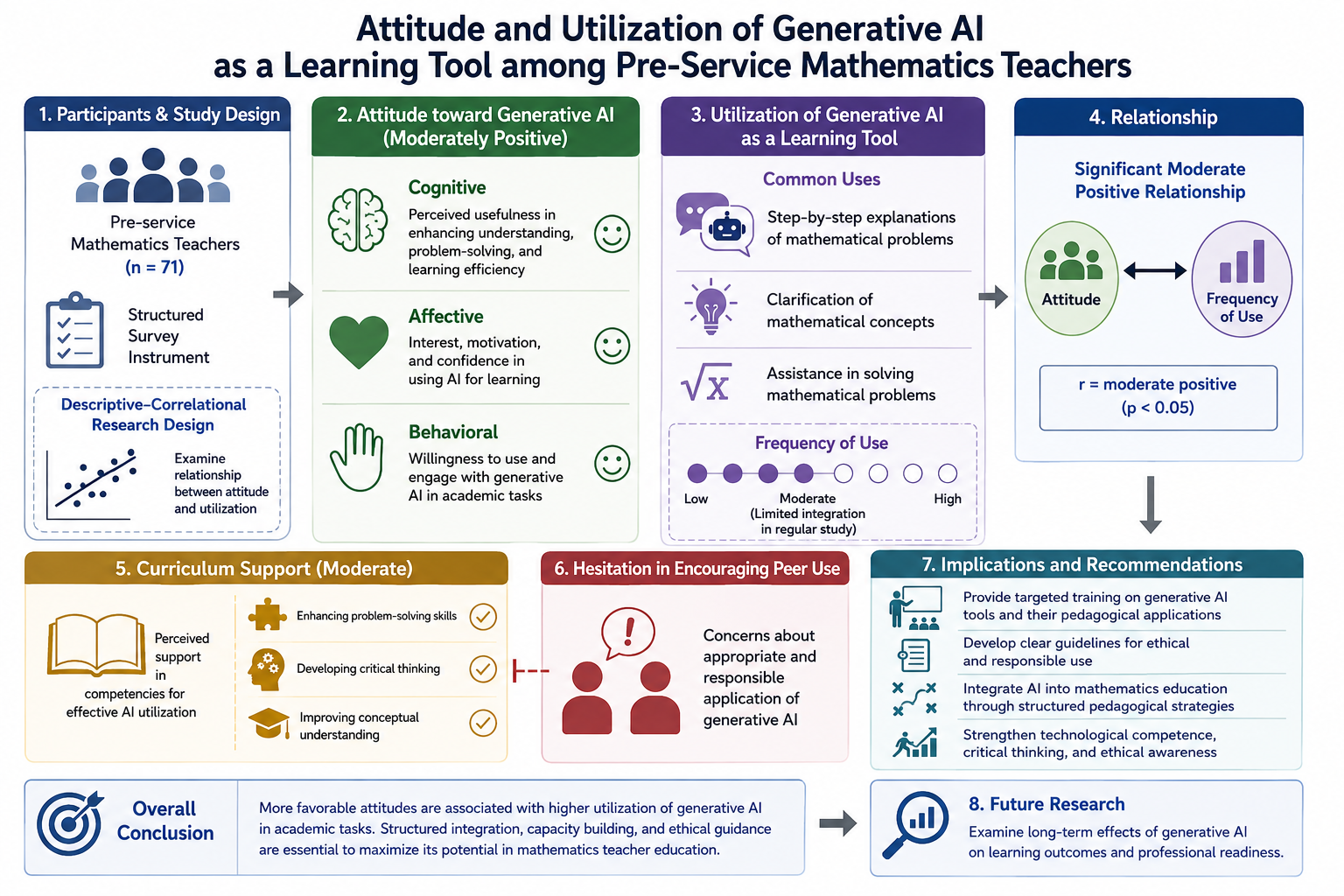
This study examined the attitudes and utilization of generative artificial intelligence (AI) as a learning tool among pre-service mathematics teachers. Employing a descriptive-correlational research design, data were collected from 71 respondents through a structured survey instrument to determine their perceptions of generative AI and the frequency of its use in learning mathematics. Findings revealed that respondents demonstrated a moderately positive attitude toward generative AI across cognitive, affective, and behavioral dimensions. In terms of utilization, participants commonly used generative AI tools for step-by-step explanations, clarification of mathematical concepts, and assistance in solving mathematical problems. However, integration of these tools into regular study routines remained limited. Correlation analysis showed a significant moderate positive relationship between attitudes and frequency of use, indicating that more favorable perceptions are associated with higher levels of engagement with generative AI in academic tasks. Respondents also perceived the curriculum as moderately supportive in developing competencies for effective AI utilization, particularly in enhancing problem-solving skills, critical thinking, and conceptual understanding. Nevertheless, some hesitation was noted in encouraging peer use, reflecting concerns about appropriate and responsible application. In general, the study highlights the need for structured integration of generative AI in mathematics education. It is recommended that teacher education institutions provide targeted training, clear guidelines, and pedagogical strategies to strengthen technological competence, critical thinking, and ethical use of AI. Future research may further examine its long-term effects on learning outcomes and professional readiness.
Downloads
References
Alreiahi, N., & Alrwaished, N. (2025). Integrating AI tools into preservice mathematics teacher education: A qualitative study of lesson planning practices. Contemporary Educational Technology, 17(4), 617. https://doi.org/10.30935/cedtech/17549 DOI: https://doi.org/10.30935/cedtech/17549
Ball, D. L., Thames, M. H., & Phelps, G. (2008). Content Knowledge for Teaching: What Makes It Special?. Journal of Teacher Education, 59, 389-407.
http://dx.doi.org/10.1177/0022487108324554 DOI: https://doi.org/10.1177/0022487108324554
Bohner, G., & Dickel, N. (2011). Attitudes and attitude change. Annual Review of Psychology, 62, 391–417. https://doi.org/10.1146/annurev.psych.121208.131609 DOI: https://doi.org/10.1146/annurev.psych.121208.131609
Creswell, J. W. (2014). Research design: Qualitative, quantitative, and mixed methods approaches. (4th ed.). Sage.
Eagly, A. H., & Chaiken, S. (1993). The psychology of attitudes. Harcourt Brace Jovanovich.
Hattie, J. (2009). Visible learning: A synthesis of over 800 meta-analyses relating to achievement. Routledge, London.
Holmes, W., Bialik, M., & Fadel, C. (2019). Artificial intelligence in education: Promises and implications for teaching and learning. Center for Curriculum Redesign.
Hossein-Mohand, H., Hossein-Mohand, H., García-Alonso, M., & Olmos-Gómez, M. d. C. (2026). Generative AI in university mathematics: Attitudes and academic-leisure use patterns. Electronic Journal of e-Learning, 24(4), 18–31. https://doi.org/10.34190/ejel.24.4.4850 DOI: https://doi.org/10.34190/ejel.24.4.4850
Lin, W., & Jiang, P. (2025). Factors Influencing College Students’ Generative Artificial Intelligence Usage Behavior in Mathematics Learning: A Case from China. Behavioral Sciences, 15(3), 295. https://doi.org/10.3390/bs15030295
Liu, Y. (2026). Individual characteristics as moderators in the AI literacy-attitude relationship among pre-service mathematics teachers. Open Praxis, 18(2), 112–125. https://openpraxis.org/articles/936
Kolb, D. A. (1984). Experiential learning: Experience as the source of learning and development. New Jersey: Prentice Hall.
Nye, B. D. (2015). Intelligent tutoring systems by and for the developing world: A review of trends and approaches. International Journal of Artificial Intelligence in Education, 25(2), 177–203. https://doi.org/10.1007/s40593-014-0028-6 DOI: https://doi.org/10.1007/s40593-014-0028-6
Sixian, L., Muhammad, M., & Xiao, J. (2026). Attitudes and acceptance of generative AI-assisted problem solving among Mathematics students. Journal of Statistical Sciences and Computational Intelligence, 2(3), 752–766. https://doi.org/10.64497/jssci.323 DOI: https://doi.org/10.64497/jssci.323
Watson, W. R., & Watson, S. L. (2017). An argument for clarity: What are learning management systems, what are they not, and what should they become? TechTrends, 15(2), 28–34. https://scispace.com/pdf/what-are-learning-management-systems-what-are-they-not-and-p5whox9np1.pdf DOI: https://doi.org/10.1007/s11528-007-0023-y
Treve, M. (2026). The ethics of AI in education policy: a comparative analysis of governance, accessibility, and equity in higher education. World Development Sustainability, 9, 100347. https://doi.org/10.1016/j.wds.2026.100347 DOI: https://doi.org/10.1016/j.wds.2026.100347
Wang, X., & Li, F. (2025). Factors influencing college students' generative artificial intelligence use in mathematics learning: A structural equation modeling approach. Behavioral Sciences, 15(3), 295. https://www.mdpi.com/2076-328X/15/3/295 DOI: https://doi.org/10.3390/bs15030295
Zawacki-Richter, O., Marín, V. I., Bond, M., & Gouverneur, F. (2019). Systematic review of research on artificial intelligence applications in higher education. International Journal of Educational Technology in Higher Education, 16(39), 1-27. https://doi.org/10.1186/s41239-019-0171-0 DOI: https://doi.org/10.1186/s41239-019-0171-0
Downloads
Additional Files
Published
How to Cite
Issue
Section
Categories
License
Copyright (c) 2026 Community and Social Development Journal

This work is licensed under a Creative Commons Attribution-NonCommercial-NoDerivatives 4.0 International License.