
The Construction of Community Identity of the Silk Weaving Group in the Context of the State and Contemporary Society: A Case Study of Ban Phon, Kham Muang District, Kalasin Province
DOI:
https://doi.org/10.57260/csdj.2026.285064Keywords:
Community identity, Silk weaving group, State, Contemporary society, Ban PhonAbstract
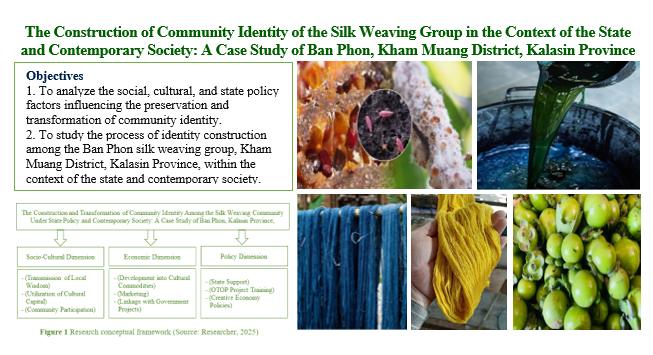
This research aims to study the process of constructing community identity among the silk weaving group in Ban Phon, Kham Muang District, Kalasin Province, within the context of the state and contemporary society. It also seeks to analyze the social, cultural, and governmental factors influencing the preservation and transformation of such identity. This study employed a qualitative research methodology, using in-depth interviews, focus group discussions, and participant observation. The key informants totaled 25 persons, consisting of 5 community leaders, 8 local silk weavers, 4 entrepreneurs, 4 government officers, 2 academic experts, and 2 cultural tourists.
The findings revealed that the identity of the Ban Phon silk weaving community has been constructed and reshaped through various social processes and state policies, particularly those promoting the One Tambon One Product (OTOP) project, creative economy initiatives, and digital media for cultural communication. The image of "Phrae Wa Silk of Ban Phon" has become a cultural symbol reflecting both local pride and modern Thai identity. However, the changes brought by the digital era have led to the reinterpretation of identity in multiple dimensions—cultural, economic, and social. Therefore, identity construction is not merely a process of preservation but also a dynamic adaptation of the community to contemporary social transformations.
Downloads
References
Akranupapong, S. (2008). Marketing management development for Phrae Wa silk products in Kalasin Province. (Master’s thesis, Rajabhat Maha Sarakham University).
Appadurai, A. (1996). Modernity at Large: Cultural Dimensions of Globalization. University of Minnesota Press , Minneapolis.
Bourdieu, P. (1986). The Forms of Capital. In J. Richardson (Ed.), Handbook of Theory and Research for the Sociology of Education (pp. 241-258). New York: Greenwood. https://www.marxists.org/reference/subject/philosophy/works/fr/bourdieu-forms-capital.htm
Cohen, A. (1985). The Symbolic Construction of Community. Routledge. DOI: https://doi.org/10.4324/9780203323373
Eoseewong, N. (1995). Thai nation, Thai land, textbooks, and monuments: On the construction of the Thai nation. Matichon.
Hall, S. (1996). Introduction: Who Needs “Identity”? In S. Hall, & P. D. Gay (Eds.), Questions of Cultural Identity. London: Sage Publications.
Jaiman, S. (2020). Roles of women in Northeastern Thai silk weaving groups. Khon Kaen University Press.
Jenkins, R. (2008). Social identity. (3rd ed.). Routledge.
Kunsri, B. (2017). Discourse of authenticity in the Thai silk market. Somdet Phra Thepparat Publishing House.
Naiyanit, B., Jutaviriyaa, K., & Grisanaputi, W. (2024). Using the patronage system to identity construction in the group management of Silk Weaving groups in Khon Kaen Province. Journal of Humanities and Social Sciences (HUSOKKU), 41(1), 122–143. https://so01.tci-thaijo.org/index.php/HUSO/article/view/269330
Naiyanit, B. ., Jutaviriya, K. ., & Grisanaputi, W. . (2024). Identity Construction within the Production Process of Thai Silk Weaving Groups in Khon Kaen Province. Journal of Mekong Societies, 20(1), 158–178. https://so03.tci-thaijo.org/index.php/mekongjournal/article/view/268692
Phansri, D. (2018). Social networks and silk identity. Silpakorn University Press.
Sangrungruengroj, P. (2020). Marketing Communication Strategy Developing for Ban Yangilai and Ban Dongua Occupational Group, Ku Santarat Subdistrict, Mahasarakham District. Journal of Applied Informatics and Technology, 2(1), 57–76. https://doi.org/10.14456/jait.2020.5
Santasombat, Y. (2001). Local wisdom and sustainable development. Thammasat University Press.
Sthapitanonda, P. (2002). Communication and community identity. Faculty of Communication Arts, Chulalongkorn University.
Thnomdham, P. (2025). The Value of Local Artistic and Cultural Identity of Native Silk in Chaiyaphum Province. MCU Ubonratchathani Journal of Buddhist Studies, 7(1), 287–298. https://so12.tci-thaijo.org/index.php/JOBU2025/article/view/3688
Thongkaew, T. (2019). Negotiating identity in Northern Thai weaving communities. Chiang Mai University Press.
Vachirakhachorn, S. (2004). One Tambon One Product policy and community empowerment. King Prajadhipok's Institute.
Vallibhotama, S. (2003). Lum Nam Khong-Lum Nam Mun: Atalak Isan [Mekong-Mun Basin: Isan identity]. Matichon.
Wannakit, N. (2023). Wisdom in “Phrae-Wa Silk of Phu Thai, Baan Phon”: Dynamic and Assimilation. Journal of Thai Studies, 10(2), 63–86. https://so04.tci-thaijo.org/index.php/TSDJ/article/view/263695
Wattanaphan, A. (2022). Impacts of BCG policy on Thai weaving communities. Chulalongkorn University Press.
Wittayapak, C. (2002). Politics of identity: Meaning and the struggle of ethnic groups. Social Research Institute, Chiang Mai University.
Downloads
Published
How to Cite
Issue
Section
Categories
License
Copyright (c) 2026 Community and Social Development Journal

This work is licensed under a Creative Commons Attribution-NonCommercial-NoDerivatives 4.0 International License.