
Reframing Social Development for Equity and Leaving No One Behind in a Changing Society
DOI:
https://doi.org/10.57260/csdj.2026.286349Keywords:
Social development, Equity, Leaving no one behind, Inclusive governance, Community participation, Institutional capacityAbstract
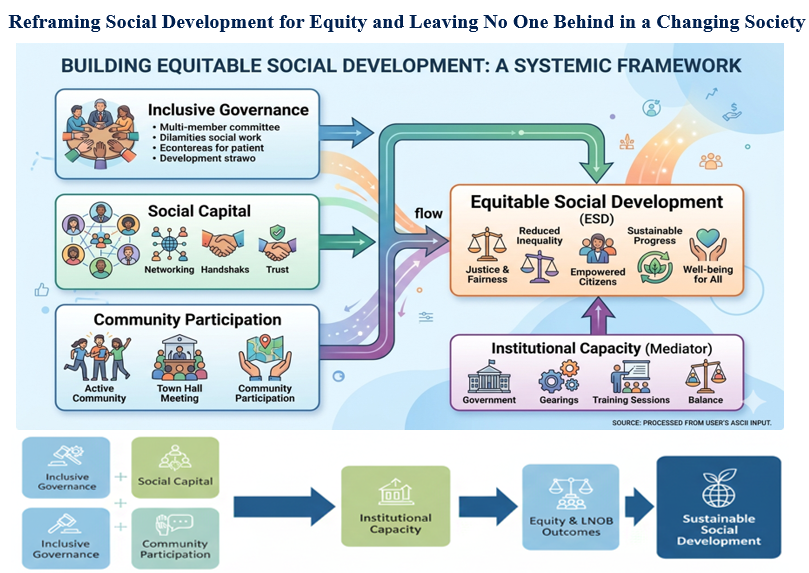
This study examines contemporary approaches to social development that promote equity and operationalize the principle of Leaving No One Behind (LNOB) in the context of rapid global transformations. Increasing socioeconomic inequality, technological disruption, and demographic change have intensified the need for inclusive development strategies that ensure equitable access to opportunities and resources. To address this issue, the study employs a mixed-methods research design integrating quantitative structural equation modeling (SEM) with qualitative insights from community development practitioners.
The quantitative component involved a survey of approximately 400 community stakeholders selected through stratified random sampling. Structural equation modeling results indicate that the proposed model demonstrates acceptable goodness-of-fit (CFI > 0.90; RMSEA < 0.08). The analysis reveals that inclusive governance (β = 0.41, p < .001), social capital (β = 0.29, p < .01), and community participation (β = 0.33, p < .01) exert significant positive effects on equitable social development outcomes. Furthermore, institutional capacity was found to significantly mediate the relationship between community participation and equity outcomes (indirect effect β = 0.18, p < .01), indicating that participatory processes achieve stronger equity outcomes when supported by effective institutional mechanisms.
The qualitative findings reinforce and contextualize these statistical results. Interviews with community leaders and development practitioners highlight that inclusive decision-making processes, trust-based community networks, and responsive institutional systems are critical factors enabling participatory development initiatives to translate into tangible improvements in social inclusion and equitable access to services. The qualitative evidence thus strengthens the interpretation of the quantitative model by illustrating how governance practices and institutional arrangements operate in real community contexts.
This study contributes to the literature by proposing and empirically validating an integrative social development model that links governance, social capital, community participation, and institutional capacity to equity and LNOB outcomes. The findings offer both theoretical and practical implications for policymakers, local governments, and development organizations seeking to design inclusive and sustainable social development strategies in rapidly changing societies.
Downloads
References
Acemoglu, D., & Robinson, J. A. (2012). Why nations fail. New York: Crown Business.
Braun, V., & Clarke, V. (2021). Thematic analysis: A practical guide. London: Sage.
Creswell, J. W., & Plano Clark, V. L. (2018). Designing and conducting mixed methods research. (3rd ed.). Thousand Oaks, CA: Sage.
Gupta, J., Pouw, N. R. M., & Ros-Tonen, M. A. F. (2015). Towards an Elaborated Theory of Inclusive Development. European Journal of Development Research, 27(4), 541–559. https://doi.org/10.1057/ejdr.2015.30 DOI: https://doi.org/10.1057/ejdr.2015.30
Hair, J. F., Black, W. C., Babin, B. J., & Anderson, R. E. (2019). Multivariate Data Analysis. (8th ed.). Cengage.
Hair, J. F., Hult, G. T. M., Ringle, C. M., & Sarstedt, M. (2019). A primer on partial least squares structural equation modeling (PLS-SEM). (2nd ed.). Thousand Oaks, CA: Sage. DOI: https://doi.org/10.3926/oss.37
Hickey, S. (2020). The politics of inclusive development. Oxford: Oxford University Press.
Hickey, S., Sen, K., & Bukenya, B. (2015). The Politics of Inclusive Development: Interrogating the Evidence. Oxford University Press. DOI: https://doi.org/10.1093/acprof:oso/9780198722564.001.0001
Kline, R. B. (2016). Principles and practice of structural equation modeling. (4th ed.). New York: Guilford Press.
Mansuri, G., & Rao, V. (2019). Localizing Development: Does Participation Work?. Washington, DC: World Bank.
Midgley, J. (2014). Social development: Theory and practice. London: Sage. DOI: https://doi.org/10.4135/9781446294987
OECD. (2021). Government at a glance 2021. https://doi.org/10.1787/1c258f55-en DOI: https://doi.org/10.1787/1c258f55-en
Putnam, R. D. (2000). Bowling alone. New York: Simon & Schuster. DOI: https://doi.org/10.1145/358916.361990
Sen, A. (1999). Development as freedom. Oxford: Oxford University Press.
Tashakkori, A., & Teddlie, C. (2021). Foundations of mixed methods research. (2nd ed.). Thousand Oaks, CA: Sage. DOI: https://doi.org/10.4135/9781506350288
United Nations Development Programme (UNDP). (2015). Human Development Report 2015: Work for Human Development. New York: UNDP.
United Nations Development Programme. (2018). What does it mean to leave no one behind? . https://www.undp.org/publications/what-does-it-mean-leave-no-one-behind
United Nations Development Programme. (2020). Human development report 2020. https://hdr.undp.org/content/human-development-report-2020 DOI: https://doi.org/10.18356/9789210055161
Woolcock, M. (2001). The place of social capital. Canadian Journal of Policy Research, 2(1), 11–17. https://www.researchgate.net/publication/269576288
Woolcock, M., & Narayan, D. (2000). Social capital: Implications for development theory, research, and policy. The World Bank Research Observer, 15(2), 225–249. https://doi.org/10.1093/wbro/15.2.225 DOI: https://doi.org/10.1093/wbro/15.2.225
Downloads
Additional Files
Published
How to Cite
Issue
Section
Categories
License
Copyright (c) 2026 Community and Social Development Journal

This work is licensed under a Creative Commons Attribution-NonCommercial-NoDerivatives 4.0 International License.