
A Peircean Semiotic Analysis of the Liuyang Confucius Worship Ritual: Symbol Classification and Cultural Representation
DOI:
https://doi.org/10.57260/csdj.2026.286389Keywords:
Liuyang confucius worship ritual, Peirce's tripartite theory of signs, Symbol classification, Cultural representation, NVivo12 qualitative qnalysisAbstract
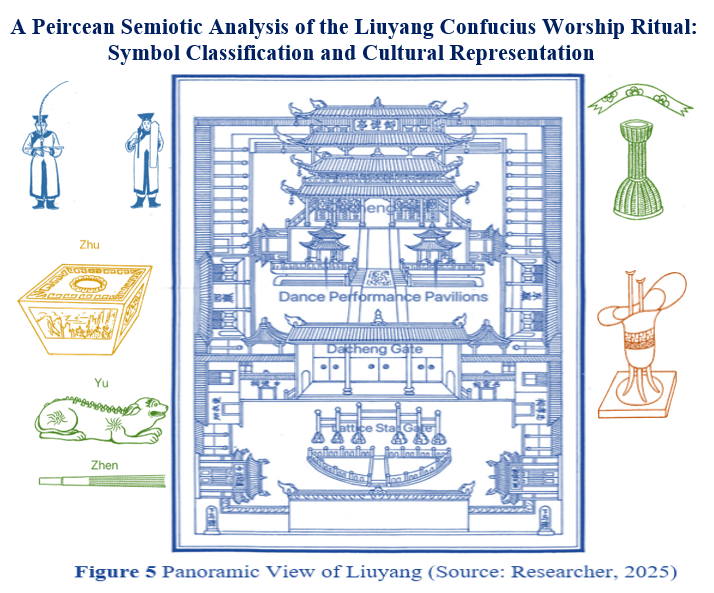
Based on Peirce's Tripartite Theory of Signs, this study systematically analyzes the symbolic classification system and representational logic of the Liuyang Confucius Worship Ritual. It aims to break through the limitation of overemphasizing description over classification in existing research on Confucius worship rituals and provide support for the dynamic inheritance of this intangible cultural heritage. Through integrating field investigation, in-depth interviews, and literature research, this study employs NVivo12 qualitative data analysis software to conduct systematic three-stage coding analysis (open coding, axial coding, and selective coding) with inter-coder reliability verification. The study identifies 68 core symbols, including 23 iconic signs (33.80%), 21 indexical signs (30.90%), and 24 symbolic signs (35.30%), and constructs a progressive classification system. These three types of signs realize meaning representation through formal similarity, contiguity/causality, and social convention respectively, and embody the integration of Confucian orthodox rituals and regional cultural characteristics. The study verifies the applicability of Peirce's theory, reveals the inheritance rules of ritual symbols, fills the gaps in relevant research, and provides a complete paradigm of theory, analysis, and interpretation, offering a reference for the research and inheritance of similar intangible cultural heritage projects.
Downloads
References
Bell, C. (1992). Ritual theory, ritual practice. Oxford University Press.
Curzer, H. (2012). Contemporary Rituals and the Confucian Tradition: a Critical Discussion. Journal of Chinese Philosophy, 39(2), 290-309. https://doi.org/10.1111/j.1540-6253.2012.01719.x
Fei, X. T. (2004). From the soil: The foundations of Chinese society. Foreign Language Teaching and Research Press.
Hu, X. (2023).The Characteristics of Rituals and Their Imprint on Chinese Culture. Journal of Chinese Humanities, 9(3), 247-263. https://doi.org/10.1163/23521341-12340156
Lin, X., & Chen, Y. (2025). The Cultural Semiotic Characteristics of Zhanjiang Nuo Dance and Innovative Pathways for Digital Empowerment in Its Transmission. Journal of Humanities, Arts and Social Science, 9(1), 62-71. http://dx.doi.org/10.26855/jhass.2025.01.009
Liu, Y., & Song, Y. (2025). The role of Chinese folk ritual music in biodiversity conservation: an ethnobiological perspective from the Lingnan region. J Ethnobiology Ethnomedicine, 21, 6. https://doi.org/10.1186/s13002-025-00755-7
Lu, M. (2017). The Cult of Confucius as Family Ritual in Late Imperial China. The Chinese Historical Review , 24(1), 21-40. https://doi.org/10.1080/1547402X.2017.1297591
Peirce, C. S. (1998). The essential Peirce: Selected philosophical writings (Vol. 2). N. Houser & C. Kloesel (Eds.). Indiana University Press.
Strauss, A., & Corbin, J. (1998). Basics of qualitative research: Techniques and procedures for developing grounded theory. (2nd ed.). Sage Publications.
UNESCO. (2003). Convention for the safeguarding of the intangible cultural heritage. UNESCO.
Yang, V. L. Y. (2024). Building Communities through Rituals: Glimpses into the Life of Chinese Christian Communities in the 17th Century. Religions, 15(4), 444. https://doi.org/10.3390/rel15040444
Zamawe, F. C. (2015). The implication of using NVivo software in qualitative data analysis: Evidence-based reflections. Malawi Medical Journal, 27(1), 13–15. https://doi.org/10.4314/mmj.v27i1.4
Zhang, X., & Sheng, J. (2017). A Peircean semiotic interpretation of a social sign. Annals of Tourism Research, 64, 163-173. https://doi.org/10.1016/j.annals.2017.04.002
Zhou, J., & Chuangprakhon, S. (2023).The Role of Nanyue Ritual Songs in Promoting Literacy and Cultural Education in Longhui County, Hunan, China, International Journal of Education & Literacy Studies, 11(3), 264-270. https://journals.aiac.org.au/index.php/IJELS/article/view/7831
Zhao, Y. (2014). Peirce's semiotics and its application in cultural studies. Peking University Press.
Zhu, X. (2011). Family rituals of Master Zhu. Princeton University Press.
Zhu, Y. X., & Tang, S. M. (2009). The living fossil of Chinese Yayue: Liuyang ancient music. Y. R. Deng (Ed.). Hunan Literature and Art Publishing House.
Downloads
Published
How to Cite
Issue
Section
Categories
License
Copyright (c) 2026 Community and Social Development Journal

This work is licensed under a Creative Commons Attribution-NonCommercial-NoDerivatives 4.0 International License.