
Whistleblower Protection as Social Capital Infrastructure: Institutional Design and Weaponization Risks in Thailand's 2025 Anti-SLAPP Law
DOI:
https://doi.org/10.57260/csdj.2026.286419Keywords:
Whistleblower protection, Anti-SLAPP, Social capital, Thailand, Corruption, Legal mobilization, UNCACAbstract
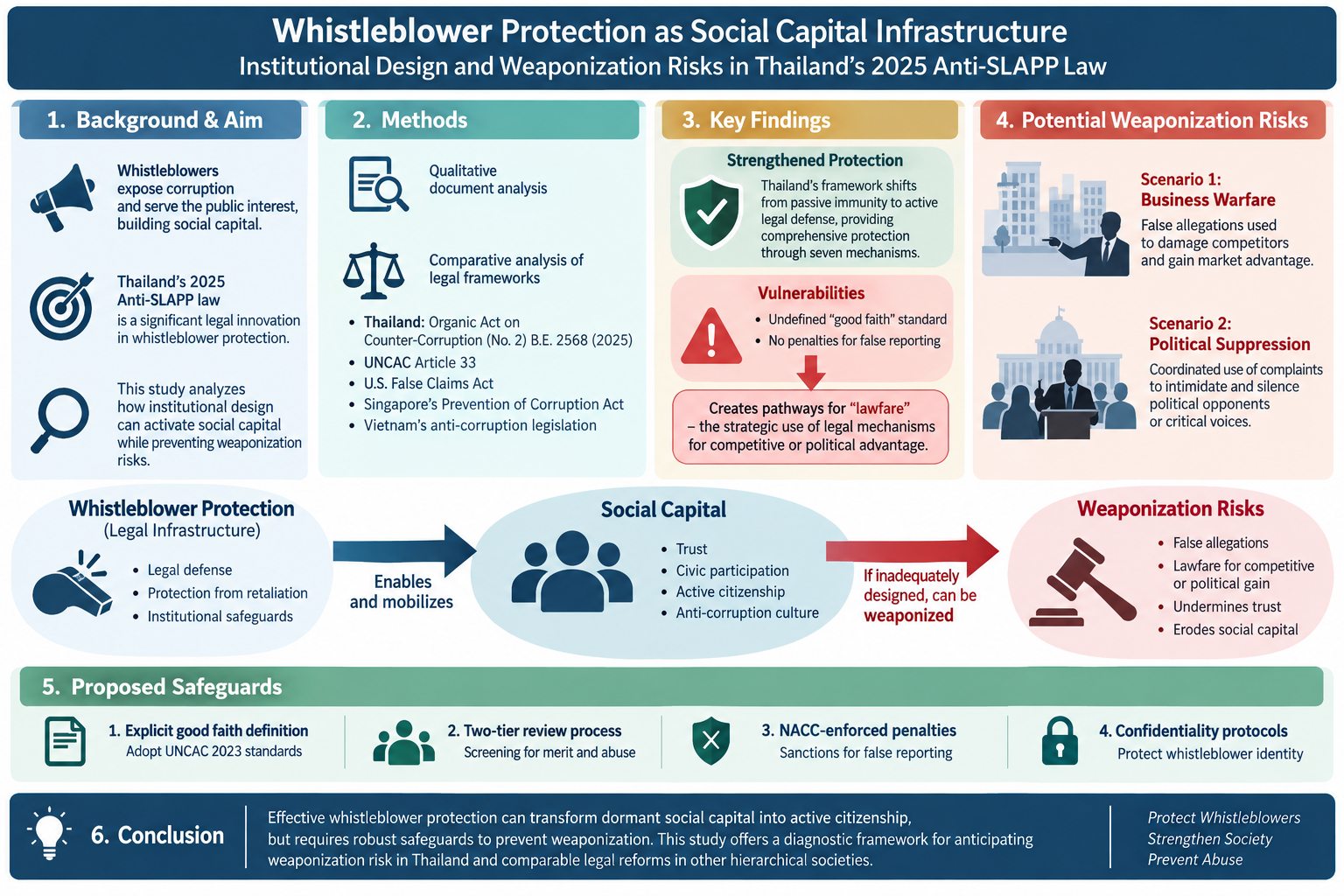
Thailand's 2025 Anti-SLAPP law marks a shift in the country's approach to whistleblower
protection, introducing comprehensive legal and financial mechanisms to address retaliatory
litigation. This article examines whether legal protection can transform dormant social capital
into active citizenship, what risks emerge when protections activate social networks, and what
safeguards prevent weaponization. Analysis reveals three critical insights: law alone cannot build
social capital without ecosystem cultivation; social capital is double -edged, enabling both
accountability and domination; and success requires balancing protection with accountability
mechanisms. The undefined "good faith" standard and absence of penalties for false reporting
create vulnerabilities that sophisticated networks can exploit. Four safeguards are proposed: an
explicit good-faith definition, a two-tier review, enforced penalties, and confidentiality protocols.
Thailand's framework requires sustained ecosystem investment to achieve a transformative
impact.
Downloads
References
Bourdieu, P. (1986). The forms of capital. In J. G. Richardson (Ed.), Handbook of theory and research for the sociology of education (pp. 241–258). Greenwood Press.
Brown, A. J., Lewis, D., Moberly, R., & Vandekerckhove, W. (2014). International Handbook on Whistleblowing Research. Edward Elgar Publishing. https://doi.org/10.4337/9781781006795
Canan, P., & Pring, G. W. (1988). Strategic Lawsuits Against Public Participation. Social Problems, 35(5), 506–519. https://doi.org/10.2307/800612
Carr, I., & Lewis, D. (2010). Combating Corruption through Employment Law and Whistleblower Protection. Industrial Law Journal, 39(1), 52–81. https://doi.org/10.1093/indlaw/dwp027
Engstrom, D. F. (2012). Harnessing the Private Attorney General: Evidence from Qui Tam Litigation. Columbia Law Review, 112(6), 1244–1325. http://www.jstor.org/stable/41708173
Epp, C. R. (1998). The Rights Revolution: Lawyers, Activists, and Supreme Courts in Comparative Perspective. University of Chicago Press. https://doi.org/10.1017/CBO9781139628983
Gingerich, D. W. (2013). Political institutions and party-directed corruption in South America: Stealing for the team. Cambridge: Cambridge University Press. https://doi.org/10.1017/CBO9781139628983
Government Accountability Project. (2023). Whistleblower resolution passes at the 10th Conference of State Parties of the UNCAC. https://whistleblower.org/press-release/whistleblower-resolution-passes-at-the-10th-conference-of-state-parties-of-the-uncac/
Human Rights Watch. (2015). Thailand: Drop Charges Against Phuket Journalists. https://www.hrw.org/news/2015/04/16/thailand-drop-charges-against-phuket-journalists
Loyens, K., & Vandekerckhove, W. (2018). Whistleblowing from an International Perspective: A Comparative Analysis of Institutional Arrangements. Administrative Sciences, 8(3), 30. https://doi.org/10.3390/admsci8030030
McCann, M. W. (1994). Rights at Work: Pay Equity Reform and the Politics of Legal Mobilization. University of Chicago Press. https://books.google.com.ni/books?id=h1ow0nN0wkYC
National Assembly of the Socialist Republic of Vietnam. (2018). Law No. 25/2018/QH14 on denunciation. Vietnam.
National Assembly of the Socialist Republic of Vietnam. (2018). Law No. 36/2018/QH14 on anti-corruption. Vietnam.
Organic Act on Counter-Corruption (No. 2), B.E. 2568 (2025). (2025). Royal Thai Government Gazette, 142(38 A).
Ostrom, E. (1990). Governing the commons: The evolution of institutions for collective action. Cambridge University Press. https://doi.org/10.1017/CBO9780511807763
Persson, A., Rothstein, B., & Teorell, J. (2013). Why Anticorruption Reforms Fail—Systemic Corruption as a Collective Action Problem. Governance, 26(3), 449–471. https://doi.org/10.1111/j.1468-0491.2012.01604.x
Portes, A. (1998). Social Capital: Its Origins and Applications in Modern Sociology. Annual Review of Sociology, 24, 1–24. https://doi.org/10.1146/annurev.soc.24.1.1
Putnam, R. D., Leonardi, R., & Nanetti, R. Y. (1994). Making Democracy Work: Civic Traditions in Modern Italy. Princeton University Press. https://doi.org/10.2307/j.ctt7s8r7
Quah, J. S. T. (2011). Curbing corruption in Asian countries: An impossible dream?. Emerald Group Pub. https://api.pageplace.de/preview/DT0400.9780857248206_A23453265/preview-9780857248206_A23453265.pdf
Reporters Committee for Freedom of the Press. (2026). Anti-SLAPP Legal Guide. https://www.rcfp.org/anti-slapp-legal-guide/
Scott, J. C. (1972). Patron-Client Politics and Political Change in Southeast Asia. American Political Science Review, 66(1), 91–113. https://doi.org/10.2307/1959280
Sidel, J. T. (1999). Capital, coercion, and crime: Bossism in the Philippines. Stanford University Press. https://doi.org/10.1515/9780804765473
United Nations. (2003). United Nations Convention Against Corruption. United Nations. https://www.unodc.org/corruption/en/uncac/learn-about-uncac.html
United Nations. (2023). Protection of reporting persons: Resolution adopted by the Conference of the States Parties to the United Nations Convention against Corruption. United Nations. https://docs.un.org/en/CAC/COSP/2023/L.12/Rev.1
UNODC. (2018). Whistle-blower Protection in ASEAN Member States. United Nations Office on Drugs and Crime. https://track.unodc.org/uploads/documents/AC-hubs-and-platforms/south-east-asia/Whistle-blower_protection_in_ASEAN_Member_States.pdf
Vandekerckhove, W. (2007). Whistleblowing and Organizational Social Responsibility: A Global Assessment. Routledge. https://doi.org/10.4324/9781315547299
Downloads
Additional Files
Published
How to Cite
Issue
Section
Categories
License
Copyright (c) 2026 Community and Social Development Journal

This work is licensed under a Creative Commons Attribution-NonCommercial-NoDerivatives 4.0 International License.