Interdependencies of Proficiency, Motivation, and Strategy: A Quantitative Study within a Socio-Cognitive Framework for TESOL Postgraduate Curriculum Design
DOI:
https://doi.org/10.57260/csdj.2026.286722Keywords:
English language proficiency, Language learning strategies, Motivation, Socio-cognitive theory, TESOL postgraduate education, Multiple regression analysisAbstract
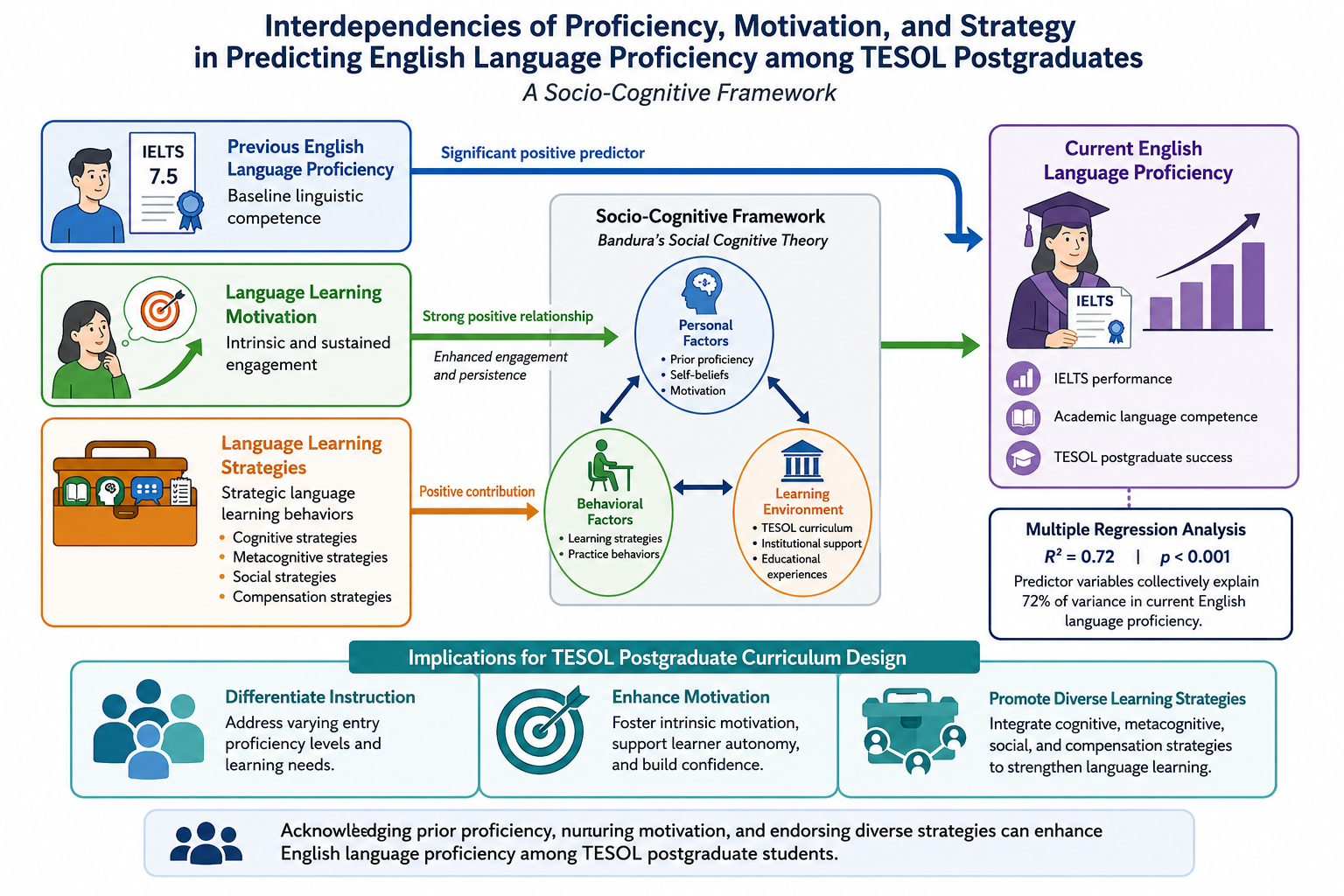
This study examined the factors influencing English language proficiency among postgraduate TESOL students. Grounded in Bandura's Social Cognitive Theory and the Socio-Cognitive Perspective, the study explored the connections between their previous English language proficiency, motivation for language learning, language learning practices, and their current English language proficiency. A quantitative design employing multiple regression analysis was used to evaluate how these elements interact. The study included forty-eight postgraduate TESOL students selected through purposive sampling. Validated instruments included the IELTS test, the Language Learning Motivation Scale, and the Strategy Inventory for Language Learning. Our study revealed several key findings. First, prior English language proficiency significantly influenced current language proficiency, highlighting the importance of designing programs to fit diverse starting points. Second, a strong positive correlation emerged between motivation and linguistic ability, emphasizing the necessity to encourage students' inner motivation. Finally, using diverse language learning strategies enhanced English language proficiency, advocating integrating different strategies in TESOL programs. The regression model explained 72.00% of the variance in English language proficiency (R²=0.72, p<0.001). These findings hold significant implications for the design of postgraduate TESOL curricula, motivational support initiatives, and language learning methodologies. Teachers and institutions can enhance language proficiency by acknowledging students' diverse linguistic backgrounds, nurturing motivation, and endorsing various learning strategies
Downloads
References
Adan, D. A., & Hashim, H. (2021). Language learning strategies used by art school ESL learners. Creative Education, 12(03), 653-665. https://doi.org/10.4236/ce.2021.123045
Aizawa, I., Rose, H., Thompson, G., & Curle, S. (2020). Beyond the threshold: Exploring English language proficiency, linguistic challenges, and academic language skills of Japanese students in an English medium instruction programme. Language Teaching Research, 27(4), 837-861. https://doi.org/10.1177/1362168820965510
Andrade, M. S. (2006). International students in English-speaking universities: Adjustment factors. Journal of Research in International education, 5(2), 131-154. https://doi.org/10.1177/1475240906065589
Azar, A. S., & Tanggaraju, D. (2020). Motivation in second language acquisition among learners in Malaysia. Studies in English Language and Education, 7(2), 323-333. https://doi.org/10.24815/siele.v7i2.16506
Bandura, A. (2001). Social cognitive theory: An agentic perspective. Annual review of psychology, 52(1), 1-26. https://doi.org/10.1146/annurev.psych.52.1.1
Creswell, J. W., & Creswell, J. D. (2017). Research design: Qualitative, quantitative, and mixed methods approaches. Sage publications.
Dawi, D. A., & Hashim, H. (2022). Preferred learning strategies among Malaysian primary ESL learners. Creative Education, 13(3), 941-951. https://doi.org/10.4236/ce.2022.133062
Dhendup, S. (2021). Investigating language learning strategy use by Bhutanese undergraduate students. i-Manager's Journal on English Language Teaching, 11(1), 28-39. https://doi.org/10.26634/jelt.11.1.17552
Gardner, R. C., & Lambert, W. E. (1972). Attitudes and motivation in second-language learning. Rowley, MA: Newbury House Publishers.
Hoang, V. Q. (2021). The differences of individual learners in second language acquisition. International Journal of TESOL & Education, 1(1), 38-46. https://i-jte.org/index.php/journal/article/view/6
Karas, M., & Faez, F. (2021). Self-efficacy of English language teachers in Ontario: The impact of language proficiency, teaching qualifications, linguistic identity, and teaching experience. The Canadian Modern Language Review, 77(2), 110-128. https://doi.org/10.3138/cmlr-2020-0012
Lee, K., & Lee, H. (2018). Korean graduate students’ self-perceptions of English skills and needs in an English-medium instruction context. Journal of Multilingual and Multicultural Development, 39(8), 715-728. https://doi.org/10.1080/01434632.2018.1438442
Nikoopour, J., & Khoshroudi, M. S. (2021). EFL learners’ learning styles and self-regulated learning: Do gender and proficiency level matter?. Journal of Language Teaching and Research, 12(4), 616-623. https://doi.org/10.17507/jltr.1204.13
Nisbet, D. L., Tindall, E. R., & Arroyo, A. A. (2005). Language learning strategies and English proficiency of Chinese university students. Foreign language annals, 38(1), 100-107. https://doi.org/10.1111/j.1944-9720.2005.tb02457.x
Oxford, R. L., & Burry-Stock, J. A. (1995). Assessing the use of language learning strategies worldwide with the ESL/EFL version of the Strategy Inventory for Language Learning (SILL). System, 23(1), 1-23. https://doi.org/10.1016/0346-251x(94)00047-a
R’boul, H. (2020). Re-imagining intercultural communication dynamics in TESOL: Culture/interculturality. Journal for Multicultural Education, 14(2), 177-188. https://doi.org/10.1108/jme-03-2020-0016
Richards, J. C. (2023). Teacher, learner and student-teacher identity in TESOL. RELC Journal, 54(1), 252-266. https://doi.org/10.1177/0033688221991308
Rose, H., Curle, S., Aizawa, I., & Thompson, G. (2020). What drives success in English medium taught courses? The interplay between language proficiency, academic skills, and motivation. Studies in Higher Education, 45(11), 2149-2161. https://doi.org/10.1080/03075079.2019.1590690
Sarwari, A. Q., & Wahab, M. N. A. (2016). Relationship between English language proficiency and intercultural communication competence among international students in a Malaysian public university: The. International Journal of Language Education and Applied Linguistics, 5,1-9. https://doi.org/10.15282/ijleal.v5.494
Sereni, L. N., & Yanto, E. S. (2021). A story of south-east Asian TESOL why teach abroad: Its opportunities and challenges. Journal of Languages and Language Teaching, 9(3), 264-278. https://doi.org/10.33394/jollt.v9i3.3978
Soupi, F. N. S. M., Zulkiflee, Z. N., Hipni, N. I., Kenol, H., Chin, L. Z., Neithanantan, P., & Hashim, H. (2022). Language learning strategies used among ESL graduates. International Journal of Academic Research in Business and Social Sciences, 12(6), 357-372. https://doi.org/10.6007/ijarbss/v12-i6/13977
Tang, K. N. (2020). Challenges and importance of teaching English as a medium of instruction in Thailand international college. Journal of English as an International Language, 15(2), 97-118. https://eric.ed.gov/?id=EJ1282858
Tantiniranat, S. (2017). TESOL purposes and paradigms in an intercultural age: Practitioner perspectives from a Thai university. (Doctoral dissertation, University of Manchester).
Yang, K. (2020). Factors influencing learners’ motivation in mobile-assisted language learning: A case study on four Chinese EFL learners. International Journal of TESOL Studies, 2(4), 80-97. https://doi.org/10.46451//ijts.2020.12.08
Zhang, L. J., Thomas, N., & Qin, T. L. (2019). Language learning strategy research in System: Looking back and looking forward. System, 84, 87-92. https://doi.org/10.1016/j.system.2019.06.002
Downloads
Additional Files
Published
How to Cite
Issue
Section
Categories
License
Copyright (c) 2026 Community and Social Development Journal

This work is licensed under a Creative Commons Attribution-NonCommercial-NoDerivatives 4.0 International License.