Enhancing Sustainable Economic Development through the BCG Model: Development and Commercialization of Stingless Bee Honey from Southern Thailand
DOI:
https://doi.org/10.57260/csdj.2026.286879Keywords:
Stingless bees honey, Chemical composition, Biological activity, Volatile organic compounds, MonosaccharidesAbstract
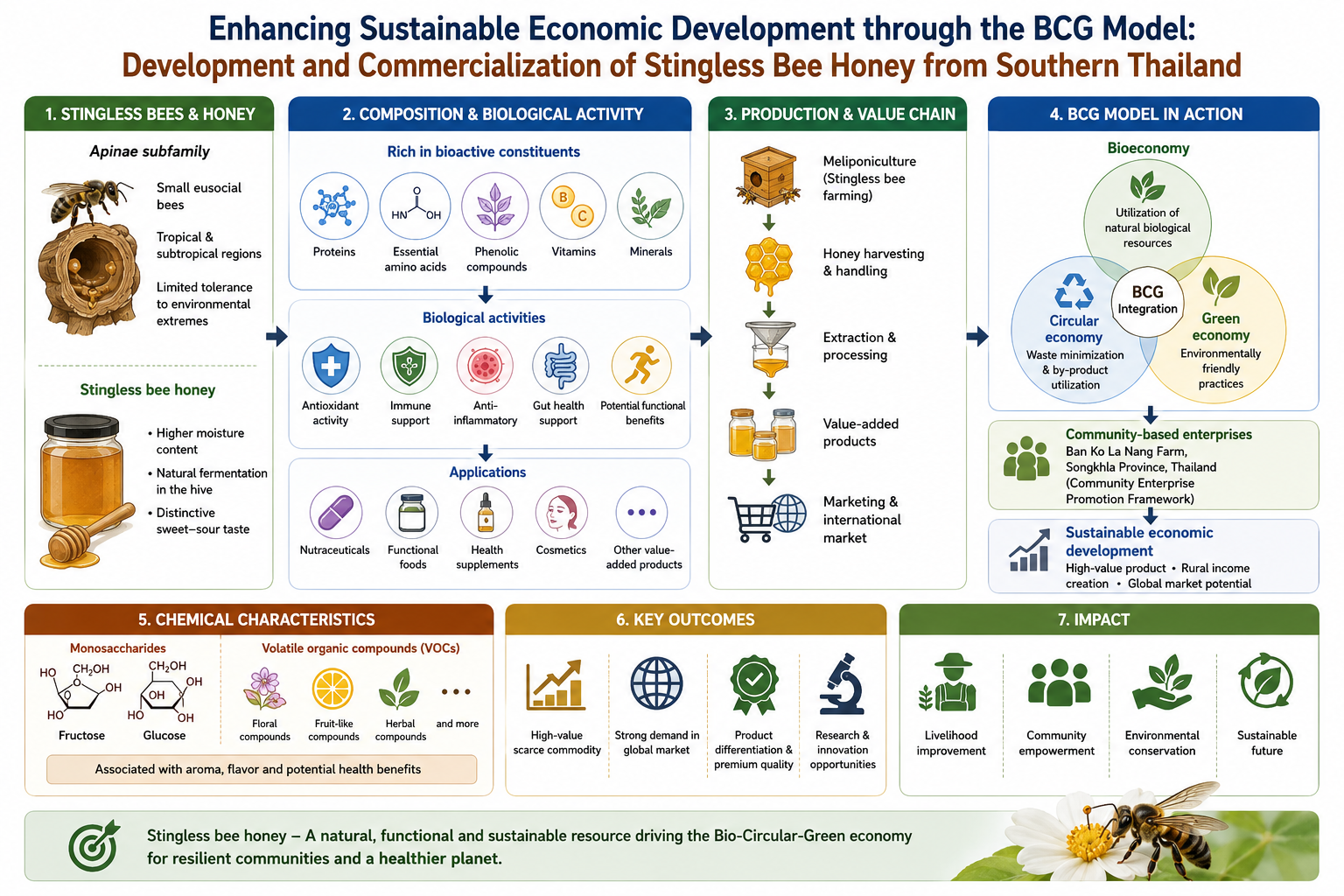
Stingless bee honey, derived from small eusocial bees within the Apinae subfamily, has emerged as a promising natural product in the global health supplement market. These bees are predominantly found in tropical and subtropical regions and exhibit limited tolerance to environmental extremes due to their reduced capacity for thermoregulation. Unlike conventional honey bees, stingless bees produce honey with higher moisture content, which undergoes natural fermentation within the hive, resulting in a distinctive sweet–sour taste profile. The compositional characteristics of stingless bee honey include proteins, essential amino acids, phenolic compounds, vitamins, and minerals. These constituents are associated with antioxidant activity and potential functional benefits, making the honey a candidate for nutraceutical and functional food development. Research has increasingly focused on its production systems, extraction processes, and value-added applications.
In Thailand, stingless bee honey production is supported by community-based enterprises, including Ban Ko La Nang Farm in Songkhla Province, operating under the Community Enterprise Promotion framework. Such initiatives contribute to sustainable rural development and are aligned with the Bio-Circular-Green (BCG) economic model, which integrates bioeconomy, circular economy, and green economy principles. Due to relatively low production yields compared to honey bees, stingless bee honey remains a scarce and high-value commodity in international markets.
Downloads
References
Ikhsan, L. N., Chin, K.-Y., & Ahmad, F. (2022). Methods of the dehydration process and its effect on the physicochemical properties of stingless bee honey: A review. Molecules, 27(21), 7243. https://doi.org/10.3390/molecules27217243
Manickavasagam, G., Saaid, M., Shafie, M. H., Lim, V., & Mohd Rodhi, A. (2024). Chemometrics exploration of monosaccharides, sugar acids, stable carbon isotopes, and volatile organic compounds in Malaysian stingless bee honey from different geographical origins. Journal of the Iranian Chemical Society, 21(9), 2351–2367. https://doi.org/10.1007/s13738-024-03074-y
Marcolin, L. C., Lima, L. R., Arias, J. L. O., Berrio, A. C. B., Kupski, L., Barbosa, S. C., & Primel, E. G. (2021). Meliponinae and Apis mellifera honey in southern Brazil: Physicochemical characterization and determination of pesticides. Food Chemistry, 363, 130175. https://doi.org/10.1016/j.foodchem.2021.130175
Mduda, C. A., Hussein, J. M., Vit, P., Newa, N. J., Chemurot, M., Kimoloi, S., Damto, T., Krausa, K., Kalekezi, A. B., Kasangaki, P., Steyn, W. L., & Ndanshau, J. A. (2025). Stingless bee honey in East Africa: Sustainability, chemical composition and quality compliance. Food and Humanity, 5, 100733. https://doi.org/10.1016/j.foohum.2025.100733
Mello dos Santos, M., Jacobs, C., Vinsen, K., Islam, M. K., Sostaric, T., Lim, L. Y., & Locher, C. (2025). Profiling of Australian stingless bee honey using multivariate data analysis of high-performance thin-layer chromatography fingerprints. Chemosensors, 13(2), 30. https://doi.org/10.3390/chemosensors13020030
Mokaya, H. O., Nkoba, K., Ndunda, R. M., & Vereecken, N. J. (2022). Characterization of honeys produced by sympatric species of Afrotropical stingless bees (Hymenoptera, Meliponini). Food Chemistry, 366, 130597. https://doi.org/10.1016/j.foodchem.2021.130597
Molino, R. J. E. J., Van Weerd, M., Torreno, V. P. M., Rellin, K. F. B., Mondragon, M. V., Parungao, L., Manila-Fajardo, A. C., Santos, D. M. C., & Junio, H. A. (2026). Multi-omics and palynology of selected Philippine forest honey. Scientific Reports, 16, 5359. https://doi.org/10.1038/s41598-024-71385-4
Moreira, F. I. N., de Medeiros, L. L., de Carvalho, L. M., Olegario, L. S., Galvão, M. S., da Franca, S. A. M., Bezerra, T. K. A., Lima, M. S., & Madruga, M. S. (2023). Quality of Brazilian stingless bee honeys: Cephalotrigona capitata/mombucão and Melipona scutellaris Latrelle/uruçu. Food Chemistry, 404, 134306. https://doi.org/10.1016/j.foodchem.2022.134306
Negera, T., Desalegn, A., Hora, Z. A., & Tigu, F. (2026). Determination of phenolic, flavonoid content and antioxidant activity of honey collected from hives and wild nests of Ethiopian stingless bees. Natural Product Communications, 21(1), 1–12. https://doi.org/10.1177/1934578X261418418
Quicazán, M. C., Mueses-Cisneros, J. J., Rueda-Almonacid, J. V., Gutiérrez-Chacón, C., Fuenmayor, C. A., Zuluaga-Domínguez, C. M., Ariza-Cruz, N., & Carvajal-Lavi, G. (2026). Physicochemical, bioactive, and safety properties of honey produced by stingless bees in the Colombian Amazon piedmont. Vitae, 33(1), e361981. https://doi.org/10.17533/udea.vitae.v33n1a361981
Yong, C.-H., Muhammad, S. A., Abd Aziz, F., Nasir, F. I., Mustafa, M. Z., Ibrahim, B., Kelly, S. D., Cannavan, A., & Seow, E.-K. (2022). Detecting adulteration of stingless bee honey using untargeted ¹H NMR metabolomics with chemometrics. Food Chemistry, 368, 130808. https://doi.org/10.1016/j.foodchem.2021.130808
Downloads
Additional Files
Published
How to Cite
Issue
Section
Categories
License
Copyright (c) 2026 Community and Social Development Journal

This work is licensed under a Creative Commons Attribution-NonCommercial-NoDerivatives 4.0 International License.