Teachers’ Classroom Management Skills and Instructional Quality in Public Secondary Schools in Ibadan Metropolis, Nigeria
DOI:
https://doi.org/10.57260/csdj.2026.287347Keywords:
Classroom management, Instructional quality, Teacher professionalism, Teaching experience, Secondary schools, Ibadan metropolisAbstract
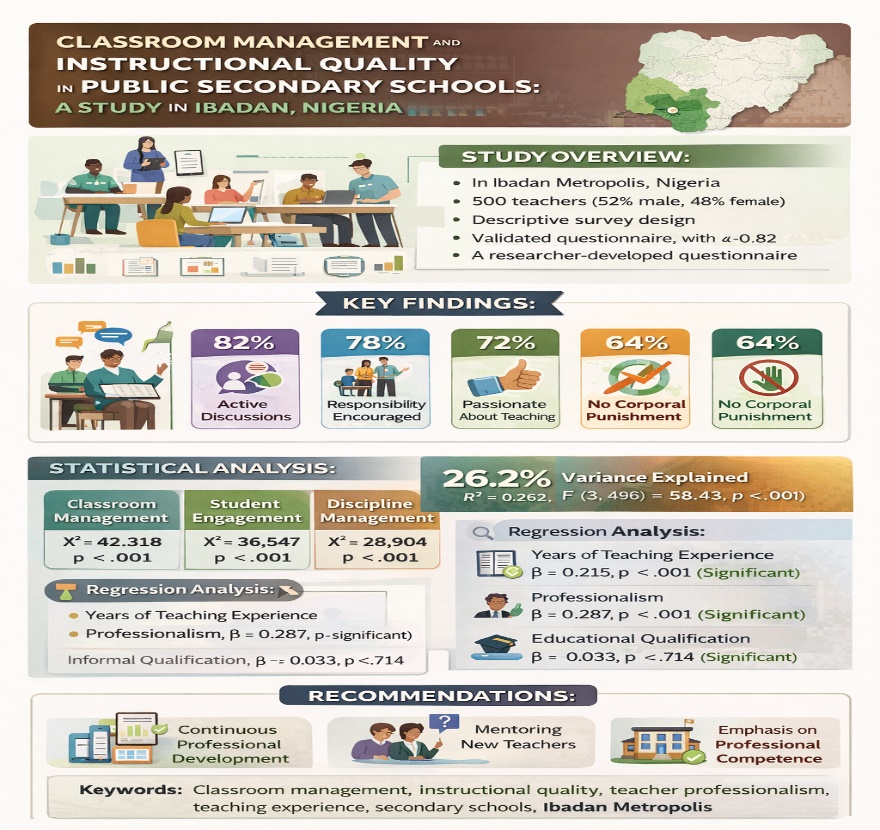
The objective of this study was to find out the teachers’ classroom management skill and its relationship with instructional quality. A descriptive survey design was adopted, and a census sampling approach was used to include all 500 public secondary school teachers in Ibadan Metropolis, comprising 52% male and 48% female respondents. Data were collected using a researcher-developed questionnaire with a reliability coefficient of α = 0.82. Descriptive statistics, Chi-square tests, and multiple regression utilized to analyze data at 0.05 level of significance Effective classroom management is shown through the use of purposeful classroom talk, developing students’ responsibility, teacher passion for classroom activities, and avoiding corporal punishment were the findings of the study. Findings reported chi-square results classroom management and instructional quality yielded significant association with the relation χ² = 42.318, df = 4 and p < .001. So, student engagement and instructional quality also resulted in significant association with the outcome χ² = 36.547, df = 4 and p < .001. Moreover, discipline management and instructional quality have also significant association as evidenced by χ² = 28.904, df = 4 and p < .001. Regression analysis indicated that professionalism (β = 0.287, p = .001) and years of teaching experience (β = 0.215, p < .001) were significant predictors of instructional quality, whereas educational qualification was not significant (β = −0.033, p = .714). The model was able to explain 26.2% of the variance in instructional quality (R2 = .262; F 3,496 = 58.43, p < .001). It can be concluded that the effective classroom management, professional attitude, and teaching experience can improve instructional quality. This advises ongoing professional development, mentoring for novice teachers, and emphasis on in-class performance as opposed to a paper qualification.
Downloads
References
Agbo, H. U. (2025). Instructional leadership dynamics for teacher quality service delivery in public secondary schools in Nigeria. International Journal of Scientific Research in Education, 18(3), 491–506. https://www.ijsre.com.ng/assets/vol.%2c-18(3)-agbo%2c-hellen-ukamakadocx.pdf
Akomolafe, C. O. (2015). The classroom environment: A major motivating factor towards high academic performance of senior secondary school students in South West Nigeria. Journal of Education and Practice, 6(34), 17–21. https://eric.ed.gov/?id=EJ1086098
Bayefa-Asaowei, H. T. (2024). Classroom management practices for quality instructional delivery in secondary education in Nigeria. International Journal of Institutional Leadership, Policy and Management, 6(4), 506–517. https://www.ijilpm.com.ng/assets/vol.%2c-6(4)-bayefa-asaowei%2c-h.-t.pdf
Ekeada, C. C. (2024). Teacher effective classroom management for quality education delivery and sustainable development in Nigeria: Challenges and prospects. Alvan Journal of Social Sciences, 1(2), 1–11. https://url.in.th/sEXag
Ezinwa, O. I. (2024). The role of teacher-student relationships in classroom management and student engagement. Jalingo Journal of Social and Management Sciences, 6(1), 234–246. https://oer.tsuniversity.edu.ng/index.php/jjsms/article/view/603
Heinschel, A., Lazarides, R., & Fauth, B. (2024). Links between instructional quality and classroom composition: Differences in classroom management, student support and cognitive activation. Learning and Instruction, 94, 102005. https://doi.org/10.1016/j.learninstruc.2024.102005
Iyah, W. E., & Taiwo, S. A. (2025). Advancing instructional quality in public senior secondary schools through 21st century classroom management strategies in Rivers State, Nigeria. International Journal of Institutional Leadership, Policy and Management, 7(2), 379-400. https://www.ijilpm.com.ng/assets/vol.%2c-7(2b)-iyah%2c-w.-o.%2c---taiwo%2c-s.-a.pdf
Jaja, S. S., Kpee, G. G., & Obasi, K. K. (2025). Influence of teachers’ classroom management on students’ engagement in blended learning classrooms in secondary schools in Rivers State. International Journal of Innovative Social Sciences & Education Research, 13(3), 156-170. https://doi.org/10.5281/zenodo.16912509
Jamilar, M., Yusuf, L. A., & Manga, S. D. (2025). Teacher professional development and teacher quality in senior secondary schools in Sokoto State, Nigeria. International Journal of EducaƟonal Research & Policies, 4(1), 39-47. https://arcnjournals.com/wp-content/uploads/2025/09/27280301629414.pdf
Jayme, I. B., & Tantiado, R. C. (2025). Teachers’ Classroom Management Practices and Learners’ Behavior. International Journal of Multidisciplinary Research and Analysis, 8(5), 2269-2277. https://doi.org/10.47191/ijmra/v8-i05-04
Oladewa, E. W., & Esowe, N. U. (2025). Optimizing instructional effectiveness through efficient classroom management practices in Rivers State’s public senior secondary schools. International Journal of Economics, Environmental Development and Society, 6(2b), 463–481. https://www.ijeeds.com.ng/assets/vol.%2c-6(2b)-oladewa%2c-e.-w.%2c---esowe%2c-n.-u.pdf
Osama, A. A. (2012). School climate—the key to excellence. Journal of Emerging Trends in Educational Research and Policy Studies, 3(6), 950–954. https://www.scholarlinkinstitute.org/jeteraps/abstractview.php?id=674
Putra, E. (2025). Classroom management: Boosting student success—a meta-analysis. Cogent Education, 12(1), 2458630. https://doi.org/10.1080/2331186X.2025.2458630
Downloads
Additional Files
Published
How to Cite
Issue
Section
Categories
License
Copyright (c) 2026 Community and Social Development Journal

This work is licensed under a Creative Commons Attribution-NonCommercial-NoDerivatives 4.0 International License.