
Development and Validation of a Digital Competency Evaluation Model for Teachers in the Faculty of Education at Higher Education Institutions in Yunnan Province, China
DOI:
https://doi.org/10.57260/csdj.2026.287669Keywords:
Digital competency, Evaluation model, University of education, University teachersAbstract
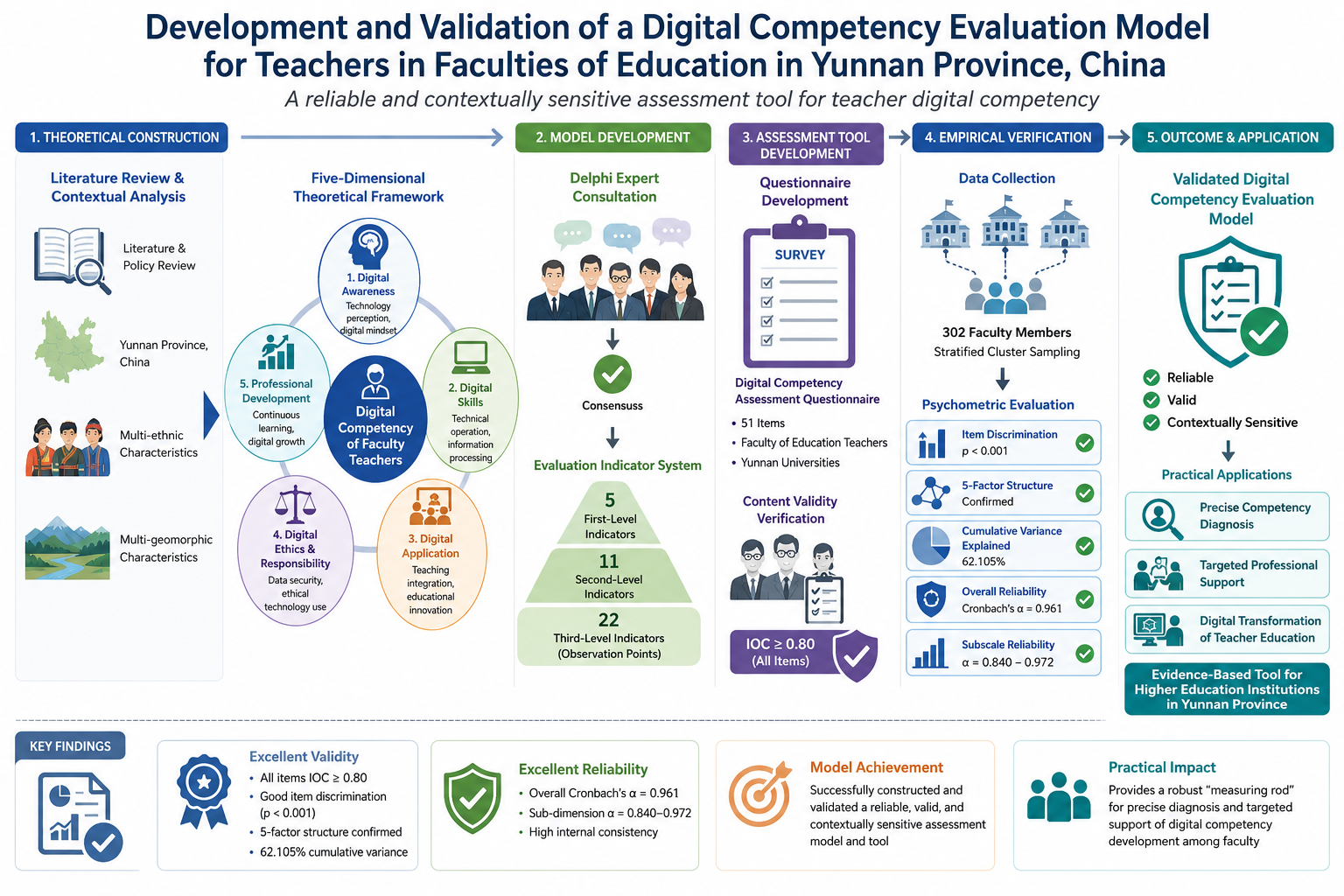
This study focuses on Yunnan Province, China, aiming to construct and validate a scientific, systematic, contextualized model for assessing the digital competency of teachers in the Faculties of Education within universities. The study followed the logic of "theoretical construction - tool development - empirical verification". First, based on literature analysis, a theoretical model covering five dimensions digital awareness, digital skills, digital application, digital ethics and responsibility, and professional development - was proposed and localized in light of the multi-ethnic and multi-geomorphic regional characteristics of Yunnan Province. Finally, an evaluation model was established using the Delphi expert consultation method, which included five first-level indicators, eleven second-level indicators, and twenty-two third-level indicators (specific observation points). Based on this, the "digital competency Assessment Questionnaire for Teachers of the School of Education, Yunnan University" (51 items in total) was developed. Subsequently, the content validity was ensured through expert review (IOC value ≥0.8 for all items). The finalized scale was then administered to a sample of 302 teachers from Faculties of Education in Yunnan universities, selected through stratified cluster sampling, and the empirical data were analyzed to verify the psychometric properties of the model.
The research result was found that: 1) the psychometric properties of the developed assessment tool were excellent, exhibiting high content validity (all items IOC ≥ 0.8), good item differentiation (p<0.001 for all items) and a clear five-factor structure (cumulative variance explained 62.105%) that is fully aligned with the theoretical model; 2) the overall reliability of the scale was extremely high (Cronbach's α = 0.961) with sub-dimension α coefficients ranging from 0.840 to 0.972, indicating excellent internal consistency; 3) consequently, this study successfully constructed and validated a reliable, valid, and contextually sensitive assessment model and tool, providing a robust ‘measuring rod’ for the precise diagnosis and targeted support of digital competency development among faculty in the Faculties of Education within universities in the Yunnan Province.
Downloads
References
Basantes-Andrade, A. Cabezas- Gonzalez, M., & Casillas- Martin S. (2020). Digital competences relationship between gender and generation of university professors. International Journal on Advanced Science Engineering Information Technology, 10(1), 205-211. https://doi.org/10.18517/ijaseit.10.1.10806 DOI: https://doi.org/10.18517/ijaseit.10.1.10806
Basilotta-Gómez-Pablos, V., Matarranz, M., Casado-Aranda, L. A., & Otto, A. (2022). Teachers’ digital competencies in higher education: A systematic literature review. International Journal of Educational Technology in Higher Education, 19(8), 1–16. https://doi.org/10.1186/s41239-021-00312-8 DOI: https://doi.org/10.1186/s41239-021-00312-8
Caena, F., & Redecker, C. (2019). Aligning teacher competence frameworks to 21st century challenges: The case for the European Digital Competence Framework for Educators (DigCompEdu). European Journal of Education, 54(3), 356-369. https://doi.org/10.1111/ejed.12345 DOI: https://doi.org/10.1111/ejed.12345
Falloon, G. (2020). From digital literacy to digital competence: The teacher digital competency (TDC) framework. Educational Technology Research and Development, 68, 2449-2472. https://doi.org/10.1007/s11423-020-09767-4 DOI: https://doi.org/10.1007/s11423-020-09767-4
Ilomaki, L. Paavola, S. Lakkala, M. & Kantosalo A. (2016). Digital competence–an emergent boundary concept for policy and educational research. Education and Information Technologies, 21, 655-679. https://doi.org/10.1007/s10639-014-9346-4 DOI: https://doi.org/10.1007/s10639-014-9346-4
Krishnamurthy, S. (2020). The future of business education: a commentary in the shadow of the Covid-19 pandemic. Journal of Business Research, 117, 1–5. https://doi.org/10.1016/j.jbusres.2020.05.034 DOI: https://doi.org/10.1016/j.jbusres.2020.05.034
Lin, L., & Johnson, T. (2021). Shifting to digital: Informing the rapid development, deployment, and future of teaching and learning. Educational Technology Research and Development, 69, 1–5. https://doi.org/10.1007/s11423-021-09960-z DOI: https://doi.org/10.1007/s11423-021-09960-z
Ministry of Education of the People’s Republic of China. (2022). Teacher digital literacy (JY/T 0646—2022). Ministry of Education of the People’s Republic of China.
Mishra, L., Gupta, T., & Shree, A. (2020). Online teaching-learning in higher education during lock down period of COVID-19 pandemic. International Journal of Educational Research Open, 1, 100012. https://doi.org/10.1016/j.ijedro.2020.100012 DOI: https://doi.org/10.1016/j.ijedro.2020.100012
Munoz - Repiso, A. G. V., Martin, S. C., & Gomez - Pablos, V. M. B. (2020). Validation of an Indicator Model (INCODIES) for Assessing Student Digital Competence in Basic Education. Journal of New Approaches in Educational Research, 9(1), 110–125. https://doi.org/10.7821/naer.2020.1.459 DOI: https://doi.org/10.7821/naer.2020.1.459
Oberlander, M., Beinicke, A., & Bipp, T. (2020). Digital competencies: A review of the literature and applications in the workplace. Computers & Education, 146, 103752. https://doi.org/10.1016/j.compedu.2019.103752 DOI: https://doi.org/10.1016/j.compedu.2019.103752
OECD. (2022). OECD education and skills today. https://oecdedutoday.com/coronavirus/
Pozas, M., & Letzel, V. (2021). “Do You Think You Have What it Takes?” –Exploring Predictors of Pre-Service Teachers’ Prospective ICT Use. Technology, Knowledge and Learning, 28, 823-841. https://doi.org/10.1007/s10758-021-09551-0 DOI: https://doi.org/10.1007/s10758-021-09551-0
Rodriguez-Garcia, A. M., Aznar, I., Caceres, P., & Gomez, G. (2019). Digital competence in higher education: Analysis of the impact of scientific production indexed in Scopus database. Revista ESPACIOS, 40(21), 8. https://www.revistaespacios.com/a19v40n21/19402108.html
Scherer, R., Howard, S. K., Tondeur, J., & Siddiq, F. (2021). Profiling teachers' readiness for online teaching and learning in higher education: Who's ready?. Computers in Human behaviors, 118, 106675. https://doi.org/10.1016/j.chb.2020.106675 DOI: https://doi.org/10.1016/j.chb.2020.106675
UNESCO. (2022). Reimagining our futures together: A new social contract for education. UNESCO.
Zarei, S., & Mohammadi, S. (2022). Challenges of higher education related to e-learning in developing countries during COVID-19 spread: A review of the perspectives of students, instructors, policymakers, and ICT experts. Environmental Science and Pollution Research, 29, 85562-85568. https://doi.org/10.1007/s11356-021-14647-2 DOI: https://doi.org/10.1007/s11356-021-14647-2
Zhao, Y., Pinto Llorente, A. M., & Sanchez Gomez, M. C. (2021). Digital competence in higher education research: A systematic literature review. Computers & Education, 168, 104212. https://www.sciencedirect.com/science/article/pii/S0360131521000890 DOI: https://doi.org/10.1016/j.compedu.2021.104212
Downloads
Additional Files
Published
How to Cite
Issue
Section
License
Copyright (c) 2026 Community and Social Development Journal

This work is licensed under a Creative Commons Attribution-NonCommercial-NoDerivatives 4.0 International License.