
Social Health Innovation and Emergency Preparedness in Universities: An Evaluation of Perceived Public Health Crisis Management Capacity in Guangxi, China
DOI:
https://doi.org/10.57260/csdj.2026.287786Keywords:
Social health innovation, University emergency management, Public health emergencies, Institutional capacity assessment, Guangxi higher education institutionsAbstract
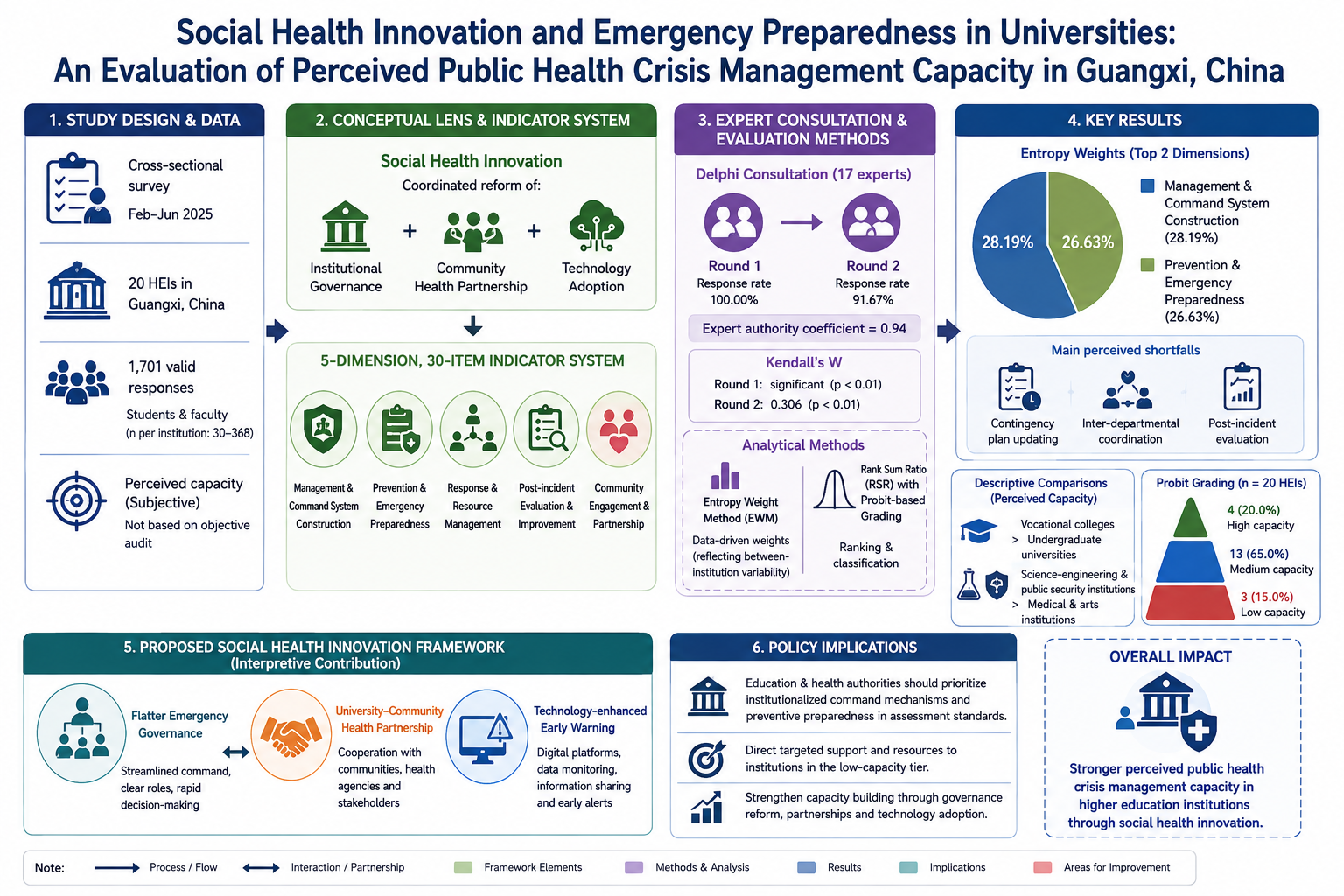
This cross-sectional survey study developed and applied a multidimensional framework for evaluating the public health emergency management capacity of higher education institutions (HEIs) in the Guangxi Zhuang Autonomous Region, China. Social health innovation defined here as the coordinated reform of institutional governance, community health partnership and technology adoption provided the conceptual lens for indicator development. A five-dimension, 30-item indicator system was constructed through two rounds of Delphi consultation with seventeen experts (effective response rates 100.00% and 91.67%; expert authority coefficient 0.94). Kendall's coefficient of concordance was in round one and 0.306 in round two (both p < 0.01), indicating statistically significant but modest expert agreement. Between February and June 2025, structured questionnaires were distributed by convenience sampling to students and faculty at twenty HEIs, yielding 1,701 valid responses (institutional sample sizes 30–368). Capacity was measured as respondents' perceptions rather than through objective institutional audit. The entropy weight method (EWM) derived data-driven indicator weights reflecting between-institution variability, and the rank sum ratio (RSR) method with Probit-based grading ranked and classified institutions. Management and command system construction (28.19%) and prevention and emergency preparedness (26.63%) carried the largest entropy weights; perceived shortfalls were most pronounced in contingency plan updating, inter-departmental coordination and post-incident evaluation. Descriptively, vocational colleges scored higher overall than undergraduate universities, and science-engineering and public security institutions scored higher than medical and arts institutions; these comparisons were not tested inferentially. Probit grading classified 4 of the 20 institutions (20.00%) as high capacity, 13 (65.00%) as medium and 3 (15.00%) as low. On the basis of these findings the study proposes as an interpretive contribution rather than a validated intervention a social health innovation framework centred on flatter emergency governance, university–community health partnerships and technology-enhanced early warning. For policy, the results indicate that regional education and health authorities should weight institutionalised command mechanisms and preventive preparedness most heavily in HEI assessment standards, and direct targeted support to institutions in the low-capacity tier.
Downloads
References
Cao, Y., Shan, J., Gong, Z., Kuang, J., & Gao, Y. (2020). Status and challenges of public health emergency management in China related to COVID-19. Frontiers in Public Health, 8, 250. https://doi.org/10.3389/fpubh.2020.00250 DOI: https://doi.org/10.3389/fpubh.2020.00250
Chen, X., Zhang, M., Bu, Q., Tan, B., & Deng, D. (2024). Evaluation and associated factors of public health emergency management among medical college students in a city in Southwest China: A cross-sectional study. BMC Medical Education, 24(1), 314. https://doi.org/10.1186/s12909-024-05317-1 DOI: https://doi.org/10.1186/s12909-024-05317-1
Dehdashti, A., Fatemi, F., Janati, M., Asadi, F., & Belji Kangarloo, M. (2020). Data of risk analysis management in university campuses. BMC Research Notes, 13, 554. https://doi.org/10.1186/s13104-020-05397-4 DOI: https://doi.org/10.1186/s13104-020-05397-4
Heinsohn. T., Lange, B., Vanella, P., Rodiah, I., Glöckner, S., Joachim, A., Konrad, M., Ott, J. J., Steinmann, E., Diel, R., Lehrer, C., Rübsamen, N., Schaade, L., Karch, A., Mikolajczyk, R., & Krause, G. (2022) Infection and transmission risks of COVID-19 in schools and their contribution to population infections in Germany: A retrospective observational study using nationwide and regional health and education agency notification data. PLoS Med, 19(12), e1003913. https://doi.org/10.1371/journal.pmed.1003913 DOI: https://doi.org/10.1371/journal.pmed.1003913
Hou, S., Zhou, Z., Zuo, Q., Wang, Z., Li, C., Liu, H., Zhang, M., Gao, H., Meng, H., & Xu, M. (2022). Status and influencing factors of emergency management ability of public health emergencies among medical students in Anhui Province. Occupational Health and Emergency Rescue, 40(3), 277–281. https://doi.org/10.16369/j.oher.issn.1007-1326.2022.03.004
Huang, Y., & Wang, Y. (2020). Emergency management systems and capacity-building in developed countries: Models, characteristics and useful experiences. Ningxia Social Sciences, 2, 90–96.
Jia, H. X., Jiang, L. F., Wang, C. L., Zhang, J. N., Wei, Y. N., Lu, J. F., Qiu, Y. M., Zhao, J. J., & Ma, B. J. (2024). Establishment and application of infectious disease monitoring, early warning and disposal system. Chinese Journal of Preventive Medicine, 58(10), 1620–1624. https://doi.org/10.3760/cma.j.cn112150-20231206-00407
Jiang, H., Feng, S., & She, Y. (2025). Analysis of the current situation of public health emergency response management education and teaching in universities in Guangdong Province. Health Professions Education, 43(9), 106–110. https://doi.org/10.20037/j.issn.1671-1246.2025.09.25
Lu, S., Christie, G. A., Nguyen, T. T., Freeman, J. D., & Hsu, E. B. (2022). Applications of artificial intelligence and machine learning in disasters and public health emergencies. Disaster Medicine and Public Health Preparedness, 16(4), 1674–1681. https://doi.org/10.1017/dmp.2021.125 DOI: https://doi.org/10.1017/dmp.2021.125
Murphy, S. A., Brown, J., Shankar, A., & Lichtveld, M. (2019). A quantitative assessment of institutions of higher education disaster preparedness and resilience. Journal of Emergency Management, 17(3), 239–250. https://doi.org/10.5055/jem.2019.0423 DOI: https://doi.org/10.5055/jem.2019.0423
SPSSPRO. (2021). SPSSPRO: Scientific platform serving for statistics professional. https://www.spsspro.com
Tian, F. (1993). The rank sum ratio method and its applications. China Statistics Press.
Wang, H., Ye, H., Liu, L., & Li, J. (2022). Evaluation and obstacle analysis of emergency response capability in China. International Journal of Environmental Research and Public Health, 19(16), 10200. https://doi.org/10.3390/ijerph191610200 DOI: https://doi.org/10.3390/ijerph191610200
Wei, W., Liu, Y., Zhou, N., Tian, M., Xie, L., Watson, R., Dai, F., Chen, Y., & Hu, W. (2023). Constructing an emergency preparedness evaluation index system for public use during major emerging infectious disease outbreaks: A Delphi study. BMC Public Health, 23, 1109. https://doi.org/10.1186/s12889-023-15980-6 DOI: https://doi.org/10.1186/s12889-023-15980-6
Weng, X., Wang, R., Wang, X., Li, N., Yu, L., & Zhang, Y. (2019). Epidemiological characteristics of communicable disease related public health emergencies in schools (child care settings) in China, 2014–2016. Disease Surveillance, 34(5), 446–450. https://doi.org/10.3784/j.issn.1003-9961.2019.05.016
Xu, G. (2021). Study on the emergency management mechanism of public health emergencies in Zunyi universities. (Bachelor’s degree dissertation, Zunyi Medical University, China).
Zhang, L. (2022). Research on the construction of university public health emergency management system based on psychological counseling intervention. Journal of Healthcare Engineering, 2022, 2033018. https://doi.org/10.1155/2022/2033018 DOI: https://doi.org/10.1155/2022/2033018
Zhizhi, F., Gehong, D., & Yuanyuan, W. (2011). Epidemiologic analysis of public health emergencies in Guangxi in 2010. Chinese Tropical Medicine, 11(10), 1295–1296. https://doi.org/10.13604/j.cnki.46-1064/r.2011.10.023
Downloads
Additional Files
Published
How to Cite
Issue
Section
Categories
License
Copyright (c) 2026 Community and Social Development Journal

This work is licensed under a Creative Commons Attribution-NonCommercial-NoDerivatives 4.0 International License.