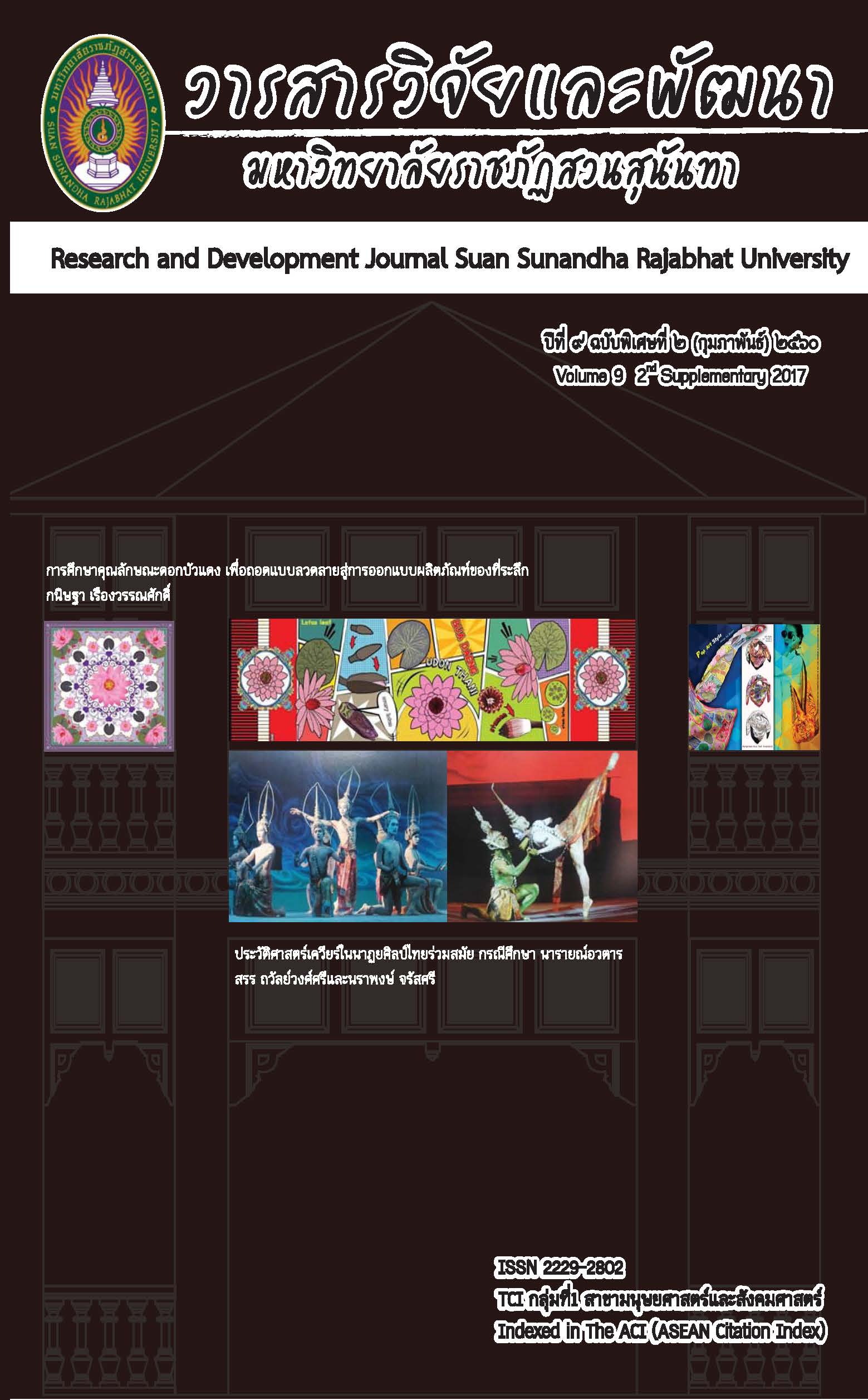
Queer History in Thai Contemporary Dance A Case Study of Narai Avatara
DOI:
https://doi.org/10.53848/irdssru.v9i2.214239Keywords:
Queer History, Thai Contemporary Dance, Contemporary Dance, Narai Avatara, Naraphong CharassriAbstract
The article Queer History in Thai Contemporary Dance: A Case Study of Narai
Avatara is part of a doctoral thesis entitled “The creation of contemporary dance
based on gender diversity” of the Faculty of Fine and Applied Arts at Chulalongkorn
University. The researcher has used the case study research methods by selecting the
dance performance, Narai Avatara directed by Naraphong Charassri at Main Hall, the
Thai Cultural Centre during February 2-4, 2003 as a case study. This research focuses
on elements and concepts of contemporary dance creation demonstrating queer
identity and connotations. The results of this research are the guidelines of the creative
process of contemporary dances to represent concepts of queer and gender diversity
for further research. The research tools are: literature reviews, interviews with experts
involved in dance creation, direct experience of the researcher participating as a
performer in this case study, participation in symposiums, data collection and fieldwork
studies. The collection of information occurred during August 2015 – August 2016.
The researcher concluded that the history and the concepts of queer
including the aspect of gender diversity are part of the creative process of Narai
Avatara. This can be explained as performance elements including: 1) Performance
script 2) Performers 3) Choreographic process 4) Costume design 5) Music 6) Stage and
scenic design 7) Props 8) Lighting design. Moreover, the research found that the
concept of queer in this performance is connected to 3 different aspects: 1) Individuality or
identity of the creator 2) Guidelines for the use of gender symbolism 3) Reflecting
gender diversity in contemporary Thai society through dance. These results and
mentioned aspects are all in accordance with the research objectives.
References
contemporary Thai dance “Narai
Avatara 2003” by Narapong
Charassri. Institute of Culture and
Arts Journal, Srinakharinwirot
University. Vol 15, No 12 (30).
Burt, R. (2007). A Male Dancer. 2nd Ed.
New York: Routledge.
Charassri, N. (2005). History of Western
Dance (1sted). Bangkok:
Chulalongkorn University Press.
Charassri, N. (2007). Narai Avatara:
Performing the Thai Ramayana in
the Modern World. Bangkok:
Amarin Printing and Publishing
Company Limited.
Martin, J. (1933). The Modern Dance.
Dance. New York: Dance Horizons
Noisette, P. (2011). Talk about
Contemporary Dance. Flammarion.
Panomrak, J. (2010). Thai indentity in
Naraphong Charassri’s Thai
contemporary dance works. M.A.
Thesis in Thai Dance, Faculty of
Fine and Applied Arts,
Chulalongkorn University.
Stoneley, P. (2007). A Queer History of
the Ballet. New York: Routledge.
Tovititwong, S. (2010). The analytical
study of female dance
movement in contemporary Thai
dance and the role of Monto in
“Narai Avatara.” M.A. Thesis in
Thai Dance, Faculty of Fine and
Applied Arts, Chulalongkorn University.
Yin, R. K. (2003). Case Study Research:
Design and Methods (3rd ed.).
Thousand Oaks, CA: Sage
Publications, In.
Interview
Charassri, N. Interview, April 4, 2016.
Charassri, N. Interview, May 2, 2016.
Charassri, N. Interview, Sep 12, 2016.
Downloads
Published
How to Cite
Issue
Section
License
บทความที่ได้รับการตีพิมพ์เป็นลิขสิทธิ์ของ สถาบันวิจัยและพัฒนา มหาวิทยาลัยราชภัฎสวนสุนันทา
ข้อความที่ปรากฏในบทความแต่ละเรื่องในวารสารวิชาการเล่มนี้เป็นความคิดเห็นส่วนตัวของผู้เขียนแต่ละท่านไม่เกี่ยวข้องกับมหาวิทยาลัยราชภัฎสวนสุนันทา และคณาจารย์ท่านอื่นๆในมหาวิทยาลัยฯ แต่อย่างใด ความรับผิดชอบองค์ประกอบทั้งหมดของบทความแต่ละเรื่องเป็นของผู้เขียนแต่ละท่าน หากมีความผิดพลาดใดๆ ผู้เขียนแต่ละท่านจะรับผิดชอบบทความของตนเองแต่ผู้เดียว