A Study on Problems of the Using Chinese Synonymous Verbs with a Same Morpheme of Undergraduate Students in Thailand
Keywords:
Chinese synonymous verbs, Comprehension level, Error patterns, Teaching solutionsAbstract
The purposes of this research were to 1) analyze and compare the comprehension level of Chinese synonymous verbs with the same morpheme, 2) the state of understanding of Chinese synonymous verbs with the same morpheme, 3) the problems and error patterns of Chinese synonymous verbs with the same morpheme, 4) find solutions to teaching and learning problems in the use of Chinese synonymous verbs with the same morpheme. Population and sample include universities that offer Chinese as a major subject in Bangkok and metropolitan areas and regions, totaling 150 people in 6 places. The research utilized the following instruments: 1) Chinese synonymous verbs with the same morpheme using tests, 2) an interview form for Chinese teachers and students on problems and errors in using Chinese synonymous verbs with the same morpheme. Statistical analysis was conducted using frequency, percentage calculations and content analysis.
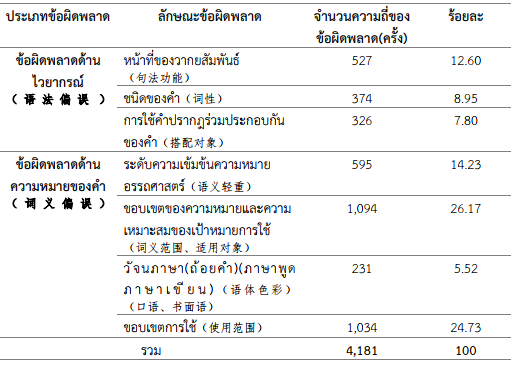
The results showed that: 1) contextual meaning, although meanings are the same or synonymous, when the scope of the meaning is different, the target of use is therefore different, as well as different degrees of hermeneutic semantics. In terms of grammatical functions, the composition of sentences is a factor that makes synonyms different in use in each context. Some words can perform different types of functions, including the structure of the word and the combined compound word type. The compound word has the highest number. 2) The condition of using Chinese synonymous verbs with the same morpheme that appear together in Chinese among Thai students was found to have a mostly correct usage rate of more than 50 percent. 3) For errors in the use of synonyms with Chinese morphemes by Thai students, it was established that the errors were in the meaning of words and grammar mistakes. 4) The guidelines for solving teaching problems consist of 4 main sides: the learners, the language difficulty level, instructors and teaching management, and textbooks, which have a solution to the problem of teaching and learning about the correct and systematic use of Chinese synonymous verbs with the same morpheme.
References
Anchaleenukul, S. (2019). Thai morphological system . Bangkok: Chulalongkorn University Press (In Thai) .
Beijing Advanced Innovation Center for Language Resources. (2019). HSK dynamic composition corpus. Retrieved June 10, 2019, from Beijing Language and Culture University: http://hsk.blcu.edu.cn/ (In Chinese)
Dong, Y. (1989). View on parts of same morpheme of Chinese disyllabic word. Thinking and Wisdom, 8(1), 41-43 (In Chinese).
Feng, Z. (2010). Modern Chinese usage dictionary. Chengdu: Sichuan Lexicographical Press (In Chinese).
Ge, B. (2001). Modern Chinese lexicology. Jinan: Shandong People’s Publishing House (In Chinese).
Gu, W. (2018). The study on the use of monosyllabic and disyllabic synonymous verbs with a same morpheme in Thai students. Thesis in Master's degree, Yunnan University (In Chinese).
Iamworamate, T. (2018). A new Chinese-Thai dictionary (35th ed.). Bangkok: Ruam Sarn (In Thai).
Jeangjai, S. (2009). The Analysis of Differences in Chinese Synonyms for Thai Learner. Songklanakarin Journal of Social Sciences and Humanities, 15(6), 1026-1036. Retrieved from https://kaekae.oas.psu.ac.th/ojs/psuhsej/include/getdoc.php?id=1577&article=703&mode=pdf (In Thai)
Liu, Y. (2001). Practical Modern Chinese Grammar. Beijing: The Commercial Press (In Chinese).
Mei, J., Zhu, Y., Gao, Y., & Yin, H. (1996). Tongyici Cilin (2nd ed.). Shanghai: Shanghai Lexicographical Publishing House (In Chinese).
Regional Education Office No.3. (2020). The conditions and problems of organizing active learning (Active Learning) of basic educational institutions in the area under the responsibility of Region Education Office No.3. Ratchaburi: Region Education Office No.3 (In Thai).
The Dictionary Department of the Institute of Linguistics of the Chinese Academy of Social Sciences. (2016). Modern Chinese Dictionary (7th ed.). Beijing: The Commercial Press (In Chinese).
Yang, J. (2004). How to compare the usage of synonyms in classroom teaching. Chinese Teaching in the World, 18(3), 96-104. Retrieved from https://cstj.cqvip.com/Qikan/Article/Detail?id=11127770 (In Chinese)
Zhu, Z. (2004). Error Analysis on Chinese Dissyllabic Compounds in Semantics. Chinese language teaching, 24(2), 61-65. doi:10.3969/j.issn.1003-7365.2004.02.012. (In Chinese)
Downloads
Published
How to Cite
Issue
Section
License
Copyright (c) 2024 Suan Sunandha Rajabhat University

This work is licensed under a Creative Commons Attribution-NonCommercial-NoDerivatives 4.0 International License.
บทความที่ได้รับการตีพิมพ์เป็นลิขสิทธิ์ของ สถาบันวิจัยและพัฒนา มหาวิทยาลัยราชภัฎสวนสุนันทา
ข้อความที่ปรากฏในบทความแต่ละเรื่องในวารสารวิชาการเล่มนี้เป็นความคิดเห็นส่วนตัวของผู้เขียนแต่ละท่านไม่เกี่ยวข้องกับมหาวิทยาลัยราชภัฎสวนสุนันทา และคณาจารย์ท่านอื่นๆในมหาวิทยาลัยฯ แต่อย่างใด ความรับผิดชอบองค์ประกอบทั้งหมดของบทความแต่ละเรื่องเป็นของผู้เขียนแต่ละท่าน หากมีความผิดพลาดใดๆ ผู้เขียนแต่ละท่านจะรับผิดชอบบทความของตนเองแต่ผู้เดียว