Leadership in Theravada Buddhism
Keywords:
Leadership;, TheravadaAbstract
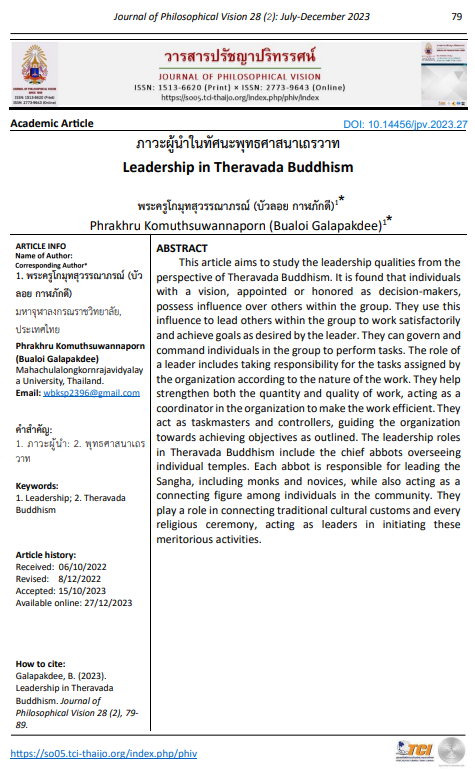
This article aims to study the leadership qualities from the perspective of Theravada Buddhism. It is found that individuals with a vision, appointed or honored as decision-makers, possess influence over others within the group. They use this influence to lead others within the group to work satisfactorily and achieve goals as desired by the leader. They can govern and command individuals in the group to perform tasks. The role of a leader includes taking responsibility for the tasks assigned by the organization according to the nature of the work. They help strengthen both the quantity and quality of work, acting as a coordinator in the organization to make the work efficient. They act as taskmasters and controllers, guiding the organization towards achieving objectives as outlined. The leadership roles in Theravada Buddhism include the chief abbots overseeing individual temples. Each abbot is responsible for leading the Sangha, including monks and novices, while also acting as a connecting figure among individuals in the community. They play a role in connecting traditional cultural customs and every religious ceremony, acting as leaders in initiating these meritorious activities.
Downloads
References
กวี วงศ์พุฒ. (2539). ภาวะผู้นำ. พิมพ์ครั้งที่ 4. กรุงเทพมหานคร : ศูนย์ส่งเสริมวิชาชีพบัญชี.
พระจารุวัฒน์ ภูริวฑฺฒโน. (2555). การศึกษาผลการดำเนินงานของหน่วยอบรมประชาชนประจำตำบล ในเขต
การปกครองคณะสงฆ์ จังหวัดลำปาง. วิทยานิพนธ์ปริญญาพุทธศาสตรมหาบัณฑิต. มหาวิทยาลัยมหาจุฬาลงกรณราชวิทยาลัย.
พระเทพปริยัติเมธี, ผศ.ดร. (2562). เรื่องกลยุทธ์การสร้างภาวะผู้นำเชิงพุทธ. สารนิพนธ์. วิทยาลัยสงฆ์จังหวัดนครสวรรค์.
พระธรรมปิฎก ประยุทธ์ ปยุตฺโต. (2540). ภาวะผู้นำ. กรุงเทพมหานคร: ธรรมสภา.
พระมหาธรรมรัต อริยธมฺโม (ยศขุน). (2543). การศึกษาเชิงวิเคราะห์หลักรัฐศาสตร์ที่มีในพระไตรปิฎก. กรุงเทพมหานคร: โรงพิมพ์สุรวัฒน์.
รังสรรค์ ประเสริฐศรี. (2565). ภาวะผู้นำการเปลี่ยนแปลง. สืบค้นเมื่อ 25 ตุลาคม 2565, จาก https://www.jaturapad.com /archives/1147
มหาจุฬาลงกรณราชวิทยาลัย. (2560). สาราณียสูตร อังคุตรนิกาย. พระไตรปิฎกภาษาไทย ฉบับมหาจุฬาลงกรณราชวิทยาลัย เล่ม 22. กรุงเทพฯ
สมเด็จพระมหารัชมังคลาจารย์. (2565). โครงการหมู่บ้านรักษาศีล 5. สืบค้นเมื่อ 25 ตุลาคม 2565. จาก https://www.sila5.com/detail/
สามารถ มังสัง. (2561). สาราณียธรรม 6 เพื่อการอยู่ร่วมกัน. สืบค้นเมื่อ 25 ตุลาคม 2565. จาก https://mgronline.com/daily/96 229668
Drath, W. H., & Palus, C. J. (1994). Making common sense: Leadership as meaning-making in a community of practice. Center for Creative Leadership.
Krech, D., Crutchfield, R. S., & Ballachey, E. L. (2008). Individual in Society. Tokyo: McGraw-Hill.
Downloads
Published
How to Cite
Issue
Section
License
Copyright (c) 2023 Journal of Philosophical Vision

This work is licensed under a Creative Commons Attribution-NonCommercial-NoDerivatives 4.0 International License.
บทความวิชาการและบทความวิจัย ในวารสารฉบับนี้ ถือเป็นความรับผิดชอบของผู้เขียนเท่านั้น
สงวนลิขสิทธิ์ตามพระราชบัญญัติลิขสิทธิ์



