Resolving Thai Political Conflicts Through Theravada Buddhist Philosophy
Abstract
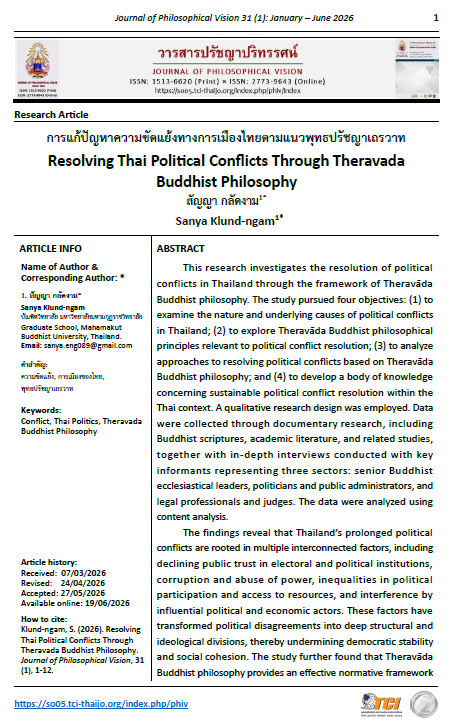
This research investigates the resolution of political conflicts in Thailand through the framework of Theravāda Buddhist philosophy. The study pursued four objectives: (1) to examine the nature and underlying causes of political conflicts in Thailand; (2) to explore Theravāda Buddhist philosophical principles relevant to political conflict resolution; (3) to analyze approaches to resolving political conflicts based on Theravāda Buddhist philosophy; and (4) to develop a body of knowledge concerning sustainable political conflict resolution within the Thai context. A qualitative research design was employed. Data were collected through documentary research, including Buddhist scriptures, academic literature, and related studies, together with in-depth interviews conducted with key informants representing three sectors: senior Buddhist ecclesiastical leaders, politicians and public administrators, and legal professionals and judges. The data were analyzed using content analysis.
The findings reveal that Thailand’s prolonged political conflicts are rooted in multiple interconnected factors, including declining public trust in electoral and political institutions, corruption and abuse of power, inequalities in political participation and access to resources, and interference by influential political and economic actors. These factors have transformed political disagreements into deep structural and ideological divisions, thereby undermining democratic stability and social cohesion. The study further found that Theravāda Buddhist philosophy provides an effective normative framework for addressing such conflicts. Specifically, the Four Noble Truths function as an analytical tool for identifying the root causes of political disputes and formulating problem-oriented solutions. The Four Sublime States of Mind (Brahmavihāra) facilitate the creation of safe communicative spaces characterized by empathy, mutual respect, and constructive dialogue among conflicting groups. Moreover, Hiri-Ottappa (moral shame and moral fear of wrongdoing) serves as an ethical safeguard against corruption, fostering accountability, integrity, and responsible political conduct. The study contributes a novel conceptual framework that integrates moral cultivation with structural political reform. This framework emphasizes the simultaneous development of ethical consciousness, democratic values, and institutional accountability as essential conditions for sustainable peacebuilding. The findings suggest that long-term political reconciliation requires not only political compromise but also the cultivation of moral responsibility and social trust, thereby enabling a more stable, inclusive, and sustainable democratic society.
Downloads
References
เกษียร เตชะพีระ. (2555). งานเขียนบทความเกี่ยวกับการเมืองไทยร่วมสมัยและความขัดแย้งทางการเมือง. กรุงเทพฯ: สำนักพิมพ์มหาวิทยาลัยธรรมศาสตร์.
อมร จันทรสมบูรณ์. (2556). บทความงานวิจัยด้านกฎหมายรัฐธรรมนูญและการเมืองไทย. กรุงเทพฯ: สำนักพิมพ์นิติธรรม.
นครินทร์ เมฆไตรรัตน์. (2562). งานศึกษาว่าด้วยการเมืองไทยร่วมสมัย ความขัดแย้ง และโครงสร้างอำนาจ. กรุงเทพฯ: สำนักพิมพ์มหาวิทยาลัยธรรมศาสตร์.
ประเวศ วะสี. (2554). งานเขียนว่าด้วยสังคม การเมือง และการพัฒนาสังคมไทย. กรุงเทพฯ: สำนักพิมพ์หมอชาวบ้าน.
พระครูปลัดไพฑูรย์ เมธิโก. (2557). พรหมวิหาร : ธรรมแนวทางการแก้ไขความขัดแย้งของ สังคมไทย. วารสารมหาวิทยาลัยนราธิวาสราชนครินทร์ สาขามนุษย์ศาสตร์และสังคมศาสตร์ มหาวิทยาลัยมหาจุฬาลงกรณราชวิทยาลัย.
พระปัญญาวรวัฒน์ สิริภัทโท. (2555). ความขัดแย้งของสังคมไทยกับ การแก้ปัญหาตามแนวทางอริยสัจ 4. วารสารบัณฑิตศึกษาปริทรรศน์. ปีที่ 8 ฉบับพิเศษ เนื่องในโอกาสเฉลิมฉลองพุทธยันตี 2600 ปี แห่งการตรัสรู้ของพระพุทธเจ้า.
พระพรหมคุณาภรณ์ (ป.อ. ปยุตฺโต). (2559). พุทธธรรม: ฉบับปรับขยาย. กรุงเทพฯ: มูลนิธิพุทธธรรม.
พระเมธีธรรมาภรณ์. (2548). พุทธศาสนาและการพัฒนาสังคม/แนวคิดทางพุทธศาสนาเพื่อสันติภาพ. กรุงเทพฯ: โรงพิมพ์มหาจุฬาลงกรณราชวิทยาลัย.
วรุตม์ อินทฤทธิ์. (2562). การศึกษากับการจัดการความขัดแย้งทางการเมืองในสังคมไทย. การประชุม วิชาการระดับชาติ มหาวิทยาลัยราชภัฏกำแพงเพชร, ครั้งที่ 3 (ฉบับที่ 9)
อาภาภรณ์ วิรุตม์พงศ์สกุล. (2563). การวิเคราะห์อิทธิพลของหิริ-โอตตัปปะที่มีต่อทัศนคติในการคอรัปชั่นของนกัเรียนชั้นมัธยมศึกษาในจังหวัดระยอง.วิทยานิพนธ์การศึกษาตามหลกัสูตรวิทยาศาสตรมหาบัณฑิต สาขาวิชาวิจัย วัดผล และสถิติการศึกษาคณะศึกษาศาสตร์ มหาวิทยาลัยบูรพา.
อภิชา สุขจีน, และปัญญา สุนันตา. (2562). พุทธบูรณาการกับแนวทางแก้ไขปัญหาความขัดแย้ง
ทางการเมืองไทย. วารสารมหาจุฬาฯ วิทยาเขตแพร่. 14(2)
Downloads
Published
How to Cite
Issue
Section
License
Copyright (c) 2026 Journal of Philosophical Vision

This work is licensed under a Creative Commons Attribution-NonCommercial-NoDerivatives 4.0 International License.
บทความวิชาการและบทความวิจัย ในวารสารฉบับนี้ ถือเป็นความรับผิดชอบของผู้เขียนเท่านั้น
สงวนลิขสิทธิ์ตามพระราชบัญญัติลิขสิทธิ์



