บัตรเชิญภาษาไทย : การวิเคราะห์โครงสร้างภาษา ค่านิยม และความเชื่อ (Thai invitation cards: Analysis of language structure, values and beliefs)
Article Sidebar
Main Article Content
Abstract
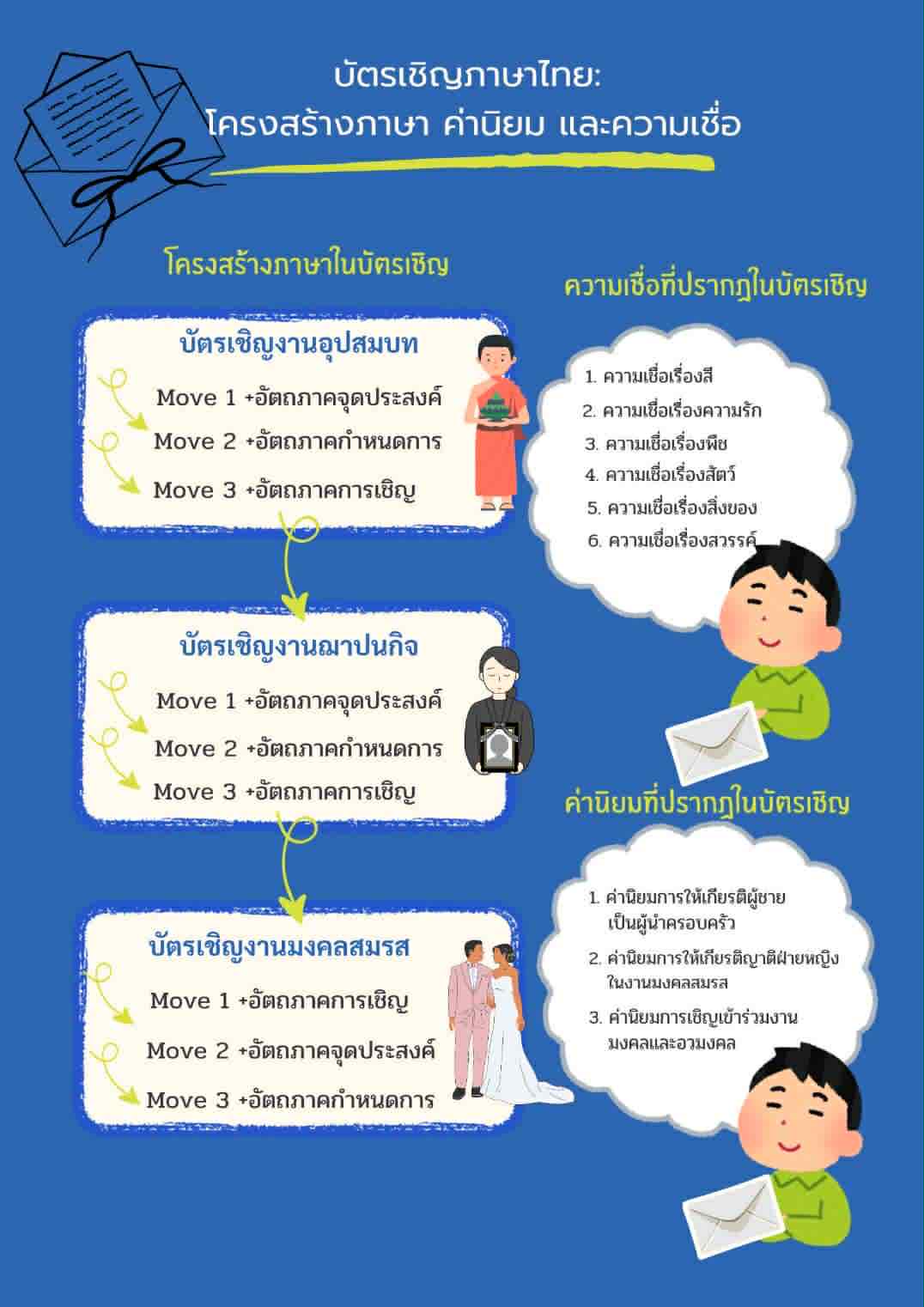
การศึกษาบัตรเชิญภาษาไทยทำให้เข้าใจโครงสร้างทางภาษา ค่านิยม ตลอดจนความเชื่อที่สะท้อนอัตลักษณ์ทางสังคมและวัฒนธรรมไทยได้อย่างลึกซึ้ง บทความวิจัยนี้มีวัตถุประสงค์เพื่อวิเคราะห์โครงสร้างบัตรเชิญภาษาไทยตามแนวอัตถภาควิเคราะห์ และวิเคราะห์ค่านิยม ความเชื่อที่ปรากฏในบัตรเชิญภาษาไทย โดยเก็บข้อมูลบัตรเชิญงานอุปสมบท งานมงคลสมรส และงานฌาปนกิจ จำนวน 300 ใบ ในช่วงปี พ.ศ. 2560-2565 ผลการศึกษาพบว่า บัตรเชิญทั้ง 3 ประเภท ประกอบด้วย 3 อัตถภาค ได้แก่ อัตถภาคจุดประสงค์ของบัตรเชิญ อัตถภาคกำหนดการ และอัตถภาคการเชิญ ซึ่งในบัตรเชิญงานอุปสมบทและงานฌาปนกิจจะเรียงตามลำดับข้างต้น ส่วนบัตรเชิญงานมงคลสมรสจะเรียงลำดับด้วยการนำอัตถภาคการเชิญ ตามด้วยอัตถภาคจุดประสงค์ของบัตรเชิญ และอัตถภาคกำหนดการในลำดับสุดท้าย นอกจากนี้ ผลการวิเคราะห์ค่านิยมและความเชื่อที่ปรากฏในบัตรเชิญ พบค่านิยม 3 ด้าน ได้แก่ ค่านิยมการให้เกียรติผู้ชายเป็นผู้นำครอบครัว ค่านิยมการให้เกียรติญาติฝ่ายหญิงในงานมงคลสมรส และค่านิยมการเชิญเข้าร่วมงานมงคลและงานอวมงคล ส่วนความเชื่อมงคลและอวมงคลของคนไทย พบ 6 ด้าน ได้แก่ ความเชื่อเรื่องสี ความเชื่อเรื่องความรัก ความเชื่อเรื่องพืช ความเชื่อเรื่องสัตว์ ความเชื่อเรื่องสิ่งของ และความเชื่อเรื่องสวรรค์ ผลการศึกษาในครั้งนี้สามารถนำไปเป็นต้นแบบการพิมพ์บัตรเชิญและเป็นแนวทางการศึกษาวิจัยโครงสร้างทางภาษาในระดับข้อความได้
The study of Thai invitation cards offers deep insights into linguistic structures, cultural values, and beliefs that reflect the social and cultural identity of Thai society. This research aimed to analyze the structure of Thai invitation cards using move analysis and to examine the values and beliefs embedded in them. A total of 300 invitation cards for ordinations, weddings, and funerals, collected between 2017 and 2022, were analyzed. The findings revealed that all three types of cards contained three moves, namely the purpose of the card, the schedule, and the invitation. In ordination and funeral cards, the moves appeared in the order of purpose, schedule, and invitation, whereas in wedding cards the sequence was invitation, purpose, and schedule. The analysis of values identified three aspects: respect for men as heads of families, honoring the bride’s family in wedding ceremonies, and the importance of inviting guests to both auspicious and inauspicious occasions. Six categories of Thai beliefs, both auspicious and inauspicious, were identified: beliefs concerning colors, love, plants, animals, objects, and heaven. These findings can serve as a model for designing invitation cards and as a guideline for further research on linguistic structures at the discourse level.
Downloads
Article Details

This work is licensed under a Creative Commons Attribution-NonCommercial-NoDerivatives 4.0 International License.
References
Austin, J. L. (1962). How to do things with words. Oxford University Press.
Boonphan, J. (2004). The metaphorical meanings of animals in Thai idioms (ความหมายเปรียบเทียบของสัตว์ในสำนวนไทย) [Master’s thesis, Thammasat University]. Thammasat University Digital Collections. https://digital.library.tu.ac.th/tu_dc/frontend/Info/item/dc:114776
Dittabanjong, R. (2009). Writing (การเขียน). Dhonburi Rajabhat University.
Frake, C. O. (1980). Language and cultural description. Standford University Press.
Handamrongkul, N. (2010). A study of guiding pressentation in French (Research report) (การศึกษาการพากย์ทัวร์ภาษาฝรั่งเศสของมัคคุเทศก์) (รายงานการวิจัย). Suan Sunandha Rajabhat University.
Jiaphong, S. (2013). Inanimate metaphors in Thai idioms: An analysis of classification and connotation (สำนวนไทยเกี่ยวกับสิ่งไม่มีชีวิต : การวิเคราะห์การจำแนกประเภท และความหมายเปรียบ). Journal of Humanities, Faculty of Humanities Naresuan University, 10(3), 31–48.
Kanoksilapatharm, B. (2007). Writing research articles in English: Microbiology (การเขียนบทความวิจัยภาษาอังกฤษ : สาขาวิชาจุลชีววิทยา) [Special issue]. Journal of the Faculty of Arts, Silpakorn University, 29, 174–208. https://so04.tci-thaijo.org/index.php/jasu/article/view/239958
Khrutmuang, S. (2012). Society and culture from kitchen utensils in Hat Kruat subdistrict (Research report) (สังคมและวัฒนธรรมจากเครื่องใช้ในครัวตำบลหาดกรวด) (รายงานการวิจัย). Naresuan University. http://nuir.lib.nu.ac.th/dspace/handle/123456789/57
Noybangyang, K. (2021). Color words in Thai society context (คำเรียกสีในบริบทสังคมไทย). Phimoldhamma Research Institute Journal, 8(1), 117–125. https://so06.tci-thaijo.org/index.php/prij/article/view/246901
Ongkeaw, W. (2010). Beliefs about auspicious and inauspicious attributes of plants and animals by villagers in Singha Nakhon district, Songkhla province (ความเชื่อที่เป็นมงคลและอมงคลเกี่ยวกับพืชและสัตว์ของชาวบ้าน อำเภอสิงหนคร จังหวัดสงขลา) [Master’s thesis, Thaksin University]. TSU Knowleadge Bank, Thaksin University Library. http://kb.tsu.ac.th/jspui/handle/123456789/2601
Phumanee, C., & Soranasathaporn, S. (2017). A study of move sequencing and language use of review article abstracts in the laboratory animal field (การศึกษาการเรียงลำดับของอัตถภาคและการใช้ภาษาในบทคัดย่อของบทความปริทัศน์ในสาขาวิชาสัตว์ทดลอง). Pasaa Paritat Journal, 32, 1–28. https://www.culi.chula.ac.th/Images/asset/pasaa_paritat_journal/file-8-72-qjg7wk068110.pdf
Prachumchai, S. (2020). Move analysis in abstracts in science journals (การวิเคราะห์อัตถภาคในบทคัดย่อของวารสารวิชาการด้านวิทยาศาสตร์). Phetchabun Rajabhat Journal, 22(1), 35–43. https://so05.tci-thaijo.org/index.php/jpcru/article/view/244674
Rodsap, N. (2012). Patriarchy : The reflection of the inequality between male and female in Asian society (ปิตาธิปไตย : ภาพสะท้อนแห่งความไม่เสมอภาคระหว่างชายหญิงในสังคมเอเชีย). Academic Journal of Humanities and Social Sciences Buriram Rajabhat University, 4(2), 30–46. https://so02.tci-thaijo.org/index.php/bruj/article/view/75658
Roongjang, S. (2005). Conceptual metaphors using /cay/ (heart/mind) in Thai (อุปลักษณ์เชิงมโนทัศน์ของการใช้คำว่า “ใจ” ในภาษาไทย) [Master’s thesis, Thammasat University]. Thammasat University Digital Collections. https://digital.library.tu.ac.th/tu_dc/frontend/Info/item/dc:114187
Roungtheera, T. (2010). Acknowledgement in theses written in French By Thai graduate students: A generic structure and socio-cultural aspects (กิตติกรรมประกาศในวิทยานิพนธ์ภาษาฝรั่งเศสของบัณฑิตไทย : การศึกษาโครงสร้างตามแนวอัตถภาควิเคราะห์และลักษณะทางสังคมวัฒนธรรม). Kasetsart Journal (Social Sciences), 31(2), 153–165.
Royal Institute. (2013). Dictionary of the royal institute of Thailand 2011 (พจนานุกรม ฉบับราชบัณฑิตยสถาน พ.ศ. 2554). Nanmee Books.
Sanguansereewanich, P. (2019, April 18). Conch shell (ตำนานหอยสังข์). Silpawattanatham. https://www.silpa-mag.com/culture/article_13277
Searle, J. R. (1969). Speech acts: An essay in the philosophy of language. Cambridge University Press.
Suwanwattana, C. (2010). Colours in Thai culture believings and myth (สีในวัฒนธรรมคติความเชื่อของไทย) [Master’s thesis, Silpakorn University]. Silpakorn University Repository. https://sure.su.ac.th/xmlui/handle/123456789/3298
Swales, J. M. (1990). Genre analysis. Cambridge University Press.
Swales, J. M. (2004). Research genres: Explorations and applications. Cambridge University Press.
Temcharoenkit, S. (2018). Beliefs in heaven and hell on crime rates in Thailand (ความเชื่อเรื่องนรก - สวรรค์ที่มีผลต่ออัตราการเกิดอาชญากรรมในประเทศไทย). Journal of Criminology and Forensic Science, 4(2), 53–66. https://so02.tci-thaijo.org/index.php/forensic/article/view/194134
Tussanaboon, P. (2019). KHWA:M - AA: - WU - SOH or seniority and linguistic strategies in the speech acts of disagreeing, complaining, and advicing in Thai (“ความอาวุโส” กับกลวิธีทางภาษาในวัจนกรรมการแย้ง การแสดงความไม่พอใจ และการแนะนำในภาษาไทย) [Master’s thesis, Thammasat University]. Thammasat University Digital Collections. https://digital.library.tu.ac.th/tu_dc/frontend/Info/item/dc:179154
Vongvirulh, S. (2020). The development of instructional model for business English writing based on genre-based approach and luxical bundles for undergraduate students (การพัฒนารูปแบบการเรียนการสอนการเขียนจดหมายโต้ตอบภาษาอังกฤษธุรกิจ ตามแนวการเขียนแบบอรรถฐานร่วมกับแนวคิดกลุ่มคำสำหรับนิสิตระดับปริญญาตรี) [Doctoral dissertation, Silpakorn University]. DSpace at Silpakorn University. http://ithesis-ir.su.ac.th/dspace/handle/123456789/3289
Wongsupachainimit, S. (2016). The study of status and roles of female characters in Nara’s novels (การศึกษาสถานภาพและบทบาทผู้หญิงในนวนิยายของณารา) [Master’s thesis, Burapha University]. DSpace Repository, Burapha University. https://buuir.buu.ac.th/xmlui/handle/1234567890/12158
Wongwattana, U. S. (2014). Thai folk plant names: A study in ethno-botanical linguistics (คำเรียกชื่อพืชแบบพื้นบ้านไทย : การศึกษาเชิงภาษาศาสตร์พฤกษศาสตร์ชาติพันธุ์). Chulalongkorn University Press.
Yamwong, P. (2018). A move analysis of English language research abstracts in the field of psychology (การวิเคราะห์อัตถภาคของบทคัดย่อภาษาอังกฤษของบทความทางวิชาการสาขาวิชาจิตวิทยา). Research Gate. https://www.researchgate.net/profile/PhaisarnYamwong/publication/328513538_A_Move_Analysis_of_English_Language_Research_Abstracts_in_the_Field_of_Psychology/links/5bd1e7d64585150b2b87508d/A-Move-Analysis-of-English-Language-Research-Abstracts-in-the-Field-of-Psychology.pdf
