
การส่งเสริมวัฒนธรรมผสมผสานเทคโนโลยีท้องถิ่นสู่การออกแบบเฟอร์นิเจอร์จักสานร่วมสมัย (Promoting cultural heritage through the integration of local technology in contemporary woven furniture design)
Article Sidebar
Main Article Content
Abstract
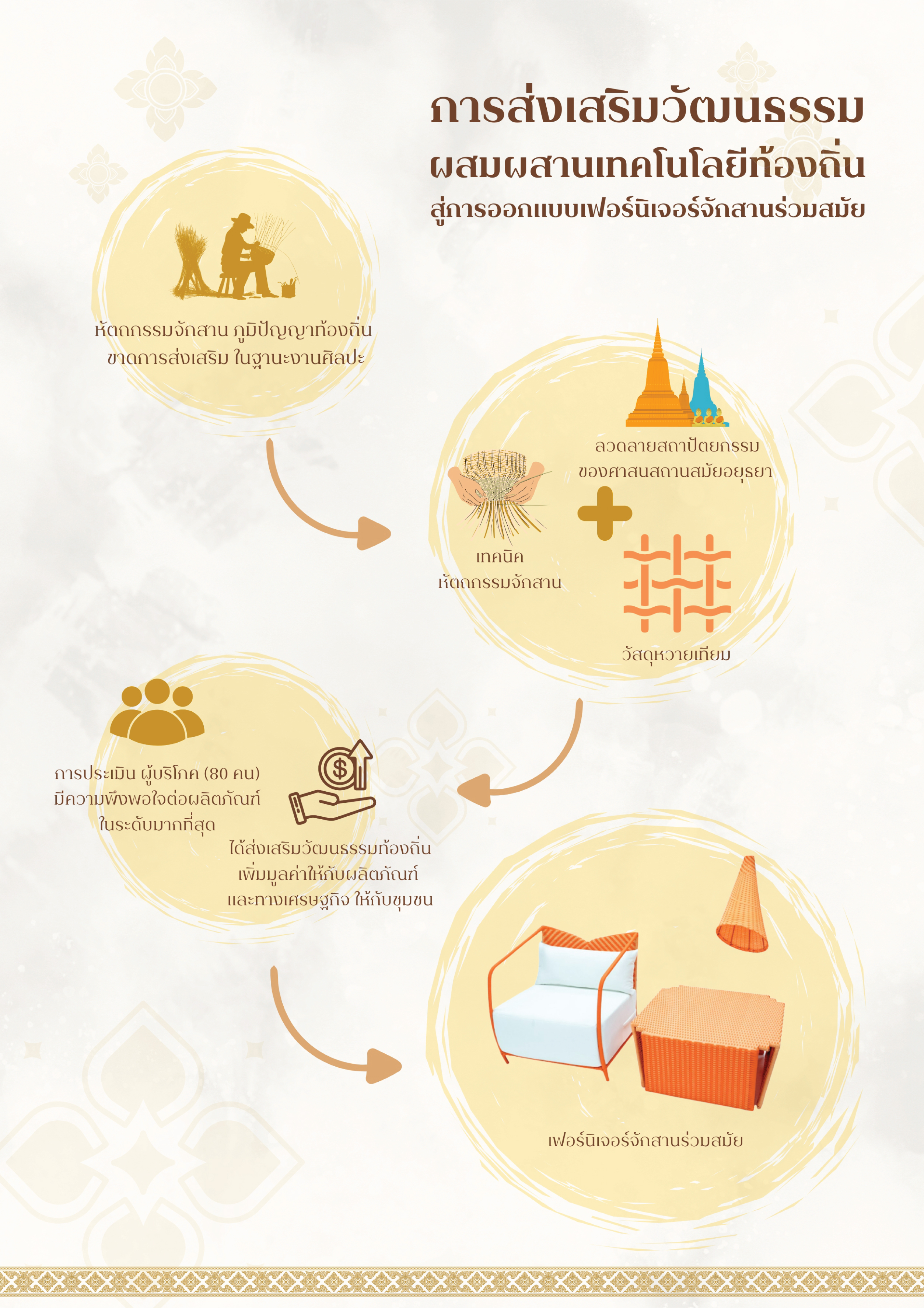
จังหวัดพระนครศรีอยุธยาเป็นพื้นที่เกษตรกรรมที่มีงานหัตถกรรมจักสานเป็นอาชีพเสริมและภูมิปัญญาท้องถิ่นที่สืบทอดมายาวนาน แต่ยังขาดการศึกษาเพื่อส่งเสริมคุณค่าและสืบสานในฐานะหัตถกรรมศิลป์ การวิจัยครั้งนี้ มีวัตถุประสงค์เพื่อศึกษาลวดลายวิจิตรสถาปัตยกรรมศาสนสถาน ศิลปะสมัยอยุธยา จังหวัดพระนครศรีอยุธยา มาเป็นแรงบันดาลใจในการออกแบบและพัฒนาผลิตภัณฑ์หัตถกรรมเฟอร์นิเจอร์ร่วมสมัย สร้างสรรค์เป็นผลิตภัณฑ์ใหม่ และประเมินความพึงพอใจผู้บริโภคที่มีต่อผลิตภัณฑ์หัตถกรรมเฟอร์นิเจอร์ร่วมสมัยจากเทคโนโลยีและเทคนิคหัตถกรรมจักสานท้องถิ่น ใช้รูปแบบการวิจัยแบบผสมผสาน (mixed methods research) โดยมีเครื่องมือที่ใช้ในการวิจัยและกลุ่มตัวอย่าง ประกอบด้วย แบบสอบถามประกอบการสัมภาษณ์จากผู้เชี่ยวชาญ จำนวน 7 คน และประเมินความพึงพอใจของกลุ่มผู้ที่ชื่นชอบและสนใจเฟอร์นิเจอร์จักสาน จำนวน 80 คน ใช้เทคนิคมาตราส่วนประมาณค่า 5 ระดับ ผลการวิจัยพบว่า ชุดเฟอร์นิเจอร์จักสานที่สร้างสรรค์แสดงให้เห็นถึงการถอดอัตลักษณ์จากสถาปัตยกรรมของศาสนสถาน ผสมผสานเข้ากับวัสดุหวายเทียม และทักษะการจักสานซึ่งเป็นภูมิปัญญาของคนท้องถิ่น ถือได้ว่าเป็นการส่งเสริมวัฒนธรรม และสามารถเพิ่มมูลค่าผ่านงานออกแบบที่เป็นอัตลักษณ์ ตรงตามหลักการออกแบบผลิตภัณฑ์ ผลการประเมินความพึงพอใจของคนทั่วไปที่สนใจต่อเฟอร์นิเจอร์จักสานร่วมสมัย โดยรวมอยู่ในระดับมากที่สุด การวิจัยครั้งนี้ถือเป็นแนวทางที่ดี ในการใช้แนวคิดเกี่ยวกับสถาปัตยกรรมไทยในแต่ละพื้นที่ที่มีอัตลักษณ์มาเป็นแรงบันดาลใจในการออกแบบเฟอร์นิเจอร์จักสานร่วมสมัย หรือการสร้างงานผลิตภัณฑ์ใหม่ ๆ ที่ก่อให้เกิดประโยชน์และสร้างมูลค่าเพิ่มทางเศรษฐกิจให้กับชุมชนท้องถิ่นได้ต่อไป
Phra Nakhon Si Ayutthaya province is an agricultural area where basketry has long served as both a supplementary occupation and a form of inherited local wisdom. However, research aimed at enhancing its value and preserving it as an artisanal craft remains limited. This study investigates the intricate patterns of religious architecture from the Ayutthaya period in Phra Nakhon Si Ayutthaya province as inspiration for the design and development of innovative contemporary woven furniture. It also evaluates consumer satisfaction with furniture products that integrate local weaving techniques and technology. A mixed-methods research design was employed. Data collection tools included questionnaires and interviews with seven experts, as well as a satisfaction survey of 80 participants interested in woven furniture, using a five-point rating scale. The findings reveal that the newly created woven furniture sets successfully translate the distinctive identity of local religious architecture into design elements. By blending synthetic rattan materials with indigenous weaving expertise, the products promote cultural heritage and add value through their unique design, aligned with product design principles. Overall consumer satisfaction with these contemporary woven furniture products was rated at the highest level. This research provides a practical framework for using the architectural identity of different Thai regions as inspiration for the design contemporary woven furniture and the creation of new products. This approach can generate cultural value and deliver economic benefits to local communities.
Downloads
Article Details

This work is licensed under a Creative Commons Attribution-NonCommercial-NoDerivatives 4.0 International License.
References
Egwutvongsa, S. (2023). Indigenous technology (เทคโนโลยีพื้นถิ่น ปัญญาญาณแห่งกลุ่มชน). Mean Service Supply.
Jongjitpotha, S. (2011). Composition (องค์ประกอบศิลป์). Wadsilp.
Laoakka, S. (2018). Education knowledge and further wisdom in product development rattan woven machine with natural materials and renewable materials commercial to promote the creative economy in Isan (การศึกษาองค์ความรู้และต่อยอดภูมิปัญญาในการพัฒนาผลิตภัณฑ์ เครื่องจักรสานหวายจากวัสดุธรรมชาติและวัสดุทดแทน เชิงพาณิชย์เพื่อส่งเสริมเศรษฐกิจสร้างสรรค์ในภาคอีสาน). Journal of Fine and Applied Arts, Khon Kaen University, 10(1), 271–292. https://so02.tci-thaijo.org/index.php/fakku/article/view/137908
Lerdwimolsak, S. (2010). The architectural structure types of Buddhist stupas in Phra Nakhon Si Ayutthaya province (แบบโครงสร้างทางสถาปัตยกรรมของพุทธเจดีย์ในเขตจังหวัดพระนครศรีอยุธยา). NAJUA: History of Architecture and Thai Architecture, 7, 19–61. https://so04.tci-thaijo.org/index.php/NAJUA/article/view/16600
Na Chumphae, S. D. (2007). The effect of technology on design (ผลของเทคโนโลยีที่มีต่อการออกแบบ). Odeon Store.
Naksorn, A. (2015). The art of industrial crafts design (ศิลปะการออกแบบหัตถอุตสาหกรรม). Triple Group.
Nildej, S. (1997). Ayutthaya art, 20th Buddhist century –1767 CE (ศิลปะสมัยอยุธยา พุทธศตวรรษที่ 20-พ.ศ. 2310). NAJUA: Architecture, Design and Built Environment, 14, 73–82. https://so04.tci-thaijo.org/index.php/NAJUA-Arch/article/view/46199/38224
Pittayamatee, P. (2022). Analysis of Thai shapes & forms from Thai arts to create further creations in Thai contemporary graphic design (การวิเคราะห์รูปร่างรูปทรงจากศิลปะไทย เพื่อสร้างสรรค์ต่อยอดในงานออกแบบกราฟิกไทยร่วมสมัย). DEC Journal: Art and Design, 1(2), 97–124. https://so07.tci-thaijo.org/index.php/decorativeartsJournal/article/view/1290
Saentong, N. (2019). Objective and key results (คู่มือประยุกต์ใช้ระบบการบริหารผลงานด้วยแนวคิดแบบ OKRs). Se-education.
Saima, W. (2021). A study of original patterns of bamboo basketry development for decorative purposes: A case study of the elderly cooperative group in Kiu Lae Pa Pao village, Mae Wang district, Chiang Mai (การศึกษาและพัฒนารูปแบบงานจักสานไม้ไผ่ลวดลายดั้งเดิมเพื่อประยุกต์ใช้ในการออกแบบตกแต่งกรณีศึกษา ชมรมผู้สูงอายุ บ้านกิ่วแลป่าเป้า อ.แม่วาง จ.เชียงใหม่). Research and Development Journal Suan Sunandha Rajabhat University, 13(2), 119–133. https://so05.tci-thaijo.org/index.php/irdssru/article/view/251021
Tongaroon, N. (2022). Architectural documentation: A case study of architectural analysis in tourism context of ancient Ayutthaya Island area (การจัดทำข้อมูลเชิงเอกสาร : กรณีศึกษาและวิเคราะห์สถาปัตยกรรมที่เกี่ยวข้องกับบริบทการท่องเที่ยว). Journal of Architectural/Planning Research and Studies (JARS), 19(2), 125–144. https://doi.org/10.56261/jars.v19i2.247224
